

To paraphrase Peter Lynch, timing the AI bubble is the hard part, and history says going to cash early can cost more than the crash itself.
Key Takeaways
Ken Griffin says AI is “almost certainly” a bubble. He may be right. Being right about a bubble and being right about its timing are two very different things.
The case for a bubble is real: Anthropic’s compute commitments run roughly 28 times its first-half revenue, and market breadth is near its narrowest in decades. The case against a 2000 replay is real too: today’s leaders are enormously profitable.
Bubble calls in 2019, 2020 and 2021 were reasonable on the data. Since October 2019, $100,000 in the S&P 500 has grown to about $287,000, while cash has grown to about $121,000.
Stocks would need to fall roughly 58% from here for the 2019 cash holder to come out ahead. As Peter Lynch warned, preparing for a crash often costs more than the crash itself.
The answer isn’t all in or all out. Participate with the bubble, but with rules decided in advance.
Ken Griffin told a room full of investors recently that we are “almost certainly” in an AI bubble. He may well be correct in that assessment, and there are plenty of media narratives that support that view. However, as always, the problem is that “right” isn’t a trade. Timing the AI bubble is where the money is made or lost, and history is littered with smart people who called a bubble correctly and still cost their clients a fortune by acting on it too soon.
“Being right, and being early, is the same thing as being wrong.” – Howard Marks
Again, I don’t disagree with Griffin’s thinking, and I want to stay entirely neutral in this analysis. Here are the two arguments as they stand currently, and both are likely correct.
The bullish argument is that AI technology is transformational.
The bears argue that the prices being paid for it look stretched.
The question that we want to answer, and the only one that actually matters for your portfolio, is what to do while both are true, possibly for years.
Griffin And Fink Are Both Right
Griffin’s comments at Citadel’s Future of Global Markets conference weren’t a dismissal of AI. They were a description of how every great technology gets financed.
“Any radical transformation of our economy is generally intertwined with a bubble. Corporate America has been very uneven in its ability to extract value from its AI models.”- Ken Griffin, Citadel, October 20, 2026
That seems correct. However, a day later, BlackRock’s Larry Fink argued the opposite risk on Bloomberg Television. Compute is scarce and expensive, he said, and “the faster we can build out more data centers, the more compute we have, the faster we can bring down the cost.” In other words, the real risk is slowing the buildout, which, in his view, “jeopardizes the economy.”
Here is the critical takeaway to incorporate in your thought process. Giffin and Fink don’t have opposing views. Griffin is talking about the price investors pay. Fink is talking about whether the infrastructure needs to exist. Railroads, electrification, and fiber optics all changed the economy, and all three also destroyed a lot of the capital that built them. Both arguments can exist simultaneously. Notably, and this is the uncomfortable part, it means the bubble and the progress can run together for a long time.
However, let’s analyze Griffin’s argument more closely.
The Case That Griffin Is Right
Let’s start with the mainstream narrative popular among permabears: “AI is a bubble because there’s no revenue.”
That isn’t accurate. Anthropic booked $16.3 billion of revenue in the first half of 2026, up from $1.1 billion a year earlier, according to the Wall Street Journal’s review of its draft S-1.1 The issue is the size of the bill relative to that money. The same filing shows roughly $450 billion in compute commitments over the next decade, much of it payable whether the capacity is used or not, and up to $750 billion, including deals still in negotiation.1
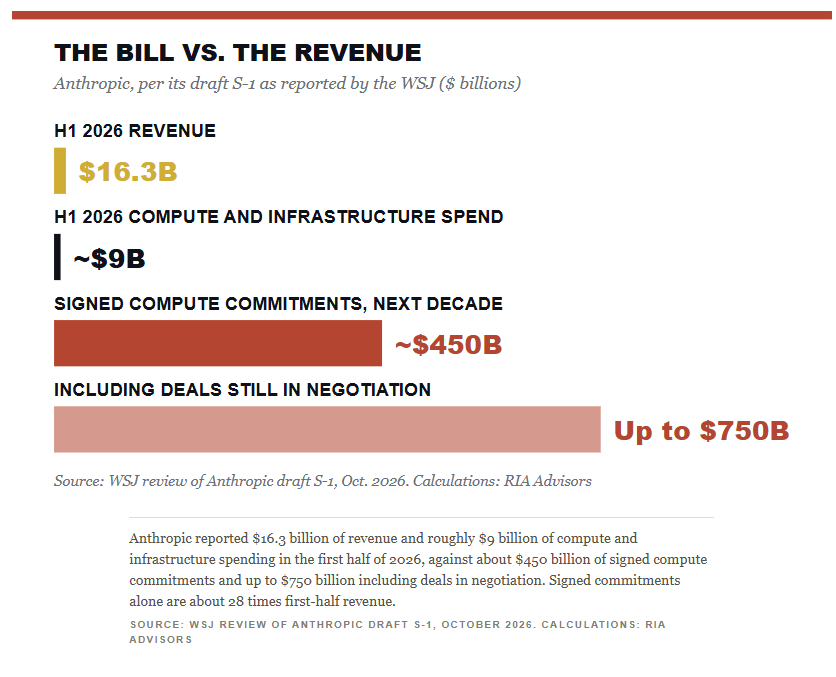
Before you point fingers and say “See, Anthropic is going to fail,” you need to put that $16 billion in revenue into perspective.
Anthropic didn’t sell its first product until 2023. Coca-Cola has been selling soda since 1886. Yet in the September quarter, Anthropic booked $16.8 billion of revenue, more than Coca-Cola, Netflix, Uber, or Intel, and more than triple the $4.7 billion it reported just two quarters earlier.
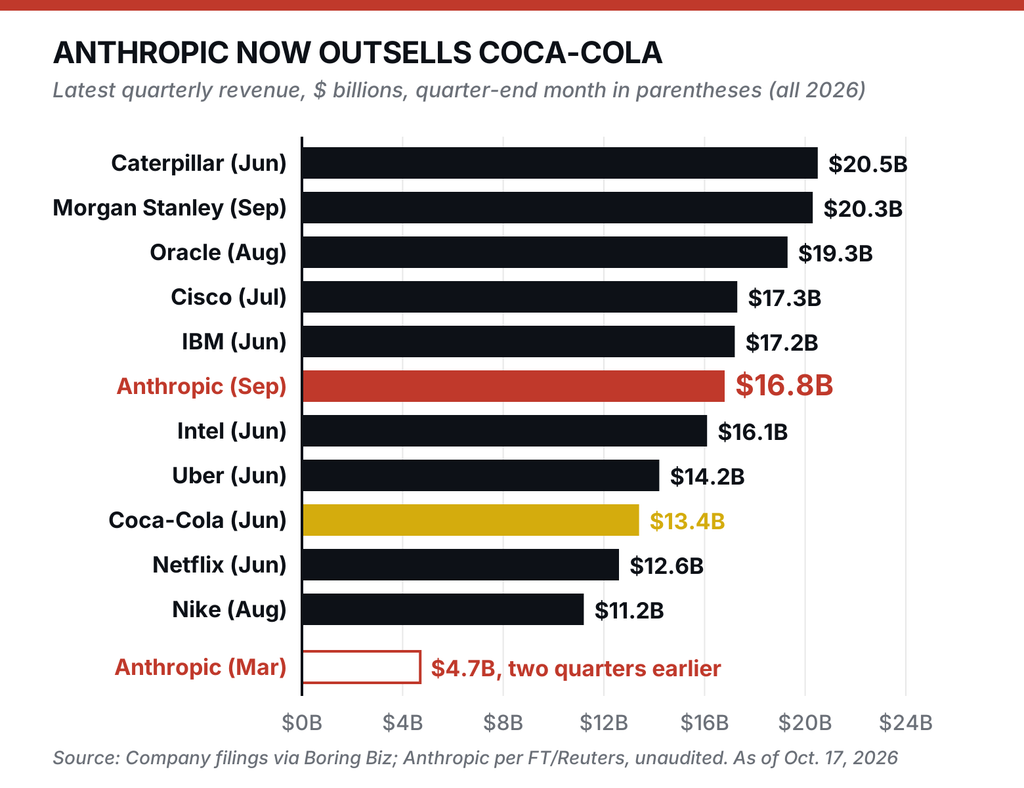
If we annualize that quarter, the revenue “run rate” lands near $67 billion. That’s already above the roughly $45 billion a year its signed commitments average over the next decade. That shrinks the 28x gap to something much closer to 7x.
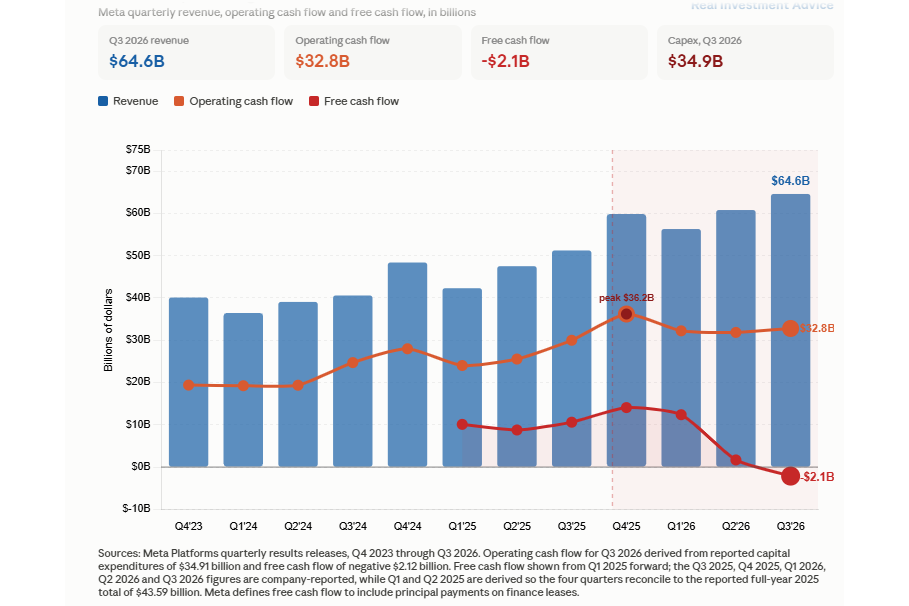
Furthermore, the financing of the AI buildout is also changing. In the early stages, the hyperscalers funded the early buildout from free cash flow. Fast forward, and Goldman Sachs’ credit team now expects project finance plus direct hyperscaler issuance to hit roughly $720 billion in 2027, up from about $37 billion of project finance in 2025.3 And as I noted earlier this week in AI Capex And Earnings: What Happens When Growth Slows, AI spending now drives about half of S&P 500 earnings growth. The risk is not that spending declines and hurts earnings; it just has to stop accelerating.
That said, a decline in free cash flow isn’t automatically a warning sign. What matters is the “why free cash flow is falling.” A company burning cash because customers are leaving or margins are collapsing has an operating problem. A highly profitable company choosing to pour its cash into new capacity has made an investment decision.
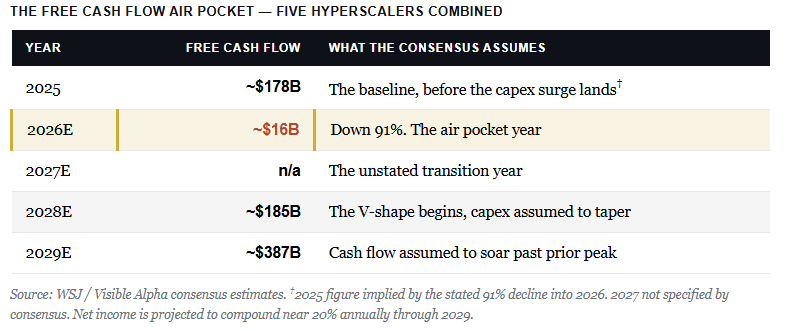
As I showed in AI Capex Depreciation Risk Is The Catch To Record Earnings, consensus estimates have the five hyperscalers’ combined free cash flow dropping roughly 91% this year to about $16 billion. Those estimates then have it recovering to about $185 billion in 2028 and roughly $387 billion by 2029 once the heaviest building is done.4 Yes, the decline in free cash flow is real, but what matters is whether the returns on that spending show up before the debt comes due. Such is the difference between Microsoft funding data centers from its operations and a neocloud borrowing against its GPUs.
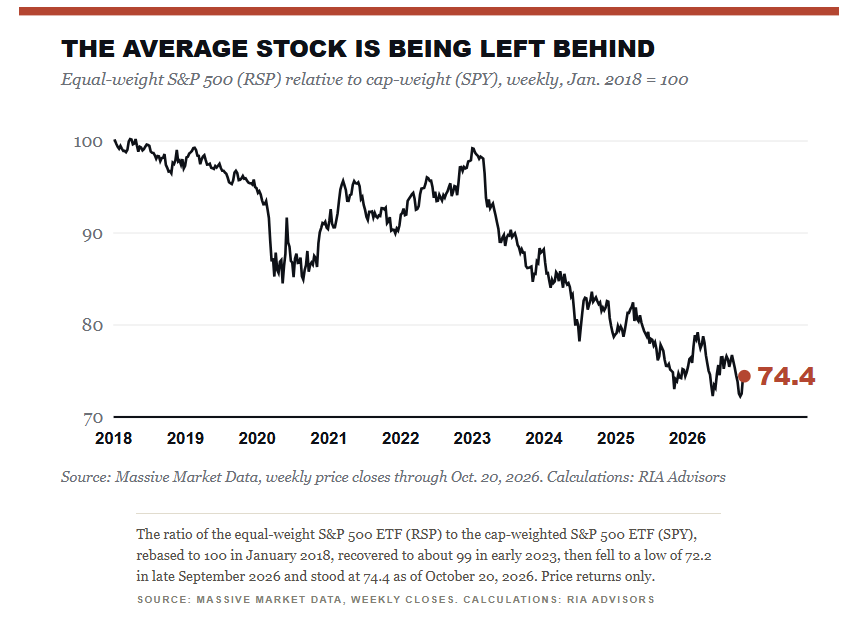
Lastly, there is also the market’s breadth issue. When the average stock keeps pace with the giants, a market is healthy. Since January 2018, the equal-weight S&P 500 has lost about 26% relative to the cap-weighted index, with most of that damage coming after the AI trade took hold in 2023.
The Case That This Isn’t 2000
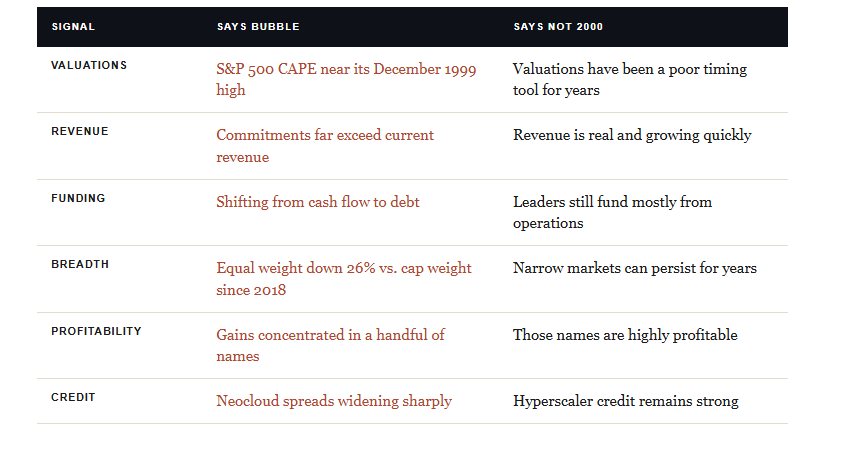
As I stated at the outset, the goal is to analyze the current environment for the real versus perceived risks. In Spotting Market Bubbles: Why History Says It’s Nearly Impossible, I compared 13 indicators against 1999. Four looked similar or worse. Six looked better, and three remain worth watching. But there is a critical distinction: the leaders of this cycle aren’t Pets.com, which went public with nine months of cash. Microsoft, Alphabet, Amazon, and Meta generate enormous profits and fund most of their spending from operations.
The productivity argument also deserves significant consideration. In the early 1980s, computers appeared everywhere but didn’t significantly affect productivity statistics until the mid-1990s. Flat productivity growth today may simply mean AI is early, not that it’s a failure, which is the immediate go-to argument for the bears.
When you put both cases side-by-side, the real answer to the question of “is it a bubble?” is “maybe.” That’s not a dodge. It’s what the evidence actually says.
Is AI A Bubble? Right Is Not The Same As On Time
Let’s suppose that Griffin is completely correct in his assessment. Should you sell all your investments today? History says no, or at least NOT yet. As I wrote in Market Bubbles: A Rational Guide To An Irrational Market, recognizing a bubble is one skill, but the “timing” of when you take action is something else entirely. This AI cycle, whether it is a bubble or not, will be no different.
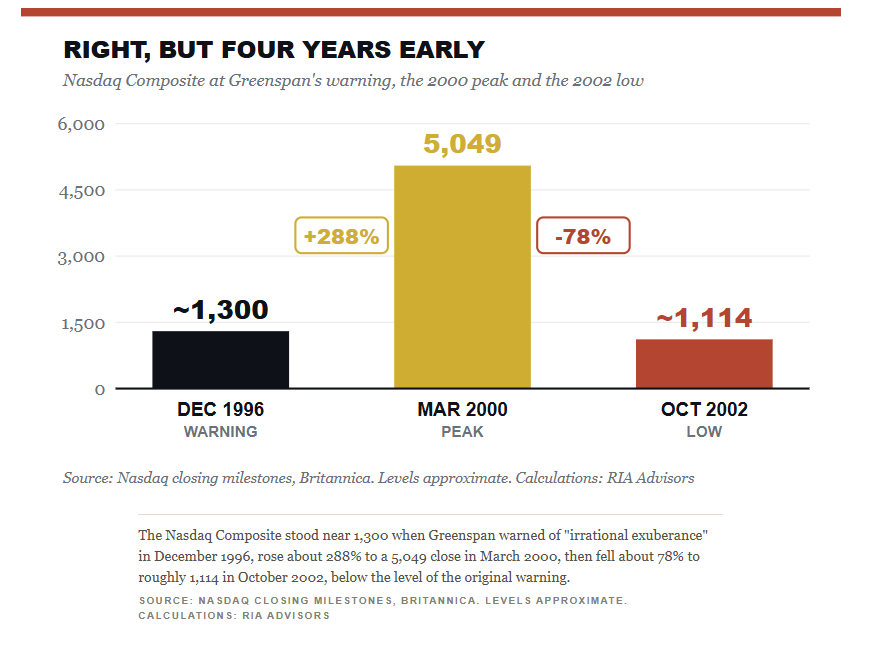
Here is a good example of prediction and timing. Alan Greenspan warned of “irrational exuberance” on December 5, 1996, with the Nasdaq near 1,300. Greenspan was 100% correct in his assessment. The problem, if you heeded his warning and sold your investment, is that the Nasdaq went on to nearly quadruple, closing at 5,048.62 on March 10, 2000. Of course, after that massive run, the “irrational exuberance” finally popped and the Nasdaq declined by roughly 78% by October 2002.5
The point is that while the “warning” did eventually come to fruition, and Greenspan was validated for his call, it took more than three years of watching everyone else get rich. Most people don’t have the stomach for that, so they buy back in near the top and get the worst of both outcomes.
However, here is an even more recent example that most have forgotten about entirely.
What Happened To The Bubble Callers Of 2019
Here’s where this gets personal. Seven years ago, plenty of serious people said the market was in a bubble, and the data backed them up. In January 2020, I wrote in Market Bubbles: It’s Not The Price, It’s The Mentality that the S&P 500 was trading nearly 90% above its long-term median valuation. I also wrote that the only missing ingredient for a correction was a catalyst to bring “fear” into a complacent market. A year later, Jeremy Grantham called the market a “fully fledged epic bubble.”6
The valuation data was accurate, and the catalyst even showed up a few weeks later, in the form of COVID leading to a swift 35% decline. But if you had sold the market in January 2020 due to the media’s calls for a bubble and failed to get back in after the pandemic crash, here is what that mistake would have cost you.
But read the following chart very carefully.
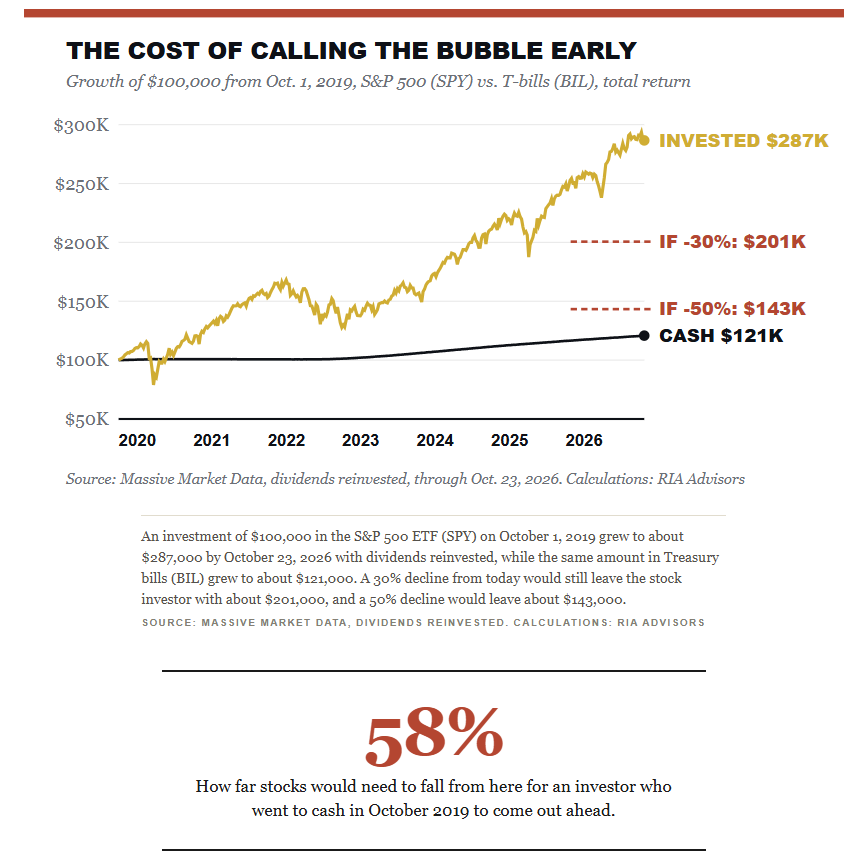
An investor who went to cash in October 2019 would need a decline worse than in 2008 just to break even with the investor who stayed. Even the investor who sold on Grantham’s January 2021 warning, and then watched his call partly vindicated by the 2022 bear market, would need stocks to drop roughly 44% today to catch up. Being early on a bubble call isn’t a small mistake. It compounds every year the bubble keeps inflating. That’s the real cost of timing the AI bubble, or any bubble, too early.
Peter Lynch put it better than anyone. To wit:
“Far more money has been lost by investors preparing for corrections, or trying to anticipate corrections, than has been lost in corrections themselves.”– Peter Lynch, former manager of Fidelity Magellan
None of that means that valuations don’t matter; they do, and they matter a lot. I argued that case in Asset Bubbles And Forward Returns; however, as I stated in that article:
“Valuations are a terrible timing indicator, but over the long term they tell you a lot about expected returns.”
Both statements are true at once. Such is precisely why the decision shouldn’t be framed as in or out.
The Strongest Case Against Staying Invested
The bearish case is real, and I am not dismissing it. What I am suggesting is that you balance the bearish view against how markets have historically performed. However, there is a real caveat worth discussing, because Lynch’s line doesn’t apply equally to everyone. When bubbles do break, and they always do, the damage is severe. The largest equity bubble drawdowns in history ran from 57% to 99%. The Nasdaq needed 15 years to regain its 2000 high. Japan’s Nikkei took about 34 years.
So, this is the point that each person must evaluate for themselves, and it all comes down to time.
“The math of staying invested works if you have 20 years, but I retire in three.”
Time is the most valuable commodity we have because it is the one thing we can not get more of. A 50% decline is survivable at 40. However, at 65, when one is drawing income from their portfolio, it can permanently change the retirement plan. This is the precise problem we discussed at length in Sequence Of Return Risk: The Math That Breaks Retirements. Your timeline, not Griffin’s forecast, should set how much bubble risk you carry. For a retiree, timing the AI bubble matters far less than surviving it.
How To Participate With The Bubble: Rules To Follow
Are we in a “bubble?” Maybe, but we won’t know for sure until it finally pops. Therefore, going to cash on a bubble call has a cost that history keeps measuring. However, riding the trade with no plan has a cost that history also measures, usually all at once.
The middle path is participation with rules, and the rules have to be set now, while you’re calm, because nobody writes good rules during a 20% drawdown. Trying to time the AI bubble is essentially equivalent to a coin flip, but managing your risk and exposure to the “bubble” isn’t.

Skip the light switch. As I wrote in the bubble-spotting piece, stocks aren’t a light switch. The choice is rarely fully invested or fully in cash. You can adjust exposure in steps as conditions change, so you never have to be exactly right about timing.
Size it, then rebalance it. Before you invest your first dollar into anything, decide, in writing, how much of your portfolio you’re willing to have tied to any trade, let alone AI. Remember that a plain S&P 500 index fund already carries a large share of the AI trade. Take programmatic steps to manage risk, such as rebalancing to target weights on a set calendar. Rebalancing is profit-taking you don’t have to agonize over, and in a bubble it’s the only kind most people actually do.
Own cash flow, and skip the leverage. Focus on, and favor, companies that fund their AI spending with free cash flow over those that fund it with debt and “take-or-pay” contracts. Notably, don’t add margin or leveraged ETFs of your own on top of a buildout that is increasingly debt-financed. Leverage is the fuel that turns a simple market correction into a financial catastrophe.
Set the exit, and watch what ends bubbles. Always define in advance, and always in writing, what will cause you to reduce portfolio risk. One simple tool is a break of the 40-week moving average. Also, pay close attention to liquidity and credit spreads. This is because bubbles usually end with a tightening of monetary policy or a credit-related event, not because of a change in the narrative. When AI-related spreads widen while stocks hold near their highs, the bond market is telling you something important.
Match the risk to your timeline. Most importantly, the closer you are to needing your investment dollars, the less risk belongs in the portfolio, particularly if you are concerned that Griffin is correct. That’s the one rule that keeps a market accident from becoming a retirement accident.
“Being right about the bubble won’t protect your portfolio. Having rules before it pops will.”
Bottom Line
Griffin may be right that AI is a bubble, but timing the AI bubble has historically cost more than riding it with rules, so participate with defined limits and a plan set in advance.
The bubble will end. It always does. The only question is whether you’re still around, with your capital intact, when it finally matters.

Comments
Log in or sign up to join the conversation.