

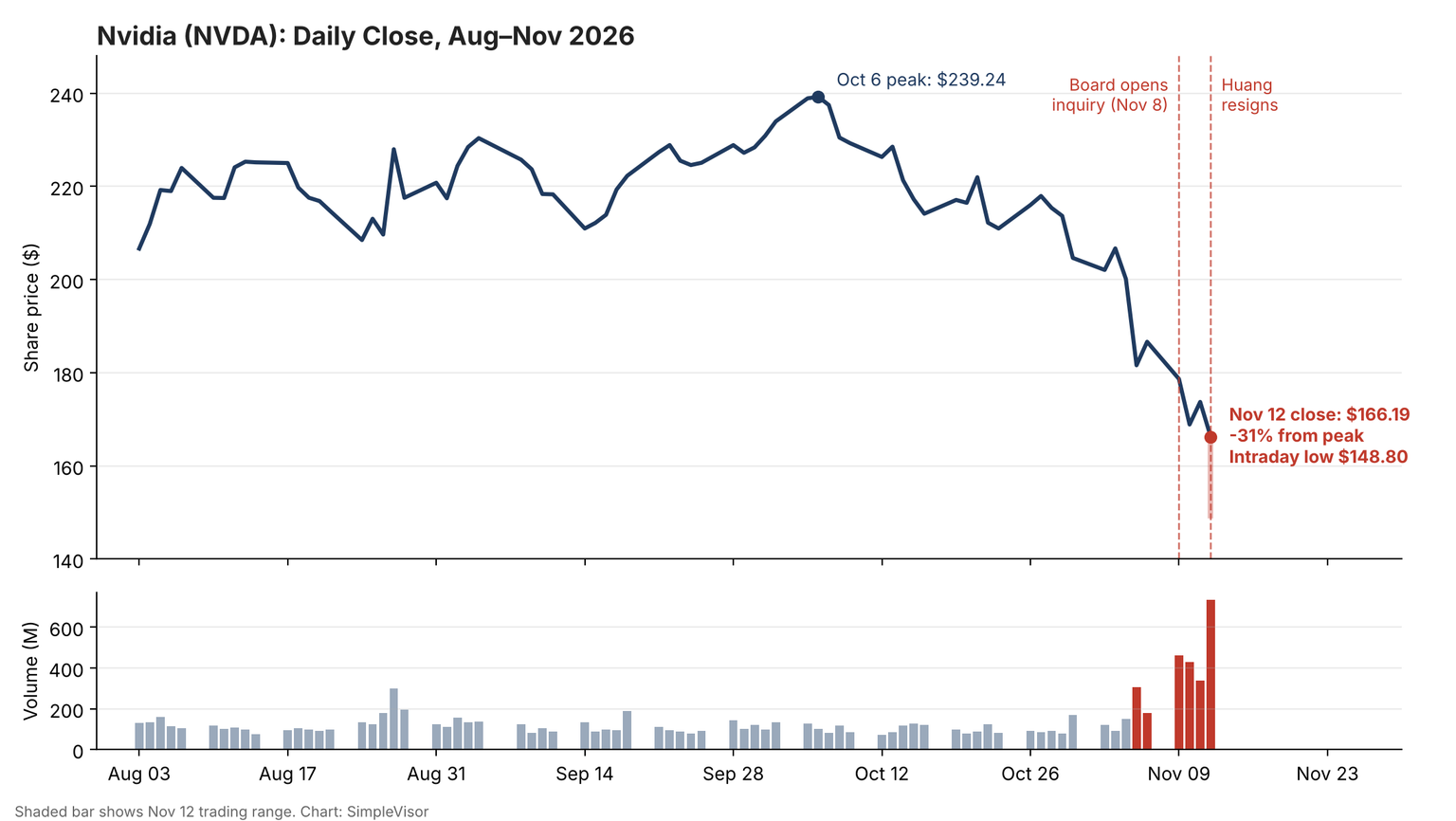
Nvidia stock fell on Thursday after Jensen Huang resigned as CEO, president, and board member, effective immediately. Shares plunged as much as 14% at the open before buyers stepped in. The stock closed down 4.3% at $166.19 on more than double the prior day’s volume. Nvidia stock now sits nearly a third below its October 6 peak. Because Nvidia carries one of the largest weights in the major indexes, its slide dragged the S&P 500 and Nasdaq lower.
The resignation follows an independent board investigation that began on November 8. The inquiry examined Huang’s personal conduct and reports that he was the target of a foreign intelligence effort. The board said it had no reason to believe the matter compromised company secrets or national security. As we show below, selling volume surged as the story unfolded.
Investors have long treated Huang and Nvidia as one and the same. He co-founded the company 33 years ago and built it into the engine of the AI boom. Yet Nvidia had no succession plan, no chief operating officer, and no board chair before Thursday. That gap explains why Nvidia stock fell so hard. The market is not repricing Nvidia’s chips; rather, it’s repricing the uncertainty over who leads the company.
The board turned to CFO Colette Kress as interim CEO. She keeps her CFO role while Harvey Jones, the board’s first-ever chair, leads the search for a successor. Kress joined Nvidia in 2013 after finance roles at Cisco, Microsoft, and Dallas-based Texas Instruments. Wall Street knows her well from over a decade of earnings calls. Per The Wall Street Journal, she also oversaw the growth of Nvidia’s balance sheet to fund support for customers buying its chips. Critics call that circular financing, while Kress has defended the deals as sound investments. She has also shown she listens to shareholders. The Journal reports she slowed a major OpenAI data-center agreement in August after the market reacted poorly. Her near-term job is continuity: hit guidance, reassure customers, and keep the roadmap on schedule.
The first test arrives Tuesday, when Nvidia reports third-quarter results. Investors will watch guidance and any update on customer financing commitments. A steady report would help Nvidia stock find its footing. A weak one would deepen the leadership discount. The broader lesson concerns concentration. When one executive’s exit can move the entire index, passive investors carry more single-stock risk than they may realize.
What To Watch Today
October PPI lands at 8:30 a.m., one month after September’s 1.3% jump. The earnings slate is quiet, so Nvidia headlines will set the tone for the AI trade into Tuesday’s report.
Economy
Time (ET) | Release (period) | Prior | Consensus | Forecast |
|---|---|---|---|---|
8:30 a.m. | PPI MoM (Oct.) | 1.3% | 0.4% | 0.3% |
8:30 a.m. | PPI YoY (Oct.) | 6.3% | 6.6% | 6.5% |
8:30 a.m. | Core PPI MoM (Oct.) | 0.7% | 0.3% | 0.3% |
8:30 a.m. | Core PPI YoY (Oct.) | 5.0% | 5.0% | 4.9% |
Earnings
Company (Ticker) | Timing | EPS est. | Rev. est. |
|---|---|---|---|
No market-moving U.S. earnings Friday. Japan’s megabanks (MUFG, SMFG, MFG) report overnight. Nvidia (NVDA) reports Tuesday, Nov. 17, after the close. | |||
Fed speakers: Vice Chair for Supervision Bowman (10:50 a.m., supervision and regulation), San Francisco’s Daly (12:00 p.m.), and Vice Chair Jefferson (7:00 p.m., productivity and new technology).
All times Eastern. Economic data: Trading Economics, confirmed against the BLS release schedule and StockTitan’s PPI preview. Fed: Federal Reserve Board calendar and Trading Economics. Earnings: StockTitan weekly calendar (Nasdaq data). As of Nov. 12, 2026.
Market Trading Update
Yesterday, in “SoftBank: Another Warning On AI Funding,” we laid out a plan to buy Nvidia’s technical washout in thirds. Hours later, the news overtook the plan. The Nvidia CEO removal the Wall Street Journal reported Wednesday night became official Thursday morning, when Jensen Huang resigned effective immediately. CFO Colette Kress is interim CEO while keeping the CFO job, and longtime director Harvey Jones became the board’s first chair. The trigger was two extramarital affairs, one with a woman U.S. intelligence officials suspect is a Chinese spy.
The stock opened down 13% at $151, traded as low as $148.80, then rallied back to roughly $164 by mid-morning. That’s a 10% bounce off the low on more volume in the first 70 minutes than all of Wednesday’s session. So the question isn’t whether Nvidia is “cheap” anymore. It’s what a CEO exit like this has historically done to the stock.
The history isn’t kind. I pulled nine companies that pushed out a CEO over conduct since 2010, from Mark Hurd at HP to Les Moonves at CBS. The median stock fell 6.3% over six months and 11.7% over twelve. Prices usually recovered by year two. But only one of the eight cases with two full years of history beat the S&P 500. That was Texas Instruments, and it won by less than a point. The median trailed by nearly 18 points.
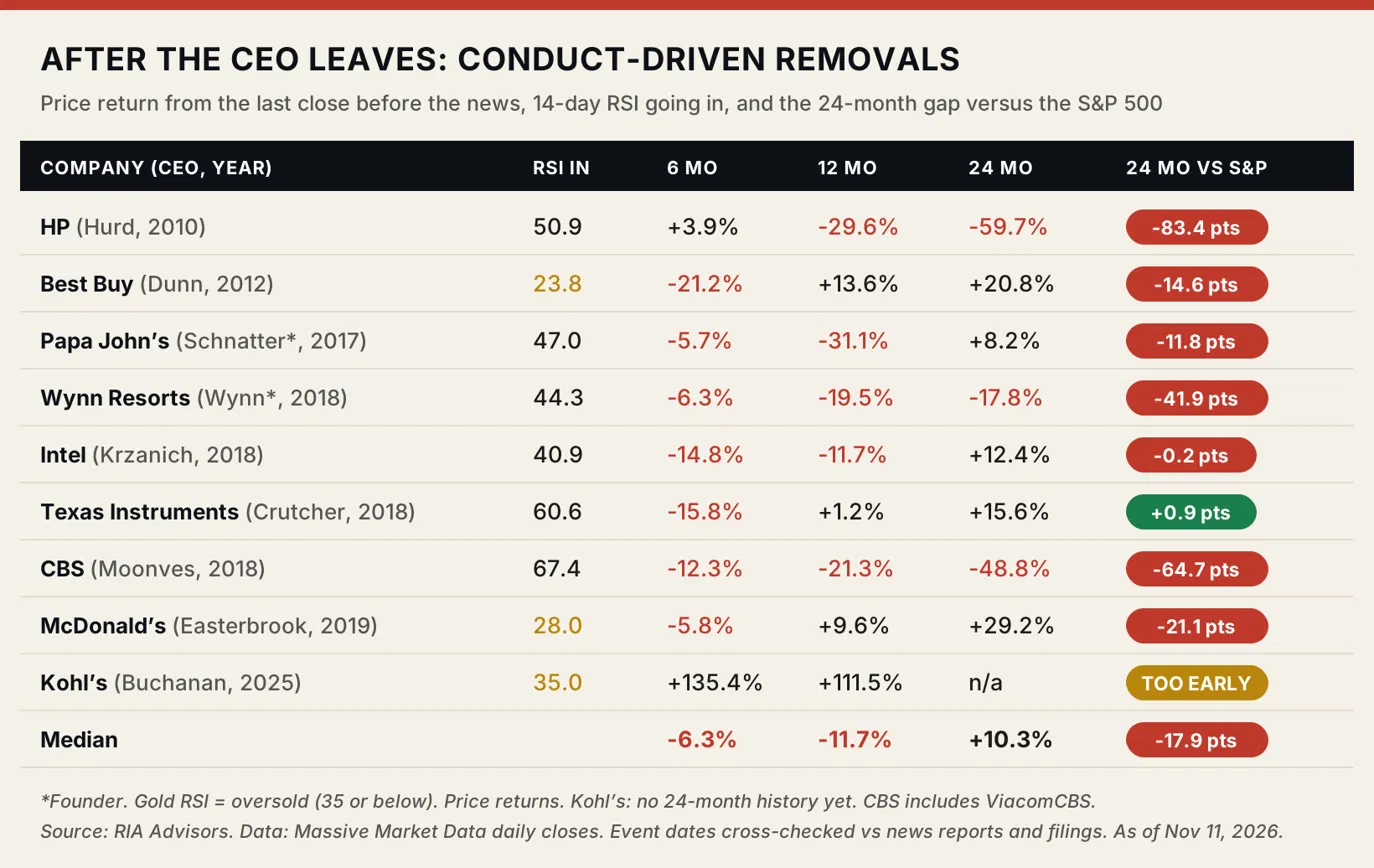
“But, Nvidia isn’t Papa John’s.” That is correct, and for someone who has owned it since the 2024 split, they are still in the green. It’s a fair point. Just because the CEO resigns, engineers don’t stop shipping GPUs. The closer analog is McDonald’s, a healthy franchise that lost its CEO over a workplace relationship. That stock gained 29% in two years and still lagged the index by 21 points. The worst analog is HP, where the successor did more damage than the scandal. That’s the risk worth pricing now. Huang said he didn’t believe in succession planning, and the board has no permanent successor. Kress is widely respected, but she is doing two jobs with an earnings call on Tuesday.
The Street split fast. Bernstein downgraded the stock to market perform and cut its target to $200, while Raymond James maintained its strong buy rating. The bigger issue may not be the CEO at all. The Justice Department is leading multiple investigations involving Alice Huang. Megaspeed, her employer and a major Nvidia customer, has faced a Commerce Department probe over suspected chip diversion to China. Senators have also asked the administration to preserve records on Nvidia’s China exports.
Such is the problem with “key person” risk as it relates to national security. It rarely leaves with the person. Bob Farrell’s Rule #9 warns that when all the experts agree, something else is going to happen. Nobody’s model had a governance crisis at the market’s favorite AI name.
Technically, Thursday broke the line that mattered, then fought back to it. The open sliced through the March 30 low of $164.27, the floor that earned our first tranche. At $164.64 mid-morning, NVDA sits 19% below its 200-DMA at $204.33 and 31% under the October 6 record of $239.24. The 14-day RSI is near 25. The lower 3 SD band, our hard stop on a closing basis, has widened to about $147..
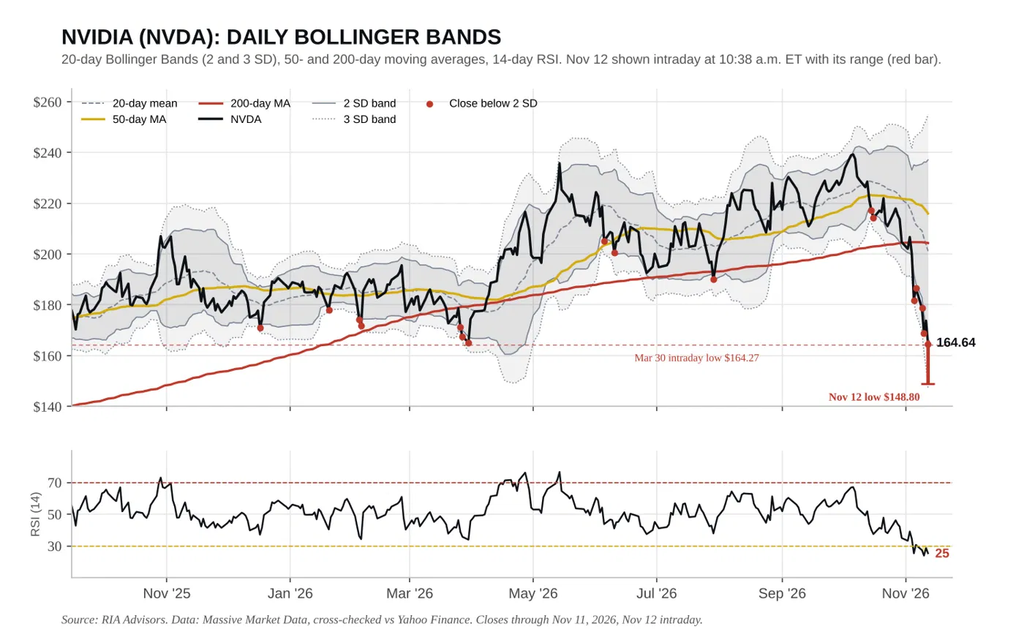
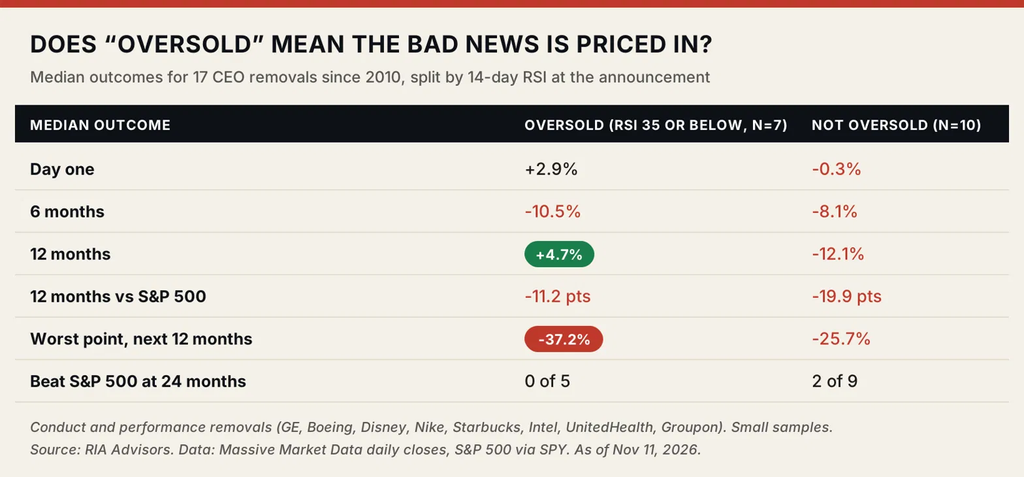
That reversal off $148.80 will look like a capitulation low to many. Maybe it is. But doesn’t “oversold” mean the bad news is priced in? It’s a good question, so I tested that across 17 CEO removals since 2010, adding performance-driven exits like GE, Boeing, and Nike.
Stocks that entered with a 14-day RSI of 35 or below finished the next year up a median 4.7%. The rest lost 12.1%. That’s the good news. The bad news is the path. The oversold group’s median worst point over the following year was 37% below the pre-announcement close, deeper than the 26% for everyone else. Oversold was NOT a bottom signal. Oversold tells you where a stock may end up. It doesn’t tell you what it costs to get there.
Nvidia’s setup cuts both ways. A stock 19% below its 200-DMA usually belongs to a broken business, like GE in 2018 or Boeing in 2019. Nvidia’s business isn’t broken, which argues against dumping long-term holdings into the gap. But the stretch didn’t come from the scandal alone. The AI chip selloff on November 5 came first. So the leadership shock lands on a stock already under pressure from the funding worries we covered yesterday. That looks more like GE than McDonald’s.
So we’re changing the plan. When the reason you bought changes, you don’t wait for the stop to tell you you’re wrong.
Exit the first tactical tranche into this rebound. Thursday’s recovery to $164 delivered the exit we were waiting for.
Shelve tranches two and three until Tuesday’s earnings confirm guidance, the board names a permanent CEO, and NVDA reclaims its 200-DMA.
Long-term holders should hold at or below target weight. Don’t sell into the gap, and don’t add until those conditions clear.
Size for the path, not the destination. If another 30% drawdown would force you to sell, the position is too big.
The first headline is rarely the last.
Housing Flashes A Warning To A Hawkish Fed
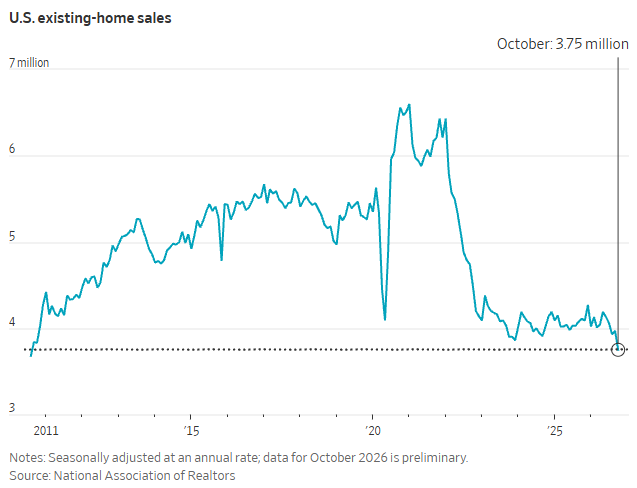
Housing just sent the Fed a warning. Existing home sales fell 5.5% in October to a 3.75 million annual rate, according to the National Association of Realtors. Economists had expected a 3.8% decline. Sales now sit at their lowest level since August 2010 and are down 8.8% from a year ago. The median price rose just 0.4% to $416,700, as homeowners with low-rate mortgages hold on to their homes and keep inventory tight. As we show below, courtesy of The Wall Street Journal, sales have given back the entire post-crisis recovery. The pandemic boom lifted the annual rate above 6.5 million in 2020 and 2021. Rising rates have since cut it by more than 40%.
The worst may still lie ahead. October closings mostly reflect contracts signed in September, when a bond selloff pushed mortgage rates above 7%. Rates climbed further in October. Hotter-than-expected October CPI lifted the 10-year Treasury yield this week. Mortgage rates track that yield closely. Goldman Sachs now expects only 3.9 million sales in 2027. Annual sales have not fallen below 4 million since 1995.
Last week, in Hiking Into Disinflation, we argued the Fed risks a policy error by fighting inflation it cannot control. Oil and AI-driven hardware prices did most of the recent damage, and neither responds to the fed funds rate. Housing does. Yet futures markets still price a December hike, and economists cited by The Wall Street Journal expect mortgage rates to stay elevated through next year.
A hike would tighten conditions in a sector already in recession-like territory. It would do little to oil, which has already fallen from its October 30 peak of $104 to below $90. Housing is the most rate-sensitive part of the economy, and it is flashing red. The Fed should take notice before it acts.
Tweet of the Day

Comments
Log in or sign up to join the conversation.