


Yields on Japanese bonds continue to rise. This week, 2-year and 5-year rates reached their highest levels in 31 years, while the 10-year yield is at a 30-year high. To most investors, these figures may seem insignificant. Yet they mark a major turning point for global financial markets.
For more than twenty years, a significant portion of the international financial system has been built on a simple assumption: it would always be possible to borrow yen at a negligible cost to finance higher-yielding investments around the world. Today, this assumption is gradually being called into question.
Over the past two years, the yield on the Japanese 2-year bond has risen from 0.35% to nearly 1.70%, representing a nearly fivefold increase in the cost of financing at the short end of the yield curve.
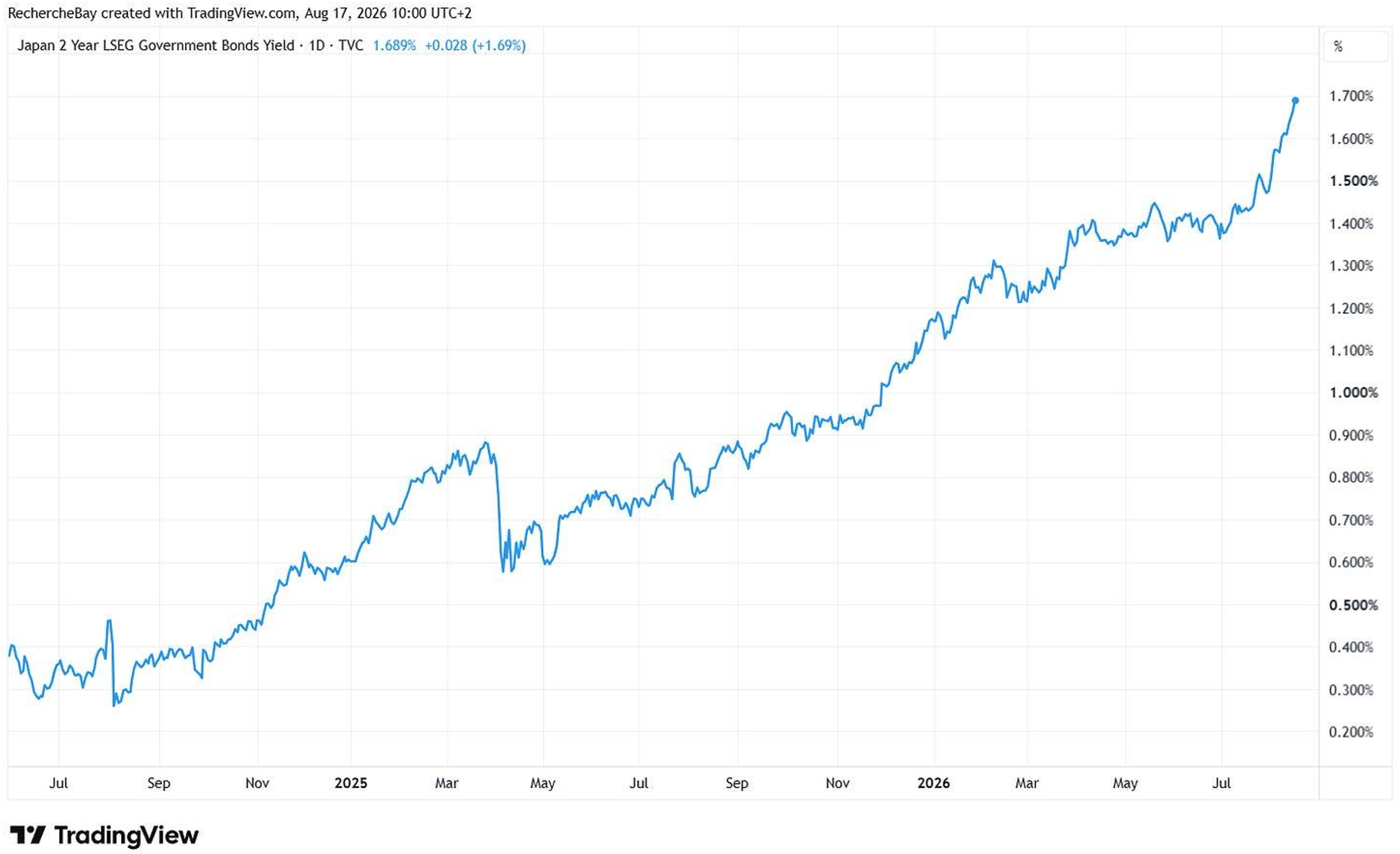
In theory, this development should have already triggered a massive unwinding of the yen carry trade. For nearly twenty years, investors have borrowed yen at a cost close to zero to buy stocks, bonds, or real estate assets offering significantly higher returns. When the cost of this financing increases nearly fivefold, logic would suggest that these positions would be gradually reduced.
Yet we are seeing exactly the opposite.
U.S. markets are setting one record after another, inflows into ETFs are reaching unprecedented levels, call option purchases are also breaking records, and, most importantly, the use of leverage continues to rise at a rate never seen before.
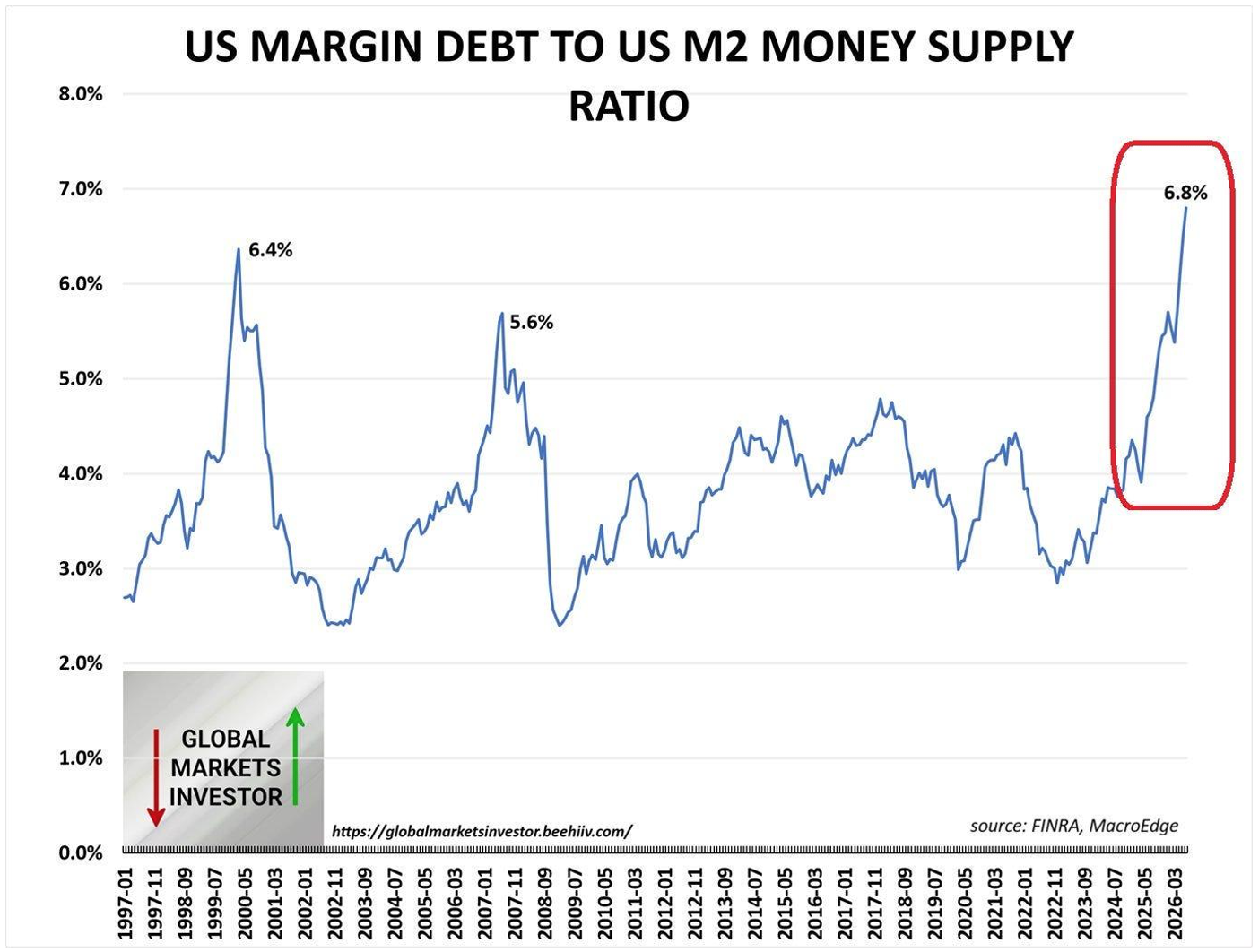
The latest estimates indicate that U.S. margin debt is expected to reach $1.58 trillion in July, setting a new all-time high. It is reported to have risen by $73 billion in a single month, by $354 billion in just four months, and by $552 billion over the past year — a 54% increase, the sharpest rise since the “meme stock” frenzy of 2021.
Even more impressive is that the ratio of this margin debt to the M2 money supply now stands at 6.8%, surpassing the previous record of 6.4% set at the peak of the dot-com bubble in 2000. In other words, financial leverage has never reached such a high level relative to the amount of money available in the economy.
At first glance, this trend seems completely contradictory. A rise in the cost of financing would normally lead investors to reduce their debt. Why are we seeing the opposite happen?
The answer likely lies in a major shift in risk perception.
The real turning point appears to have been around August 4. On that day, Scott Bessent hinted that an agreement on the Strait of Hormuz could be reached as early as the following Tuesday or Wednesday.
In the end, the agreement never materialized, but the message sent to the market was clear: the U.S. Treasury would continue to do everything in its power to prevent a shock to financial conditions and inflation expectations. This statement triggered a powerful buying spree in stocks, accompanied by a record volume of call option purchases.
To understand what happened next, it is important to recall the role of market makers (“dealers”). When an investor buys a call option, the dealer generally ends up as the seller of that option. To limit their exposure, they must buy a portion of the corresponding stocks or futures contracts to hedge their position. The more calls investors buy, the more dealers must buy into the market.
When these purchases become massive and dealers find themselves in negative gamma, the mechanism can become self-perpetuating: every rise in the indices forces them to buy more of the underlying asset to maintain their hedges. The rise then automatically fuels… yet another rise.
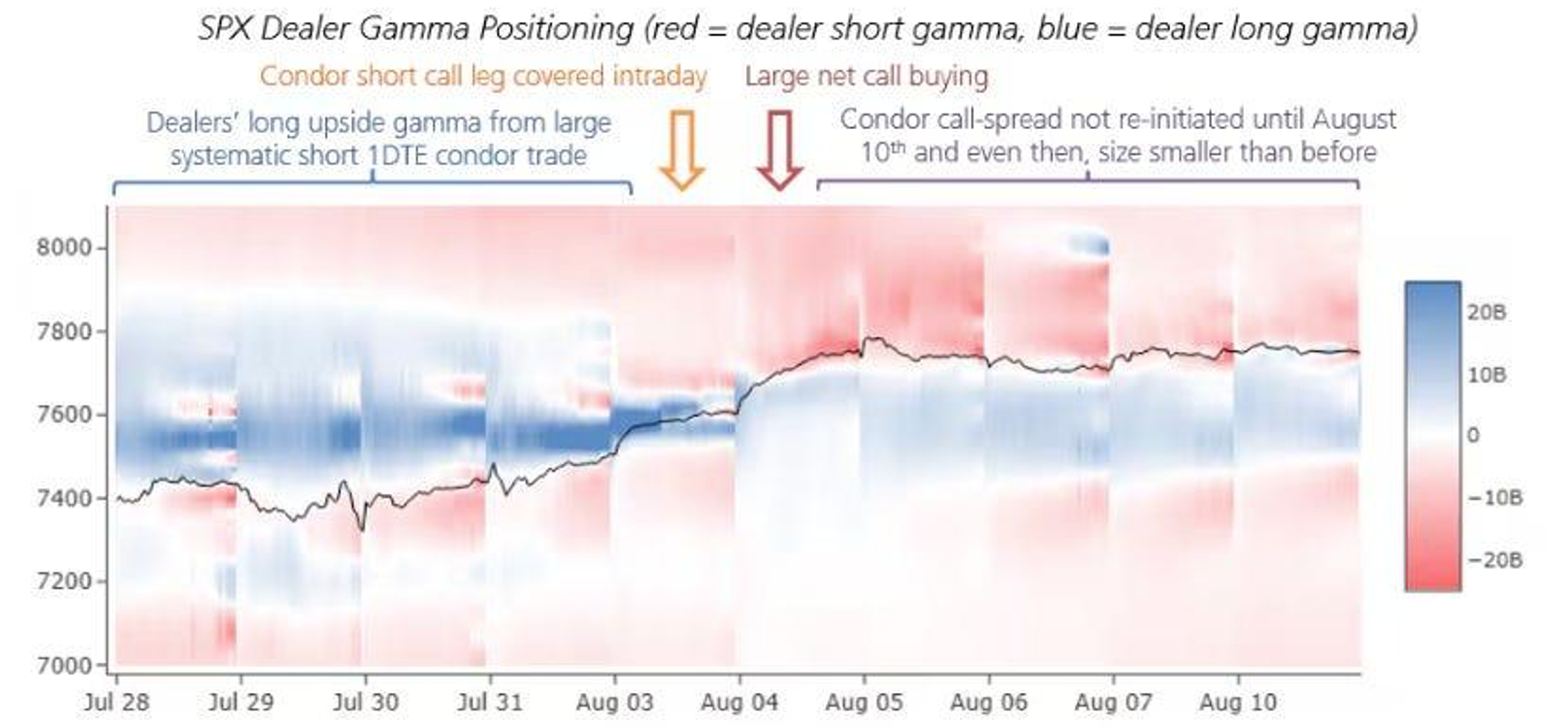
That is precisely what the chart shows. Until early August, dealers were generally in positive gamma (blue areas), a configuration that tends to dampen market movements. Starting on August 4, following a surge in call option purchases, the market gradually shifted into negative gamma (red zones). From that point on, every rise in the S&P 500 forced dealers to buy more futures and stocks to adjust their hedges, which automatically fueled the upward trend.
My interpretation is that this was also the moment when several hedge funds chose to increase their leverage rather than reduce it. The implicit message sent by the Treasury — its desire to prevent a disorderly unwinding of the carry trade and to preserve financial conditions — was likely interpreted as a signal that the risk of an immediate correction was diminishing. Instead of deleveraging their portfolios despite rising Japanese interest rates, some investors appear to have increased their exposure, while forced buying by dealers further amplified the rally. This paradox could explain why markets are now hitting new highs even as the cost of yen-denominated financing continues to rise.
A few days earlier, the U.S. Treasury had already stepped in to prevent Japan from being forced to sell off large amounts of its Treasuries in order to defend the yen, notably by facilitating the use of the FIMA Repo mechanism. For many investors, the message is crystal clear: Washington will likely not allow financial conditions to deteriorate sharply.
This perception profoundly changes hedge funds’ economic calculations.
Consider a fund that finances a $300 million portfolio through a yen-denominated loan. Two years ago, its annual financing cost was approximately $1 million. Today, it exceeds $5 million. The most prudent response would naturally be to reduce the size of the portfolio.
But if that same fund believes that U.S. authorities will intervene at the slightest sign of tension, another strategy may become rational.
Instead of reducing its exposure, it may seek to preserve its profitability by increasing its leverage. Its portfolio grows from $300 million to $400 million, then to $500 million. The return on each dollar invested decreases, but this decline is offset by greater exposure. As long as the markets continue to rise, this strategy remains profitable.
The Treasury’s intervention may therefore not have eliminated the risk of a carry trade unwinding. It may have convinced some investors to postpone deleveraging — or even to strengthen their positions.
This dynamic is reinforced by a second factor, one that is often underestimated.
At the same time, the U.S. Federal Reserve continues to purchase Treasury bills, officially intended to maintain “ample” bank reserves. These operations inject new liquidity into the financial system, which can then be quickly redirected toward other assets. Even though they are not officially classified as QE, their effect on short-term maturities is similar: they increase the amount of liquidity available in the system.
We thus find ourselves in a paradoxical situation.
On the one hand, the continued rise in Japanese interest rates is gradually undermining one of the historic pillars of the global carry trade.
On the other hand, interventions by the U.S. Treasury and the Fed’s liquidity injections give investors the sense that a safety net exists beneath the markets.
The result is evident in the numbers: instead of declining, leverage has now reached a level never before seen in the modern history of U.S. markets.
But that is precisely what makes the situation potentially more fragile.
In the final stages of a credit cycle, rising financing costs do not necessarily lead to immediate deleveraging. On the contrary, at first they may prompt some investors to take on more risk in order to maintain their profitability. The system thus appears remarkably sound at the very moment its vulnerability is increasing.
Perhaps this is the paradox of today’s market. Japanese interest rates are sending a signal of caution, but government interventions and U.S. liquidity are encouraging even greater leverage. The longer this divergence persists, the more likely it is that the eventual deleveraging will be brutal once it becomes impossible to refinance these positions under the same terms.
It is probably no coincidence that the price of gold has resumed its rise precisely as this leverage-related risk reemerges.
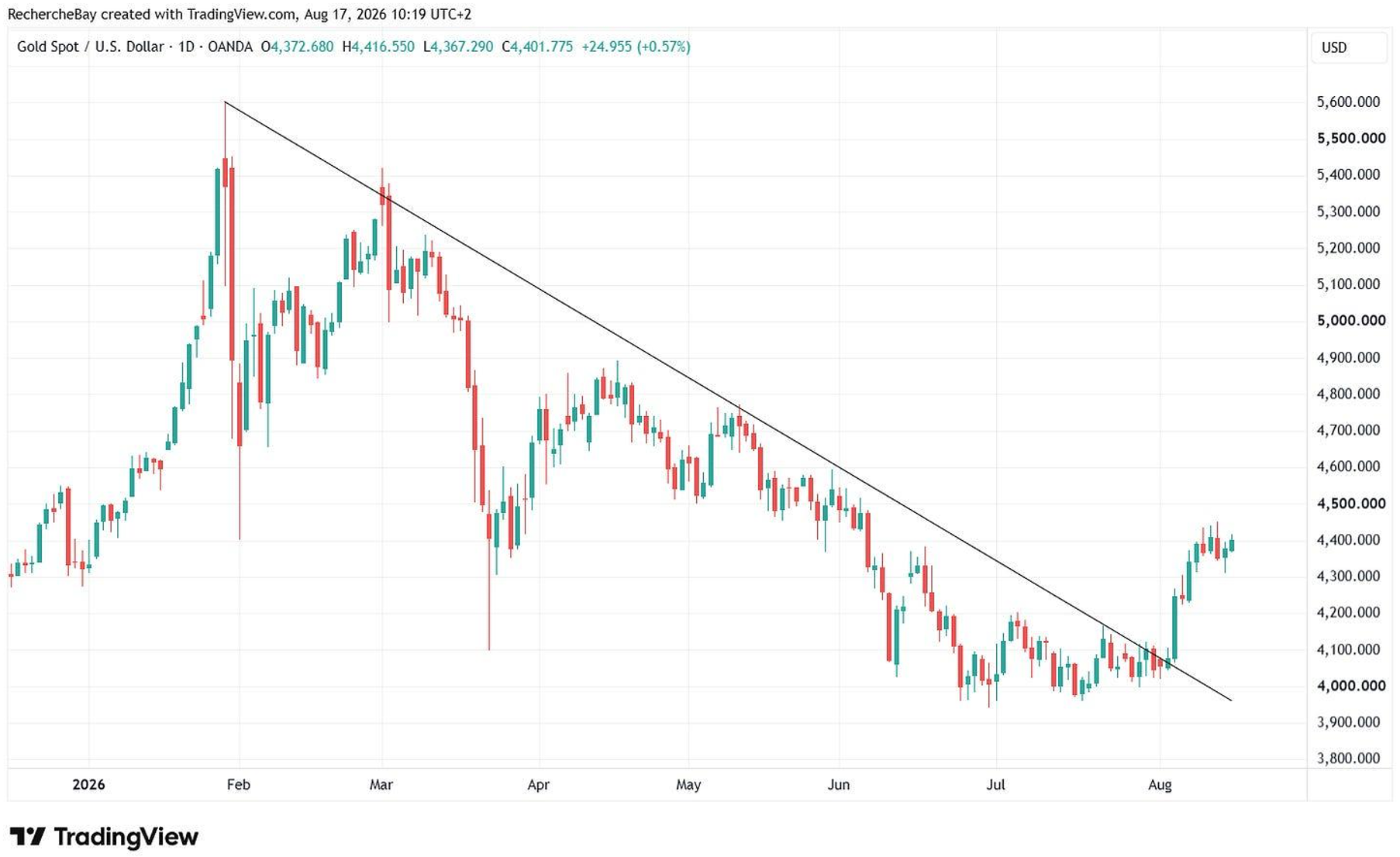
Unlike stocks, gold does not benefit directly from liquidity injections intended to support the financial markets. It reacts primarily to the credibility of the monetary system. However, in recent weeks, several signals have converged: the Fed continues to monetize a growing portion of short-term debt; the Treasury is intervening directly to prevent Japan from selling Treasuries; hedge funds are increasing their leverage even as the cost of financing rises sharply; and investors are demanding ever-higher yields to hold U.S. sovereign debt.
Gold thus seems to be sending a simple message: the authorities are still managing to postpone deleveraging, but at the cost of increasingly frequent interventions and ever-greater liquidity creation.
It is precisely this type of environment that has historically favored precious metals. When markets begin to realize that the stability of financial assets depends more on government intervention than on their own economic equilibrium, the value of fiat currency becomes harder to assess. Gold then represents not only a hedge against inflation, but also insurance against the proliferation of monetary interventions themselves. The more central banks and Treasuries are forced to act to preserve market functionality, the more gold regains its role as an independent monetary asset.
The paradox, then, may be this: current interventions are prolonging the rally in equity markets and maintaining record levels of leverage. But at the same time, they are reinforcing the fundamental reasons driving long-term investors back toward gold.
Stocks are currently celebrating the abundance of liquidity; gold, on the other hand, already seems to be anticipating the future cost of that liquidity.



Comments
Log in or sign up to join the conversation.