


Gold price (XAU/USD) drifts lower to near $4,410 during the early Asian session on Tuesday. The precious metal extends the decline as a stronger-than-expected US Nonfarm Payrolls (NFP) report for August bolsters expectations for a Federal Reserve (Fed) interest rate hike this month.
Data last week showed that US NFP climbed by 162K in August, versus an upwardly revised rise of 21K prior, above the market consensus of 56K. Meanwhile, the Unemployment Rate in the US held steady at 4.1% during the same period.
Traders see a 60% odds of an interest rate hike at the Fed's policy meeting next week, compared with a probability of 50% before the jobs data was released on Friday, according to the CME FedWatch tool.
"Gold and silver have moved in the opposite direction to energy prices, extending their declines after Friday’s strong U.S. jobs report lifted bond yields and reinforced expectations of a Fed rate hike on 16 September," said Ole Hansen, head of commodity strategy at Saxo Bank.
Traders will take more cues from the US Producer Price Index (PPI) and Consumer Price Index (CPI) inflation data later this week. Any signs of hotter inflation in the US would reinforce a September hike. This, in turn, could underpin the US Dollar (USD) and weigh on the USD-denominated commodity price. A cooler reading would strengthen the case for a rate hold and drag the Greenback lower.
Gold slips on US data even as structural bull run deepens
Analysts at Societe Generale argue that Gold has now “entered a new phase of its 2026 bull run,” one they characterise as being “defined less by speculative momentum and more by broad-based, structural conviction across every category of market participant.” What initially “began as a geopolitical shock” has, in their view, “evolved over the following months into something far more durable: a synchronised build-up of physical, futures, and options exposure that now spans retail investors, professional money managers, and derivatives traders alike.”
At the same time, strategists at UOB Group highlight that near-term price action remains sensitive to macro data, noting that Gold “fell more than 0.9% last Fri to $4429.98/oz for a weekly loss after stronger-than-expected US jobs data boosted expectations that the Fed could raise interest rates as soon as this month, denting the non-yielding bullion’s appeal.”
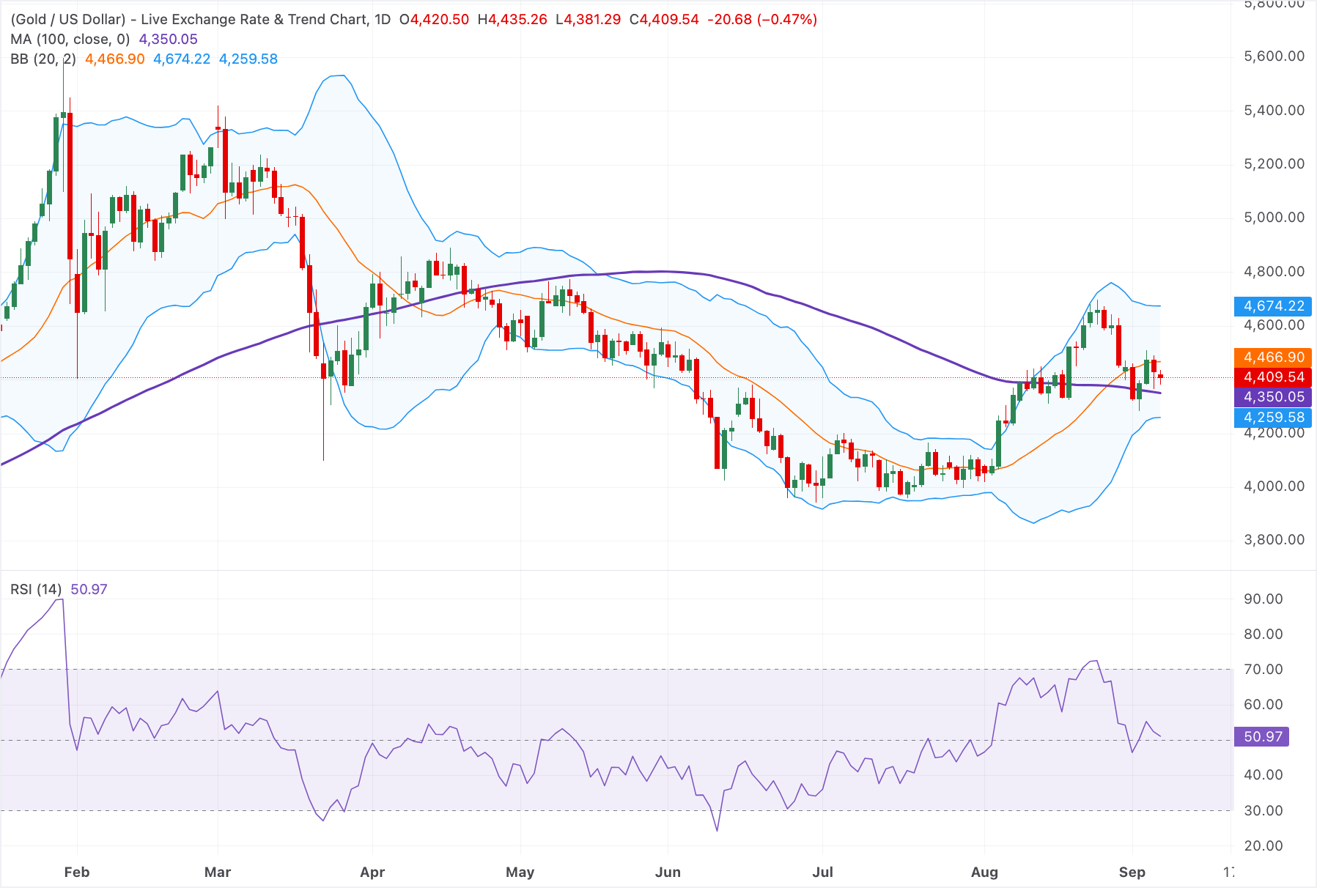
Technical Analysis: Gold price retains a neutral tone in the near term
In the daily chart, XAU/USD sits between the 100-day Simple Moving Average (SMA) and the 20-day SMA, leaving the metal supported by the longer-term average but capped by the shorter-term trend line overhead. The latest Bollinger Bands (20, 2) show spot holding comfortably above the lower band while failing to challenge the upper band, reinforcing a mid-range consolidation tone. The Relative Strength Index (14) around 51 is neutral, hinting at balanced momentum rather than a clear directional push.
On the topside, immediate resistance aligns with the 20-day SMA and Bollinger middle band near $4,465, with a subsequent barrier at the upper Bollinger band around $4,675 if buyers regain control. On the downside, initial support is seen at the 100-day SMA near $4,350, ahead of stronger demand into the lower Bollinger band around $4,260, where a break would open the door to a deeper corrective phase.

Comments
Log in or sign up to join the conversation.