


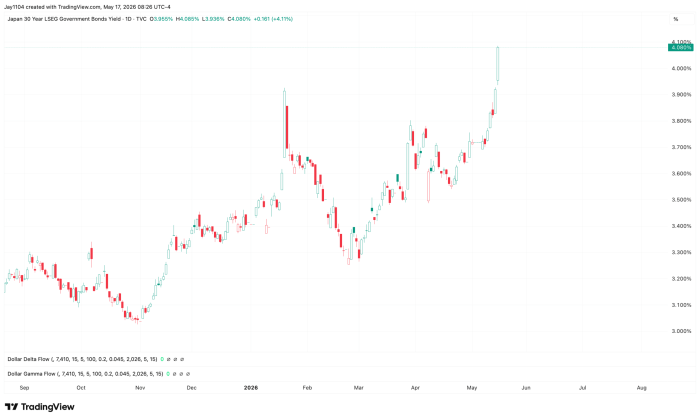
Stocks fell sharply on Friday as rates broke out globally. The move higher began in Japan, where PPI rose 2.3% month over month versus estimates of 0.8%, while the year-over-year rate surged to 4.9% against expectations of 3%. That sent the 30-year JGB yield soaring 16 basis points to 4.08%.
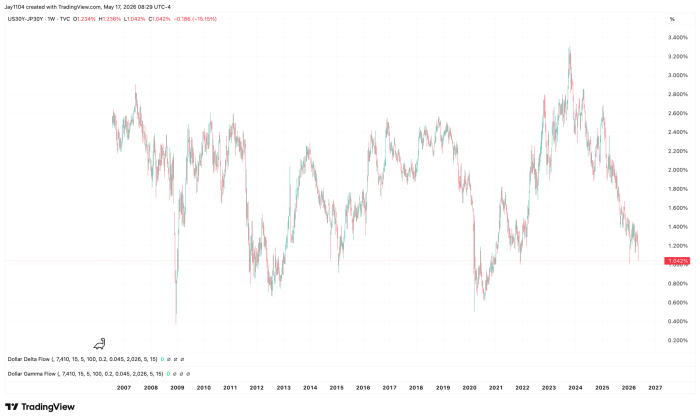
This caused the spread between the US 30-year Treasury yield and the 30-year JGB yield to narrow to just 1.04%, pushing it back toward the lower end of its historical range dating to 2007. Unless that spread compresses further — which seems unlikely — the US 30-year yield will likely move largely in tandem with the 30-year JGB yield going forward.
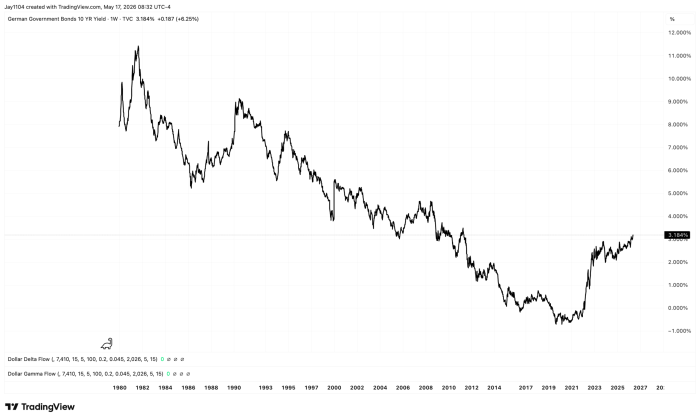
The German 10-year yield also reached a new cycle high on Friday, marking its highest level since 2011.
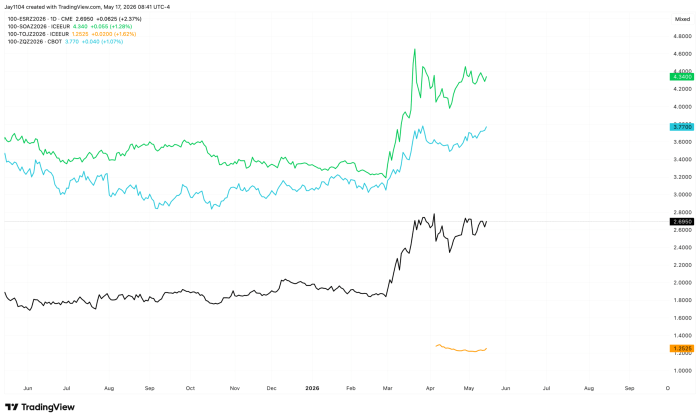
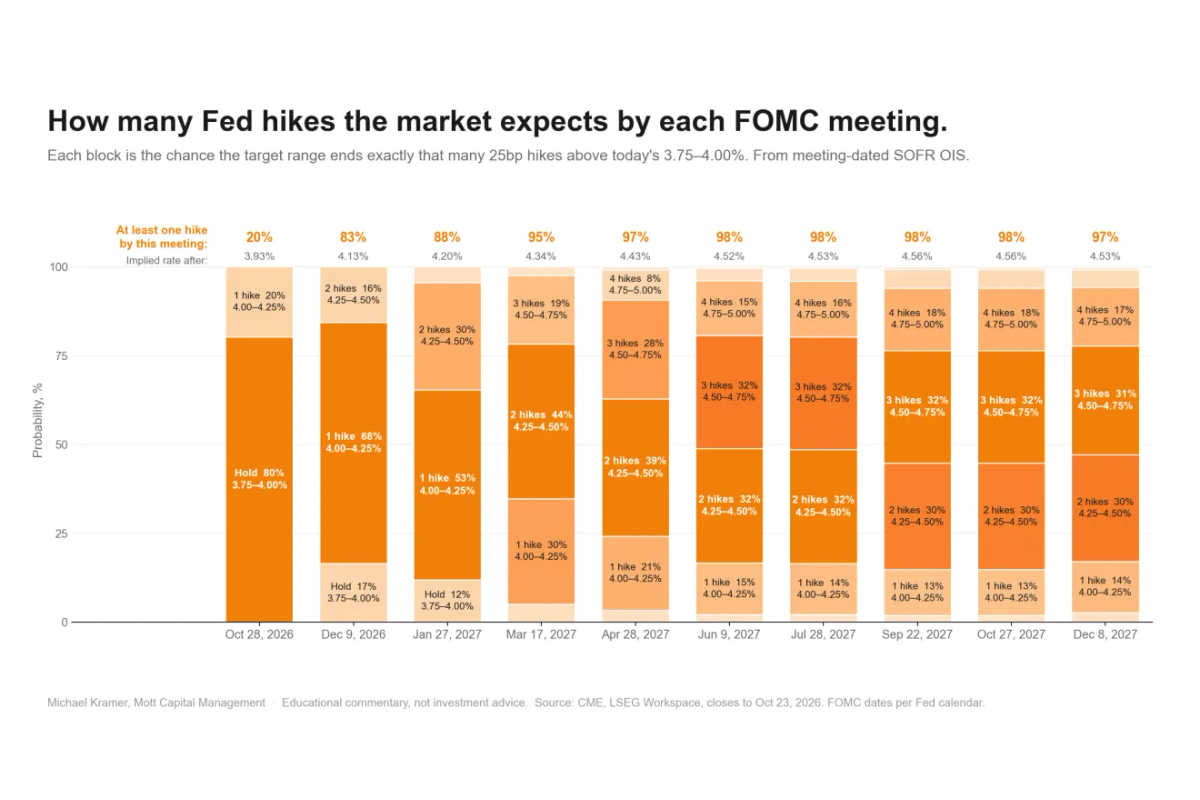
In fact, markets are now pricing in between two and three rate hikes this year from nearly every major central bank outside the US. Meanwhile, at least for now, the market is also pricing in the possibility of a Fed rate hike before year-end.
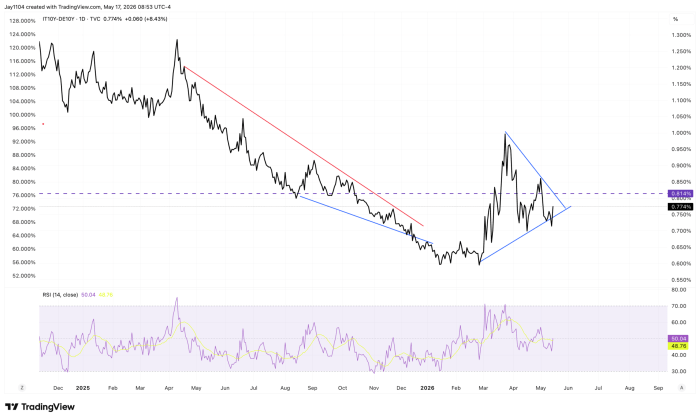
This also caused the spread between Italian and German 10-year yields to widen back to 77 basis points, which remains historically very tight. More importantly, though, the spread has been consolidating for some time and now appears to be nearing a potential breakout of its own. A break out in this would be news for all credit spreads.
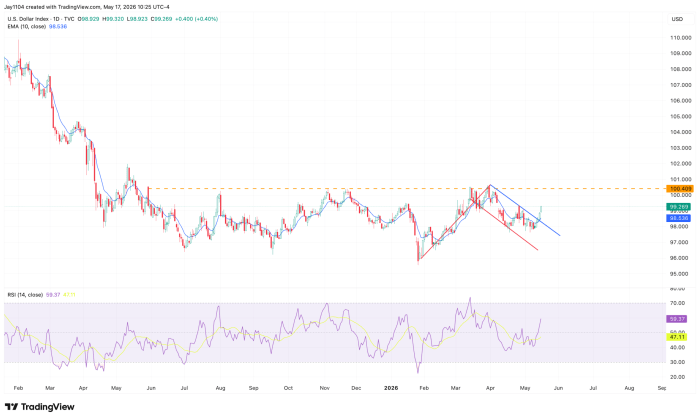
As a result, the dollar broke out of a bull flag on Friday and could now be on its way back toward the 100 to 100.5 range.
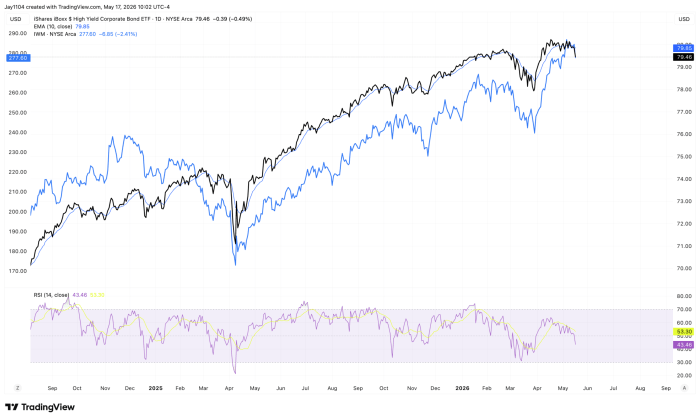
A breakout in credit spreads, or a breakdown in the HYG ETF, would likely be devastating for small-cap stocks and the Russell 2000, as represented by the IWM ETF.
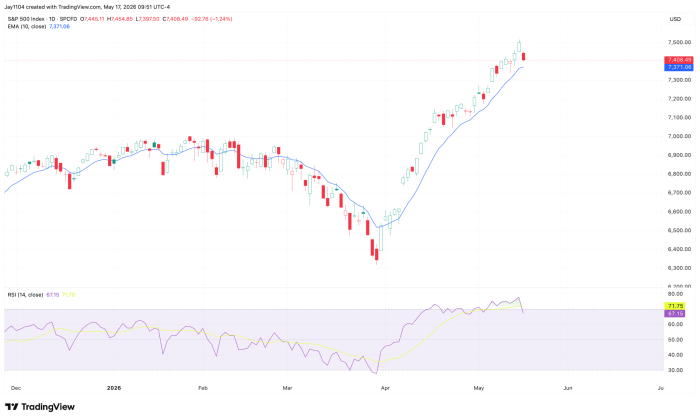
This obviously had a negative impact on the S&P 500, and for now, the key level to watch for a potential change in trend is the 10-day exponential moving average. It served as resistance during the March decline and then acted as support throughout April. As of Friday, that level was around 7,350, and if it breaks and the index remains below it for three to four days, it would suggest a trend change is underway. That would also likely coincide with NVIDIA (NVDA)’s earnings report.
NVIDIA once again finds itself heavily overloaded with call positioning, and unless the stock sees a meaningful pullback ahead of earnings that helps reengage put demand, I think the most likely outcome is another post-earnings sell-off.
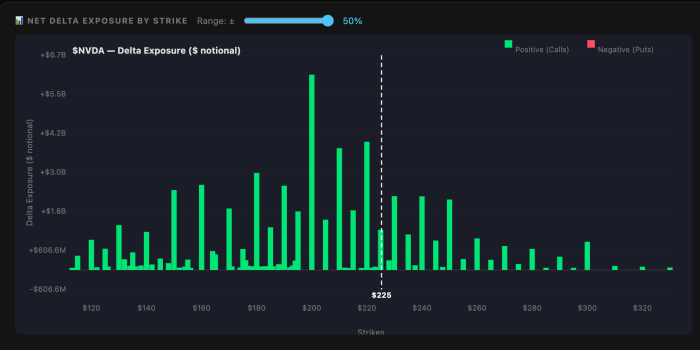
Implied volatility for NVIDIA is currently in the mid-70% range for the May 22 expiration, and I am fairly certain it will be closer to, or even above, 100% by 4 p.m. ET on May 20. That means both calls and puts will become significantly inflated in value ahead of the results, and once earnings are released, implied volatility on those near-dated options will collapse. In turn, that should result in a substantial amount of option premium and delta value across the board being erased.
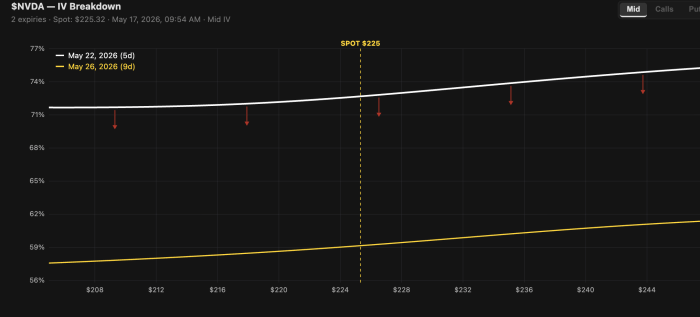
So unless NVIDIA is able to truly blow traders away with its results, the stock likely faces the usual “sell-the-news” reaction, or, as I like to call it, the mechanical unwind.


Comments
Log in or sign up to join the conversation.