

Berlin may be Germany’s innovation powerhouse, but across Europe, the country is still playing catch-up. When it comes to AI, however, it could have much more up its sleeve than its overall innovation performance suggests.
Once we turn from traditional innovation to artificial intelligence, Germany suddenly looks much more competitive.
Germany’s innovation problem runs deep…
Germany’s innovation landscape remains highly fragmented. Berlin tops our national Innovation Index for the 12th consecutive year, followed by Hamburg and Baden-Württemberg, while Thuringia, Mecklenburg-Western Pomerania and Saxony-Anhalt remain at the bottom, held back by demographic pressures, skills shortages and weak business creation.
These regional differences reflect the structural challenges holding back innovation capacity across the country. Consequently, Germany only ranks 16th out of the 21 eurozone countries in our ING Germany Innovation Index for the eurozone, leaving one of Europe’s largest economies in the lower half of the table. Ireland remains the eurozone’s innovation leader, followed by Luxembourg and Estonia, while Bulgaria, Greece and Italy sit at the bottom.
At first sight, Germany's low position in our innovation ranking isn't good news for its economic prospects. However, in the age of AI, inventing new technologies is increasingly becoming a smaller part of the equation. The winners might be those able to adopt, integrate and put AI applications to productive use quickly. And once we turn from traditional innovation to artificial intelligence, Germany suddenly looks much more competitive.
…but on AI, it jumps ahead
Our new ING Germany AI Index, covering research, investment, patents, adoption and ICT skills, puts Germany in sixth place, suggesting the country already has many of the ingredients needed to turn AI’s potential into economic gains.
The countries at the top of our ranking have a clear advantage when it comes to research. Finland recorded more than six high-impact AI publications per capita, while Luxembourg produced more than 10. Germany managed only 3.5. The gap in funding is even larger: relative to GDP, Finland invested around five times as much in AI start-ups as Germany.
But digital talent could matter just as much. The AI race isn't only about developing models; it's also about having enough people who know what to do with them.
Digital talent and AI adoption
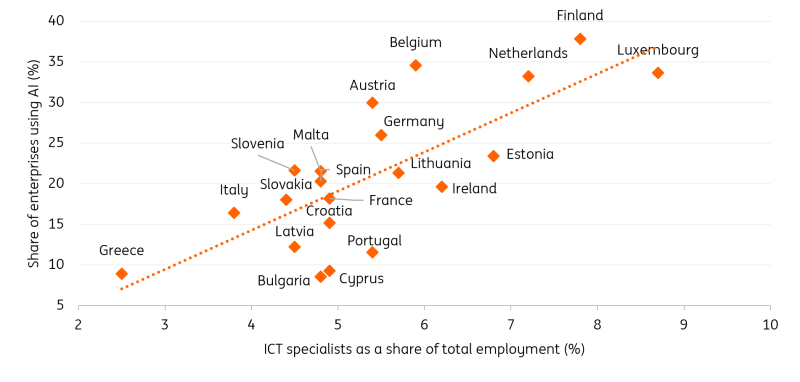
In Germany, more than 5% of employees work in ICT-related jobs and roughly 6% of university graduates complete their studies in an ICT-related field. Around one in four German businesses already uses AI, and Germany is among the leading locations for AI-related patents.
The same pattern emerges elsewhere in Europe. In Luxembourg, Finland and the Netherlands, between 7% and 9% of employees work in ICT-related jobs. At the same time, these countries are among Europe’s frontrunners in AI adoption, with around one in three businesses and one in four individuals already using AI. Greece sits at the other end of the spectrum: its pool of ICT specialists is much smaller, and fewer than one in ten businesses use AI.
Digital talent could be Germany’s AI edge
Germany's comparative strength may lie less in developing its own large AI models and more in applying them across its industrial base and providing the infrastructure to do so. Investment plans are moving in that direction too. The German government plans to at least double data centre capacity by 2030 and quadruple available AI computing capacity. International technology companies, including Nvidia and Amazon, are also investing in German AI computing and cloud infrastructure.
Building innovative capacity takes years, if not decades. But advantages from adopting existing technology can emerge much faster. For Germany, the crucial question is therefore not whether it develops the next big AI model, but whether its companies can turn AI into productivity, growth and competitiveness.
On that measure, Germany may have more up its sleeve than its overall innovation performance suggests.



Comments
Log in or sign up to join the conversation.