

Germany’s housing market has so far proven resilient in the face of rising interest rates and renewed geopolitical tensions. However, beneath the surface, affordability pressures and weakening lending dynamics suggest that this resilience is increasingly being put to the test.
The German housing market has withstood the geopolitical storm, so far
When the war in the Middle East escalated in March and capital market interest rates surged, concerns about yet another housing market downturn quickly resurfaced. However, just-released data on house price developments in the first quarter show that the German housing market has initially weathered the storm.
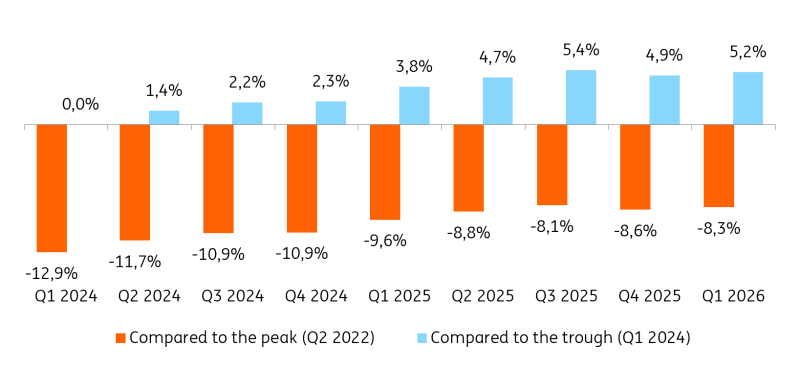
According to the German Statistical Office’s house price index, house prices rose by 0.3% quarter-on-quarter, from a downwardly revised -0.5% QoQ in 4Q 2025. On the year, house prices were up by 1.4% in Q1 2026. With this, house prices are still some 8.3% below the peak reached in 2022, but at the same time they are more than 5% up from the trough reached in 2024.
House prices compared to recent peak and trough levels
Source: German Federal Statistical Office; ING Economic & Financial Analysis
Still, stable house prices do not mean that the housing market is immune to the adverse economic effects of the Middle East war. Instead, the shock has hit a market already under pressure from weak affordability. Capital market, and, consequently, lending rates have been rising since the start of the year, reflecting expectations of higher government debt. At the same time, house prices have continued to increase, while wage growth has slowed.
This combination was already weighing on mortgage lending before the geopolitical escalation. At the start of the year, new residential mortgage lending weakened and has since shown increased volatility. March saw a strong rebound, likely driven by frontloading effects, but new lending declined sharply again in April. Rather than signalling a sustained recovery, recent developments suggest that mortgage demand remains highly sensitive to financing conditions.
In other words, while prices suggest stability, lending developments tell a more fragile story.
Challenging outlook, with structural support in place
Looking ahead, the near-term outlook for Germany’s housing market remains challenging. Higher financing costs, a cooling labour market and lingering pressure on real incomes are all set to dampen demand.
Yet, structural factors continue to provide important support. The gap between housing demand and supply remains pronounced, not least due to a growing construction backlog. Following a brief improvement, the imbalance between building permits and completions widened again last year, underlining the persistent scarcity of housing. At the same time, a gradual economic recovery expected in the second half of the year could provide a modest tailwind.
Ultimately, Germany’s housing market is being pulled in two directions. Structural undersupply and a stabilising economy are providing support, while deteriorating affordability and volatile financing conditions are acting as a drag.
For now, the market continues to hold up. But the balance is becoming increasingly fragile and the resilience seen so far is likely to be tested in the months ahead.


Comments
Log in or sign up to join the conversation.