

The Gen Z gambling epidemic is quietly moving a generation’s money from the market to the house, and the bill comes due later.
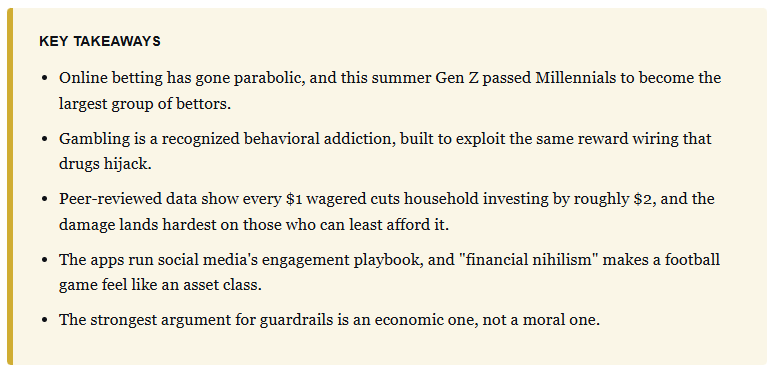
Something changed this summer. Bank of America, which monitors money moving across its customers’ accounts, found that roughly 5% of its customers sent cash to an online betting platform in July, with the number of bettors up 40% since January. The Gen Z gambling epidemic stopped being a headline and became a trend line. First-time bettors in June and July ran more than triple the January pace. And here is the part that should stop every parent and every advisor cold: one in five of these users now calls it “investing.”
The Turning Point Nobody Voted On
By generation, Gen Z and Millennials now make up 88% of online betting activity. Gen X trails at 9%. Boomers barely register. As recently as this spring, Millennials were the bigger group. Then Gen Z passed them, and Bank of America called it a “turning point.” A turning point is the moment when a behavior stops being the domain of early adopters and becomes the default for a whole cohort.
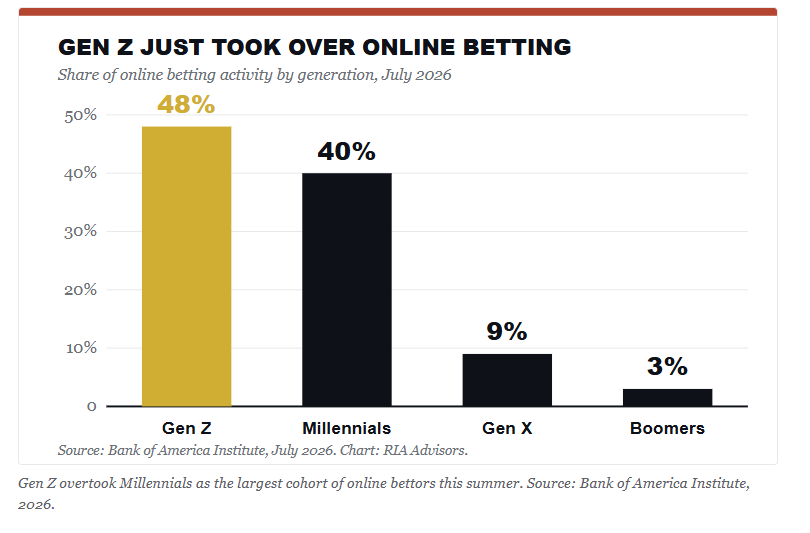
This is not a poverty story. The activity splits almost evenly across income, 37% lower, 34% middle, 29% higher. The data also cuts across everyone. However, what binds the young end together has nothing to do with income. Rather, it is a shared conviction that the old path to wealth is closed, and the “house” wins upstairs anyway. In other words, you may as well play the house down here.
To a generation raised on the “Fed put,” zero-day options, and a community tab, the market is no different than betting on a football game. The sentiment is understandable after years of steadily rising markets. However, Bob Farrell’s Rule #4 also warns that exponential moves run further than you expect before they break. Such isn’t new, and I have written before about the manias this cycle keeps minting.
The Oldest Vice, The Newest App
Put a number on the American toll first. Roughly 2.5 million US adults meet the clinical bar for gambling disorder in a given year, another 5 to 8 million carry milder problems, and about 20 million report at least one warning sign “many times” over the past year. Only around one in ten ever seeks help, one of the lowest rates for any addiction. And only 39% of Americans call gambling addiction “very serious,” against 62% for drugs. We are underrating it in real time.
That’s the modern side. Disapproval of gambling goes way back. In ancient Rome and China, the Jewish Talmud, Islam, and Buddhism, gambling was restricted or condemned. In ancient Egypt, habitual gamblers could be sentenced to hard labor. Even the soldiers at the foot of the cross cast lots for Christ’s garment. Scriptures warn not specifically about dice, but about loving money and seeking shortcuts to wealth.
Even in the Bible, Proverbs puts it plainly that “wealth from get-rich-quick schemes quickly disappears.” Turn to Islam, and it names the thing “maysir” and calls it Satan’s handiwork. The Jewish faith, in the Talmud, waives off the dice player as a witness, on the grounds that a man who profits only when another loses, adds nothing.
Puritan Massachusetts banned gambling, and Benjamin Rush, a prominent Founding Father and signer of the Declaration of Independence, warned that gambling led to “poverty and wretchedness.”
Think about this for a moment, objectively. Every society and religion throughout history that has thought deeply about money has come to the same conclusion: rewards not tied to work, “gambling,” can harm both individuals and the community.
While you may want to dismiss the historical and religious precedents, modern research also supports these old instincts. Modern research keeps proving the old instinct right. A birth cohort followed to age 45 found that disordered gambling predicted worse financial and occupational outcomes decades later. Register studies find mortality and suicide increased sharply. Most who bet never reach that point, and most who wobble recover. For the subset who do not, the damage compounds like negative interest.
Why The Machine Is Built To Win
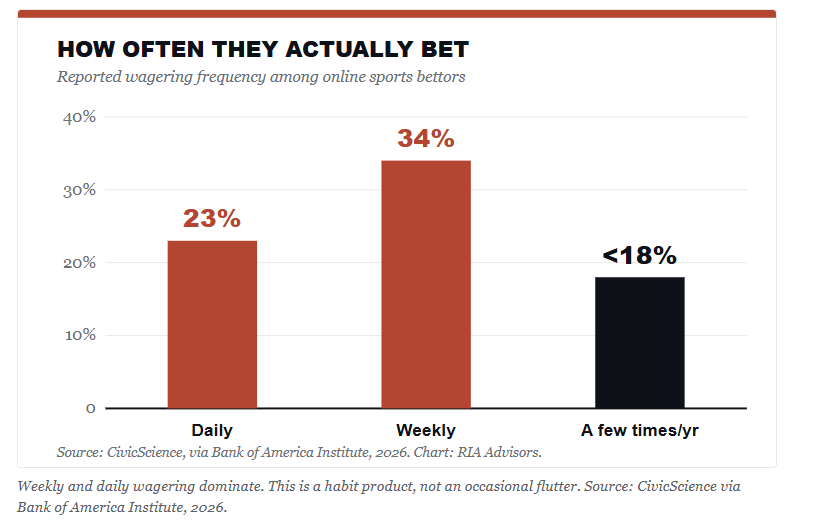
Okay, let’s tackle this topic more directly. Let’s start with how often people bet, because it tells you what kind of product this is. One-third of respondents stated that they place wagers weekly. Nearly a quarter bet daily. Fewer than one in five are the once-a-year “Super Bowl” crowd. That is the engagement profile of a social app, not a lottery ticket
Interestingly, in 2013, the American Psychiatric Association did something quietly radical. It moved gambling out of the “impulse-control” bin and set it beside alcohol and cocaine, the first behavioral addiction medicine formally recognized. The brain does not care much whether dopamine comes from a substance or a screen, and the same ventral striatum lights up on a bet as on a drug.
Here is where things get more interesting when it comes to the psychological impacts of gambling. The “near-miss,” like on a slot machine when you get two cherries and a lemon, pays out zero. However, that loss still fires the same reward circuit as a real jackpot. That’s how a “slot machine” keeps you glued to your seat. Add the “illusion of control,” the sense that studying the roster buys you an edge, and the product is tuned to your neurology. Such is the design of the parlay. The bet with the worst odds for you carries the fattest margin for the house, and the app pushes it hardest.
Will most people who bet spiral into addiction? No. But the ones who develop it are NOT a rounding error. Gambling disorder carries the highest suicide rate of any addiction, and roughly one in five who develop it attempt to take their own life. That is the tail this product drags behind it.
Every Dollar Bet Is A Dollar Not Invested
The delivery system of gambling has already rewired how young people spend their attention. An increasing multitude of app developers have figured out how to deliver the “addiction.” They ping you with “bonus bets” and “no-sweat” promos, assign “VIP hosts” to the heaviest users, and fold the odds into the broadcast so the line is on screen before kickoff. Then the athletes and influencers close the loop on your social media feed, which is the growth engine pointed at your bank account.
Underneath all of this sits the story usually called “financial nihilism.” An increasingly large share of Gen Z feels priced out of the old path, and the surveys are stark. For example, Northwestern Mutual found that 73% of Americans who feel behind think speculative bets will get them there faster than saving. However, among Gen Z, that number climbs to nearly 80%. Notably, young adults now post the worst consumer sentiment of any age group.
It isn’t surprising that when the ladder looks this broken, a “swing for the fences” looks like rational behavior. But it is a carefully crafted illusion through social media, fueled by access, margin, and an engineered gambling mentality, which does more of the work than mood does. Yes, the hopelessness is certainly real because social media has fed you that narrative. However, it is the match, not the fuel.
This is where I get the most interesting pushback.
“It is my money, and it is just entertainment.”
Fair enough, on the entertainment. Here is the problem with the money. The best study we have, now in the Journal of Financial Economics, tracked household accounts through legalization and found that betting does not come out of the movie budget. It comes out of savings. Every dollar wagered cuts the net investment by roughly two dollars. Brokerage deposits fell by 14% across all bettor households and by 56% among frequent ones.
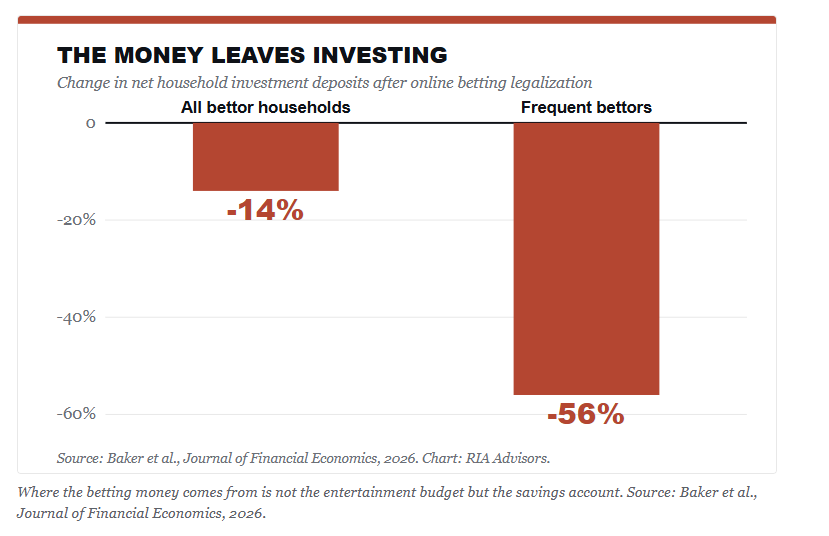
Furthermore, it is the balance sheet that gets worse on the other side. A separate UCLA study found that where online betting arrived, credit scores fell, debt in collections rose, and bankruptcies climbed. Less went into the savings account. MORE went to the collections agency. Howard Marks likes to say that risk means more things can happen than will happen. The crowd treating a bet like an “asset class” has it backward.
“In investing, the base case compounds in your favor. At the sportsbook, it grinds you down.“
Then there is the win rate, which the industry would rather you not run. At standard pricing, you have to hit 52.4% of your bets simply to break even, and only about 3% of sports bettors clear that bar over the long haul. Roughly 95% lose money over time. Ask them, though, and a third will insist they come out ahead. The gap between what bettors believe and what the math pays is the entire business model.

How To Know If You Are The Product
So, how do you tell when the line has moved from fun to problem? Clinicians use a screen so short it fits in a sentence. The “Lie/Bet” tool has two questions.
Have you needed to bet more and more to feel the same?
Have you lied to people close to you about how much you bet?
A yes to either is reason enough to look harder.
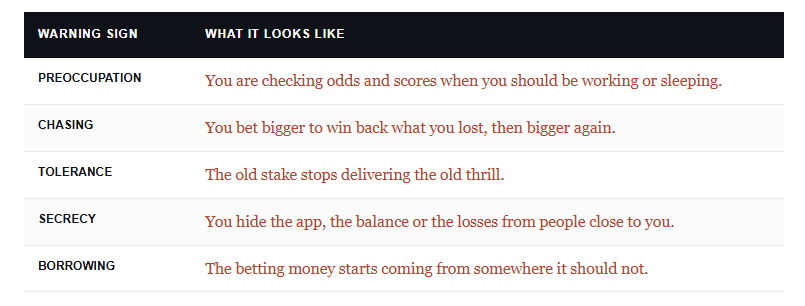
Now run the same checklist one screen over, in the brokerage account. This is the “oh it’s investing” delusion in practice. If your “investing” looks like the column below, it has quietly turned into betting.
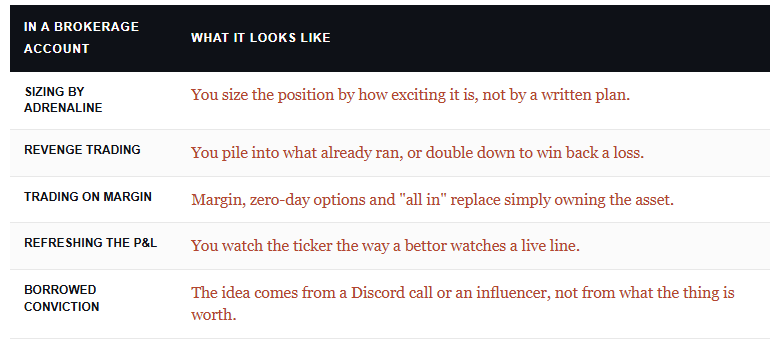
If a few of those land, the good news is that this responds to treatment better than most people expect. The steps are unglamorous, and they work.
Delete the apps.
Turn on self-exclusion, which every legal state offers, and
Set deposit blocks with your bank.
Add blocking software if the pull is strong.
Unfortunately, those steps are easy. The hard part comes next.
You have to get a human involved. Every piece of research on recovery makes it clear that isolation lets the behavior grow in the dark, while connection is the one thing that reliably starves it. Cognitive behavioral therapy targets the exact distortions the machine installs, and Gamblers Anonymous has run the twelve-step version for decades.
One number is worth saving before you need it. The National Problem Gambling Helpline, 1-800-GAMBLER, is free and runs by call, text, or chat. If the darker thoughts I mentioned earlier are in the room, call or text 988. Secrecy is the oxygen here, so the most useful move is to say it out loud to one person who will not flinch. Such is the nature of this addiction. It thrives in silence.
The Case For Guardrails Is Economic, Not Moral
I am generally skeptical that Washington can solve problems it helped create, so let me make the case that persuades me. It is an economic one. To wit, from Keynes in 1936:
“When the capital development of a country becomes a by-product of the activities of a casino, the job is likely to be ill-done.”
Three points carry the argument. First, the losses are not only private. Problem gambling loads costs onto everyone else through treatment, lost productivity, bankruptcy, and family breakdown, none of which the operator that booked the wager ever pays. Economists call that a negative externality, the textbook reason to regulate a product. Second, the industry’s revenue leans on its most damaged users. The highest-margin product, the parlay, is the one built on the “near-miss.” A business whose economics depend on the people it harms most is a market failure, not a free market.
Third, the money the young feed into this is the money that builds a retirement. A generation that saves less and owes more becomes a future claim on the safety net, and their sportsbook losses become everyone’s problem eventually.
We do need to acknowledge the industry’s view. Legal gambling books pulled wagering away from offshore bookies that funded criminal organizations. They also fund state budgets and carry consumer protections that the black market never offered. Furthermore, the American Gaming Association calls federal rules an overreach, and when it comes to jobs and tax receipts, they do have a valid point.
However, here is where those arguments quickly run out of road. The displacement of the illegal betting market was meant to reduce harm, not expand the customer base. Unfortunately, what we are now seeing in both the data and the number of online applications in the marketplace is a rapidly growing customer base.
Yes, there are active measures being taken, like the “SAFE Bet Act,” that would potentially set floors on advertising, require affordability checks, and stop the AI targeting that hunts the most vulnerable. For example, Britain has already taken steps to cap stakes and pare back on “bonus” inducements.
Those are certainly a start, but they don’t stop a soul from betting. They just stop the machine from being tuned to the people least able to walk away. Of course, that is the whole point of a guardrail: it does not close the road; it just keeps you from going off the cliff. However, if you hit the guardrail, it will damage your car, potentially beyond repair.
What concerns me is that this generation is enrolling in a freshman class that learns the hard way that the “house always wins.” That lesson will be taught one parlay at a time, and if access keeps expanding and no one builds a guardrail, the best growth investment left in the country may turn out to be a chain of Gamblers Anonymous meeting halls.
And football season is just getting underway.
Sources & Notes
Bank of America Institute and BofA Global Research analysis of online betting adoption, September 2026, drawn from the report provided. July figures reflect BofA customer transaction data and a cited CivicScience survey, and trace to a single research note not independently confirmed.
American Psychiatric Association, DSM-5 (2013), reclassifying gambling disorder as the first behavioral addiction.
Clark et al., “Gambling Near-Misses Enhance Motivation to Gamble,” Neuron (2009); Murch and Clark, “Games in the Brain,” The Neuroscientist (2016).
National Council on Problem Gambling; Lancet Regional Health Europe, Norwegian registry cohort (2024), on gambling-related suicide risk.
Baker, Balthrop, Johnson, Kotter and Pisciotta, “Gambling Away Stability: Sports Betting’s Impact on Vulnerable Households,” NBER Working Paper 33108 and Journal of Financial Economics (2026).
Hollenbeck, Larsen and Proserpio, “The Financial Consequences of Legalized Sports Gambling,” UCLA Anderson (2024, revised 2025). Bankruptcy-risk estimates range from roughly 10% to 25 to 30% across paper versions, and the conservative online-access figures are used above.
Win rate: break-even at standard -110 odds requires a 52.4% success rate; industry analyses estimate only 1 to 3% of sports bettors are profitable long term, with roughly 95% losing money over time, while a Siena College Research Institute poll found about a third self-report winning more than they lose.
Kyla Scanlon, “Why My Generation Is Turning to Financial Nihilism,” Wall Street Journal (2025); term coined by Demetri Kofinas (2020); Northwestern Mutual Planning and Progress Study (2026); University of Michigan consumer sentiment. See also “Financial Nihilism and the Trap Young Investors Are Walking Into,” RealInvestmentAdvice.com.
SAFE Bet Act (Rep. Tonko and Sen. Blumenthal); UK Gambling Commission reforms, including online slot stake limits and restrictions on bonus and VIP inducements.
J.M. Keynes, The General Theory of Employment, Interest and Money (1936).
National Council on Problem Gambling, NGAGE 3.0 survey (2024), for US prevalence, attitudes and help-seeking; treatment-seeking is estimated near one in ten.
Britannica, “Gambling: History,” on curtailment in ancient Rome, China, the Talmud, Islam and Buddhism, the Egyptian quarry penalty, and the casting of lots for Christ’s garment; Quran 5:90 on maysir; Talmud, Sanhedrin 24b, on gamblers as witnesses; Proverbs 13:11; Benjamin Rush, via “History of Gambling in the United States.”
Dunedin Multidisciplinary Health and Development Study, disordered gambling followed to age 45 (2023); nationwide register study on gambling disorder, elevated mortality and suicide (2018).
Help is available. The National Problem Gambling Helpline, 1-800-GAMBLER, is free and confidential by call, text or chat. In a crisis, call or text 988.

Comments
Log in or sign up to join the conversation.