


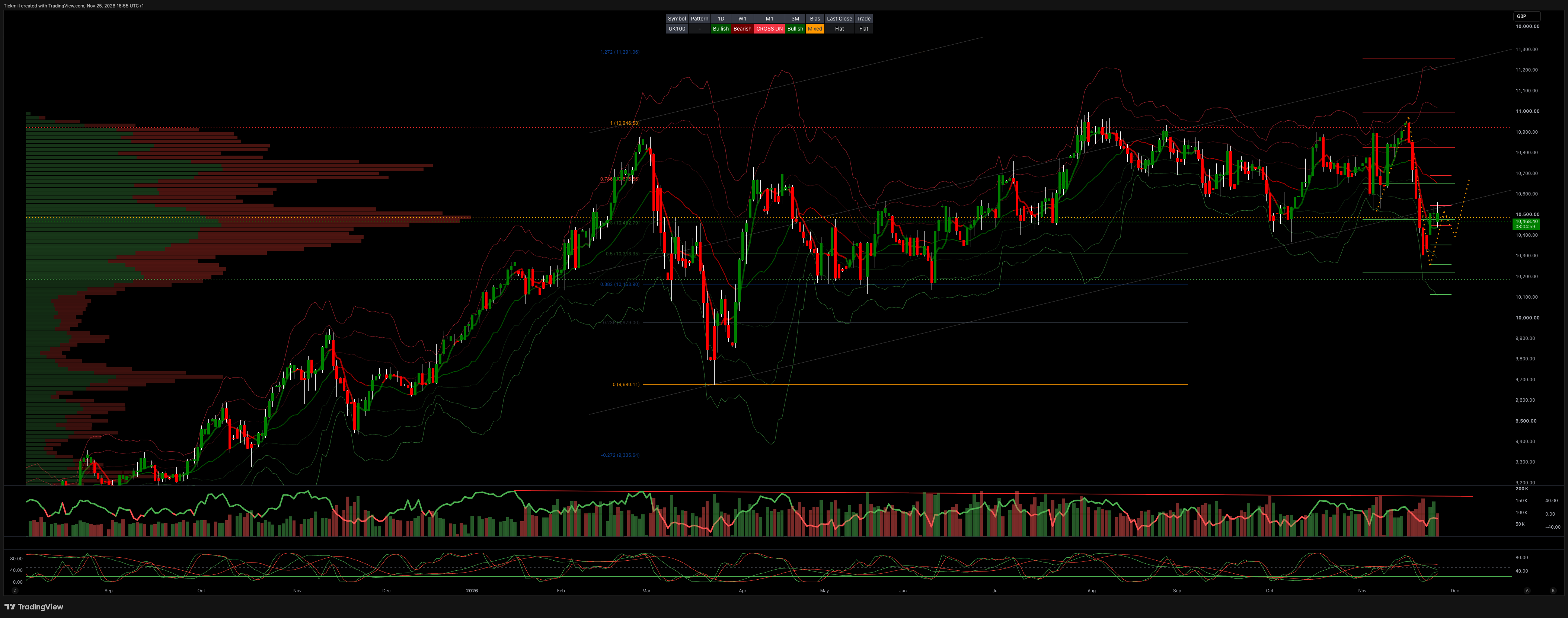
London's benchmark FTSE 100 demonstrated notable relative resilience on Wednesday, oscillating tightly around the flatline in the 10,450–10,475 range after pairing an early morning push toward an intraday high of 10,545.01. Following Tuesday’s close at 10,467.07 (-0.13%), London's blue-chip index significantly outperformed global and European peers as Wall Street suffered a sharp technology-led sell-off. While hotter-than-expected U.S. inflation data, fresh tariff threats, and fading artificial intelligence momentum weighed heavily on broader risk appetite, the FTSE 100's heavy weighting in defensive consumer staples and limited direct tech exposure provided steady insulation.
Defensive consumer staples, tobacco, and select retail counters spearheaded top-flight risers as investors rotated away from growth-sensitive assets. Imperial Brands, British American Tobacco, Unilever, Reckitt Benckiser, Burberry Group, 3i Group, Diageo, and Kingfisher all advanced firmly on the session. Outside the main benchmark on the FTSE 250—which underperformed the top flight—specialty retailer Pets at Home rallied strongly after delivering solid first-half results and guiding full-year earnings toward the top end of market expectations, while online grocer Ocado traded weaker.
Conversely, competitive disruption headlines, softer commodities, and broader tech caution pressured key blue chips. Online automotive marketplace AutoTrader Group came under heavy pressure after Amazon (AMZN) announced plans to launch Amazon Autos in the U.K. in early 2027—marking its first expansion outside the United States—with Hyundai as an initial launch partner alongside used inventory from dealership group Vertu Motors. Notable downside moves also weighed on Computacenter, Standard Chartered, Rolls-Royce Holdings, Lion Finance, Metlen Energy & Metals, The Sage Group, and BT Group (BT.A). Meanwhile, softer spot gold and silver prices kept precious and industrial miners subdued, alongside lagging performance across select banks and industrials.
Global macroeconomic and geopolitical cross-currents dominated afternoon trading desks. In the United States, October Personal Consumption Expenditures (PCE) inflation—the Federal Reserve’s preferred price gauge—came in hotter than anticipated, with headline PCE rising 0.3% month-on-month and accelerating to 3.8% year-on-year (up from 3.6%), while core PCE climbed 0.3% monthly and 3.3% annually (up from 3.1% and above the ~3.2% consensus). Released alongside preliminary U.S. GDP figures, the sticky inflation print reinforced market pricing for a 25-basis-point Fed rate hike in December and kept the door open for further tightening into early 2027, pushing equities, gold, and silver lower post-release. Compounding market caution, renewed U.S. tariff threats targeting roughly 16 trading partners—including China, the EU, and Japan with potential 10% to 15% levies—dampened global trade sentiment alongside fading post-reinstatement momentum in Nvidia (NVDA) and broader scrutiny over hyperscaler AI capital expenditure.
On the domestic corporate and consumer front, airline operator EasyJet reported weaker annual profits amid ongoing Middle East airspace and operational disruptions, while households braced for a widely anticipated ~26% increase in the U.K. energy price cap set to take effect in January. In foreign exchange and energy markets, sterling softened slightly against a firmer U.S. dollar, while crude oil prices drifted modestly lower.
Finish Line: U.K. equities weathered a punishing global tech and inflation storm by leaning on defensive staples and tobacco heavyweights, keeping the FTSE 100 anchored near the 10,450–10,475 zone even as U.S. indexes rolled over. While hot U.S. core PCE figures, tariff uncertainty, and Amazon’s entry into U.K. auto retail capped upside momentum, London's value-oriented composition continues to buffer the benchmark against global growth-stock volatility.



Comments
Log in or sign up to join the conversation.