

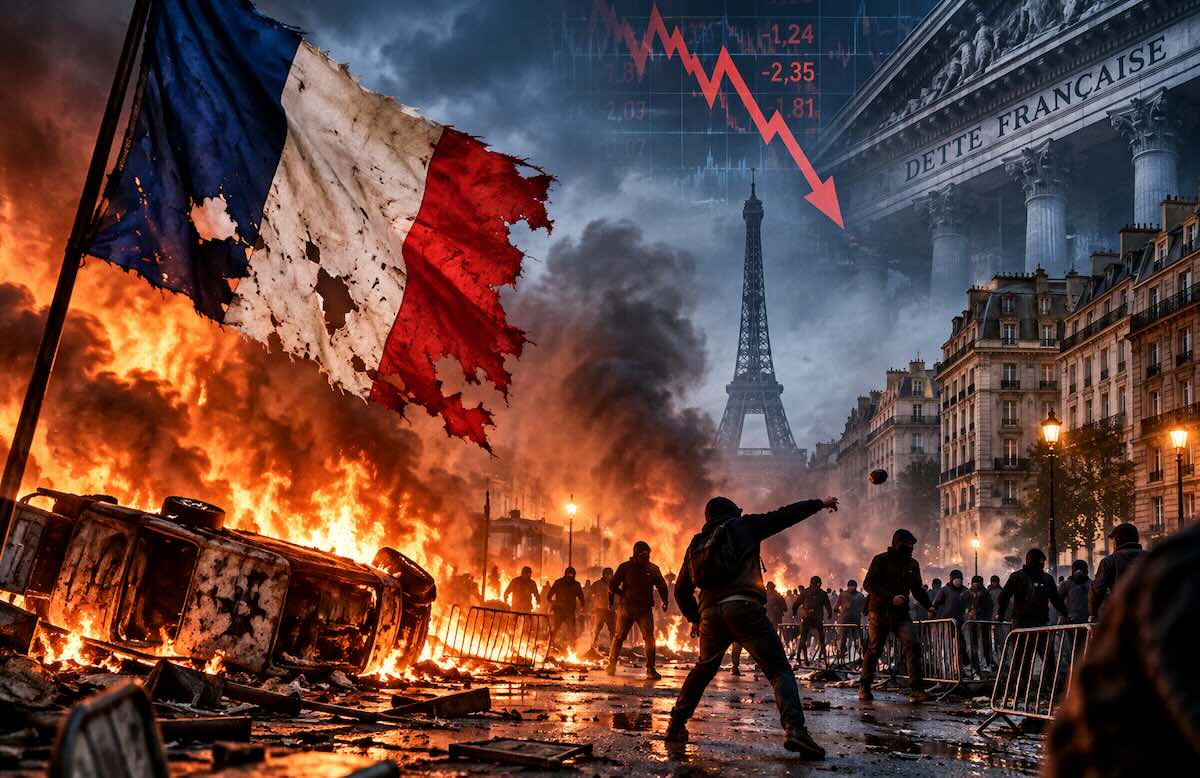
As if the ongoing deterioration of public finances weren’t enough, as if the political deadlock in a National Assembly divided into three irreconcilable blocs weren’t enough, France is now sinking into anarchy.
The riots on October 17 broke all records: reports speak of 3,000 vandalized stores, devastated streets, the Limoges city hall set ablaze, and nearly 1,000 police officers and gendarmes injured.
These images of destruction and attacks on shopkeepers have been seen around the world. And it’s not over yet: several small groups are announcing “Act 2” for Saturday, October 24. The day before, the rating agency Moody’s will have announced its decision on France’s credit rating. Here are two timelines converging, much to the detriment of the French economy.
The result: there was a massive sell-off of French bonds following the weekend of riots, borrowing rates skyrocketed, and market mistrust reached a level not seen since 2012, as reported by BFMTV. Many investors are dumping French debt, and the spread between France and Germany has widened to 150 basis points. However, as we noted in our previous article, at 200 basis points, “governments tend to resign. It’s a sort of vote of no confidence by the bond markets.”
Beyond the financial markets, the real economy also risks being hit hard: these riots will weigh on business activity. Carrefour’s CEO anticipates an impact of €200 million (Le Figaro). The group is even revising its outlook: “Citing a decline in foot traffic, reduced operating hours due to curfews, and higher operating costs related to security and logistics in France, the group says it is targeting a slight decline in net free cash flow in 2026, whereas this metric was previously expected to show ‘slight growth’ for the fiscal year. ” (BFM Bourse). Affected retailers will suffer heavy losses in business, while those spared risk seeing their customers desert them if the riots continue.
Tourism will also be affected, as will all the jobs that depend on it. The real estate market is also likely to suffer. In fact, 10 to 20% of purchases in Paris’s upscale districts are made by foreigners. They are the ones driving prices, so if they start selling… Admittedly, the real estate market did not collapse during the Yellow Vests protests, but at that time, there was no debt crisis. “The markets no longer give France the benefit of the doubt that they still granted it in 2018 during the Yellow Vests crisis,” explains an asset manager (Le Figaro). Crisis follows crisis, mistrust is growing, and collapse looms.
In a civil war, real estate is worthless, and with repeated riots, it’s not worth much. No, it’s not a safe-haven asset, because you can’t pack your apartment into a suitcase—unlike physical gold, which can even be stored securely in Switzerland. Bitcoin is also highly portable, but Ledger keys resold in Asia by an authorized provider were compromised: a malicious device allowed the recovery phrases to be transmitted, leading to the theft of $90 million. With cryptocurrencies, one must exercise a level of caution that borders on paranoia.
Indeed, security, in all its forms, is becoming an increasingly valuable asset.



Comments
Log in or sign up to join the conversation.