

All the combatants in the war between Iran and the U.S./Israel have been filling news feeds with a variety of dubious claims and threats, and the markets have been oscillating based on hopes and fears. Since the situation now is quite murky, it is difficult to give predictions about the evolution in the war. Nevertheless, the disruption to energy and related commodity production has already been large enough that we know that there is going to be an economic effect. This article outlines the predictable debates.
The Debates
Will there be recession(s) in specified parts of the globe?
What will be the near-run peak in the inflation rate?
How persistent will the rise in inflation be (i.e., will the rise in inflation be transitory?).
What will central banks do with policy rates (or, what should they do)?
1) Recession
I think it is safe to say that at least some countries will have a recession courtesy of just the shock that we have experienced up to the time of writing. The question is how far the recessionary conditions spread.
I believe that the key concern is the length of hostilities — there might be a sigh of relief once the shooting stops, even though an oil price shock is somewhat baked in at this point. I originally had a bias towards the situation being bad enough for both sides that a quick ceasefire was possible, but that increasingly looks to have been an under-estimate of the anger of the Iranian regime.
Since I am not attempting to be a forecaster, I do not have an “official recession call,” but I think it would be unsurprising if there is a synchronised global recession if hostilities do not end quickly.
2) Inflation Peak
When I was working in finance, I generally did not pay too much attention to near-term inflation data, on the basis that core inflation was basically static during the 1990-2020 period. What mattered were measures of capacity utilisation, which tended to tighten in an expansion. This is what normally mattered for medium-term rates positioning, although one had to watch out for rapid reversals during crises.
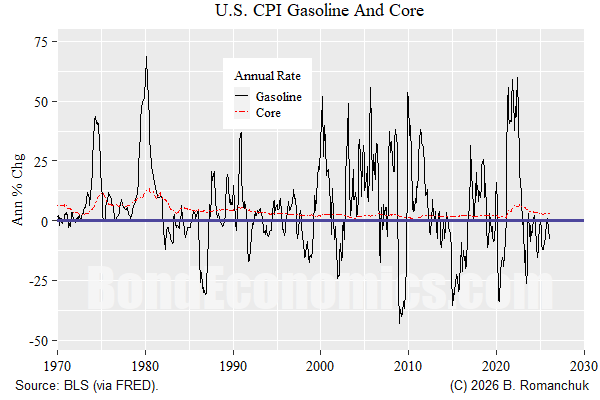
The chart above is arguably silly, but it provides a good hint as to why analysts can hope to make short-term inflation calls if energy prices are mobile. It shows the (urban) gasoline component of the U.S. CPI versus core (CPI less food and energy). When an oil price spike hits, the rate of change on gasoline dwarfs that of the rest of the CPI. Most other consumer prices in the developed countries are mediated via middle-men and retailers (the main non-energy exception being fresh whole foods), and so prices incorporate profit margins and wage and other costs, and those other costs tend to be slower-moving. (Gasoline prices are the most volatile in the U.S. versus most other countries as those other countries generally have hefty taxes imposed on gasoline that are often not proportional to the commodity prices). The unusual level of transparency of gasoline prices — no other prices are always prominently displayed outside vendors — means that prices tend to track refinery output.
Although the weighting of gasoline prices in the CPI is not that large (2.9% for gasoline alone, one can then add in more energy categories), the volatility differential means that short-term headline inflation volatility is dominated by energy costs. This means that an analyst can line up energy price projections and near-run headline inflation forecasts during a spike. However, it is extremely difficult for oil prices to sustain annual price changes of more than 50% for very long, and so energy-centric analysis is mainly going to tell us about peak inflation rates.
3) Inflation Persistence
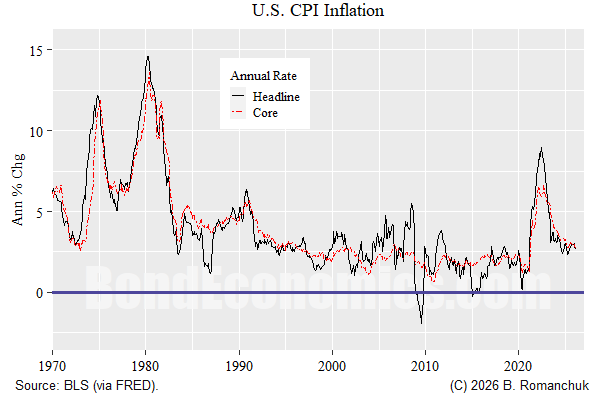
One of the main points of wrangling after the pandemic was whether inflation would be “transitory.” This debate is going to repeat once energy prices make their way into inflation data, and the second-order effects hit. It is entirely reasonable to expect that there will be second-order effects of the supply disruption for a couple of years.
The figure above shows headline and core inflation for the United States from 1970 to the present. (Other countries had similar experiences, albeit with inflation rates with different scaling factors versus the U.S.). I want to draw a comparison between the 1970s and later decades. The 1970s had inflation cycles with successively higher peaks and troughs, which were reversed in the 1980s to early 1990s.
I took a strong definition of whether inflation would be “transitory”: would the post-pandemic inflation spike require traumatic recessions (and extremely high interest rates) to reverse, like the 1970s? I would argue that it did not, although Trump II could result in inflation outcomes that start to echo the 1970s “higher peaks” experience. However, there is a difference between now and the 1970s: the current inflation spikes are the result of extremely erratic decisions of one man, while in the 1970s, inflationary psychology was embedded in almost all the industrial democracies (even Switzerland had higher inflation).
However, the people who claimed victory in the “transitory debate” took a much weaker definition — would central banks hike rates in response to inflation? They did, but the question is whether that was too weak a definition.
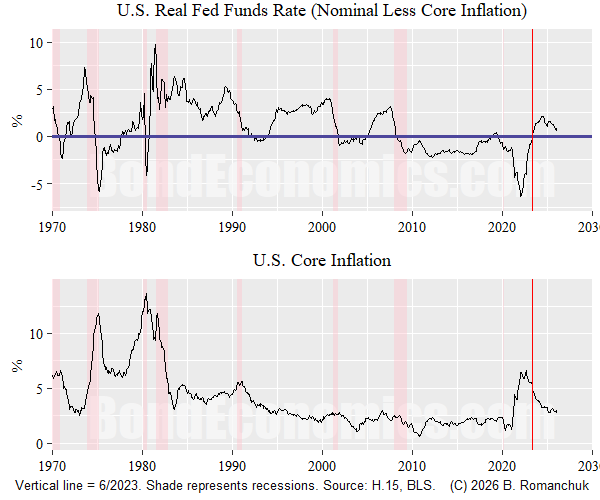
If we look at the above figure, we see that the “real Fed Funds rate” (the nominal Fed Funds rate less core CPI) only became positive in June 2023. This was after the inflation peak. There was also no recession. This was not what many of the more hawkish commentators predicted — they only expected inflation to turn around after the real Fed Funds rate was 2% or so. This is not that minor a complaint — would it really matter if the Fed had hiked the policy rate by 0.25%? (Conversely, people could argue that what mattered was term interest rates and expectations, which rose before the real Fed Funds rate was positive. Alternatively, one can say that the real Fed Funds rate is irrelevant — a stance I agree with, but calls into question neoclassical theory.
The slipperiness of the definition of “transitory” is why one would need to be careful in stating what one means when discussing it.
My bias is that inflation should be transitory by my stronger definition, but this outlook is crashing into the policies that are emanating from the White House, which all tend to push inflation rates higher. The Supreme Court shutting down Trump’s “social media tariffs” helped, but they are pushing for tariffs using more convoluted articles. The USMCA trade deal is due to be renegotiated in 2026, and ill-will between Canada and the United States generated by President Trump could possibly lead to the agreement going down in flames (although punting to 2027 seems likely). Outside the United States, it is less clear that there will be as many pro-inflation policies enacted.
4) Policy Rates
The direction of the policy rate is of utmost importance for rates markets. If we had a situation where inflation rises due to energy prices were the only thing happening, I think it would be safe to expect to central banks to hike rates. Their tolerance of “looking through” an oil price spike is likely to be much lower than in other post-1990 cycles due to the post-pandemic inflation misses.
Unfortunately, it seems unlikely that inflation data are the only thing to move. If the energy supply disruption persists, global activity must drop — we need energy for the industrial economy. (In the long run, there can be a divergence between energy consumption and GDP, but short-term interruptions will dwarf long-term drifts in the mix of activity.) If there is a recession with a spike in unemployment, forward-looking measures of supply constraints will point towards inflation. Central banks are stuck between ugly current inflation data versus dismal forward projections (which was a core issue in the 1970s that inflation hawks largely skim over).
Pre-pandemic, my bet would be for central banks that are not the ECB to “look through” the energy price spike, but that appears less likely this time. However, I doubt that we would get rate hike campaigns to get the real policy rate to +2% that the inflation nutters will demand.
There is also the “do central banks have the policy rate backwards?” debate between Modern Monetary Theory and the conventional wisdom, which I am skipping over. I discuss it in my books.



Comments
Log in or sign up to join the conversation.