

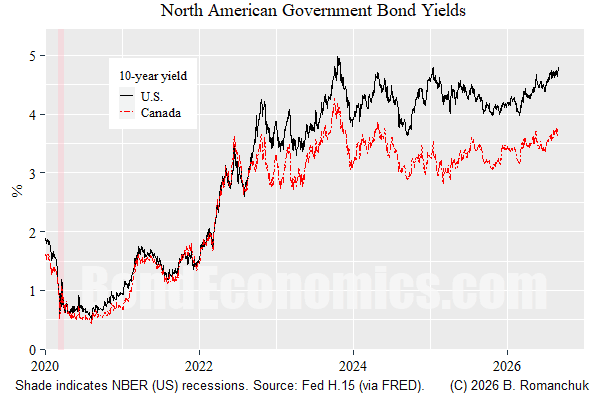
One of the points that is coming up in my news flow is the simultaneous rise in bond yields. This was of particular interest for the United Kingdom, where the chattering classes get deeply excited by rising gilt yields. I looked around at my data sources, and the above chart was somewhat interesting.
It shows American and Canadian 10-year government yields since 2020, which was when they were driven down in the pandemic panic. The yields were glued together until 2023 or so, when a divergence has opened up.
The interesting thing to long-time Canadian market watchers is that the U.S. yields are higher. This is not that novel — Canadian yields were lower in the 2010s as well (although I chopped that part of the history off so we can see recent moves). However, if we go back further, Canadian yields were persistently higher than American ones. This led to silliness like modelling the 10-year GCAN as a spread to U.S. Treasuries.
In a gold standard, senior countries will generally borrow at the lowest rates in the system. With fixed currency parities, the fair value spread between government bonds is zero, so the spread between them would reflect liquidity and credit/devaluation risk premia. (In the gold standard world, a devaluation is a form of default.) Modelling Canadian bonds as a spread to Treasurys would make sense in a gold standard system.(The historical experience might not align to this, as the Canadian dollar floated for most of the World War II era, and earlier, the British Pound would have been considered the “senior currency” for countries in the Commonwealth.)
That logic breaks down when currencies float. The fair value in each country is the expected value of the path of the overnight rate. So a country will have a positive spread over another if its expected path of nominal overnight interest rates is higher.
Up until a certain someone started swinging the tariff axe (and renaming bodies of water, threatening invasion, etc.), the Canadian and American economies were highly integrated and it made sense that the Bank of Canada would tend to shadow what the Fed is doing. What we started to see in the 2010s was that the Bank of Canada could keep its policy rate lower than the Fed while keeping the inflation rate on target.
This does not necessarily match market dogma, where people argue that Canada would need to keep interest rates higher because the U.S. dollar is a reserve currency, or whatever. The problem with international-led analyses like that is that international flows into fixed income are a pipsqueak facing off against the 200 kilogram gorilla that is the domestic housing market, which is far more interest-rate sensitive than international unhedged capital flows (which are dominated by equities).
The recent divergence is not really that surprising, and does not really reflect Canadian virtue or other pop psychological/political explanation one can come up with. (The British press loves such explanations.) Although the White House is hammering away on every “let’s raise prices!” button it can reach is obviously negative factor for U.S. bond prices, the tariff shocks on the Canadian economy darkens the growth outlook, which is supportive of bond prices. As such, the divergence is not surprising. It is unclear when the economic outlooks will re-converge.



Comments
Log in or sign up to join the conversation.