

Yet another stronger-than-expected US jobs number in an environment of rising inflation is fuelling expectations of a Fed rate hike before the end of the year. Nonetheless, there is a lack of breadth in job creation and wage growth is slowing, meaning household finances are coming under increasing pressure.
Payrolls boosted by the usual 'big 3'
The May jobs report is strong, with non-farm payrolls rising 172k versus the 88k consensus expectation, plus there were 93k upward revisions to the past two months’ data. Private payrolls are up 120k versus 89k expected, while government added 52k. Meanwhile, the unemployment rate remained at 4.3% and wage growth slowed to 3.4% from 3.6%.
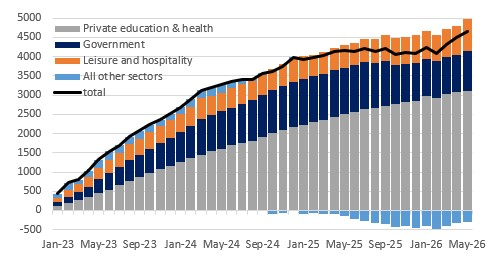
The breakdown shows that it is the usual three sectors of leisure & hospitality (+70k), government (+52k) and private education and healthcare services (+40K) that are generating the gains. That means every other sector of the US added just 10k jobs in total. The chart below shows that these 'big 3' sectors have accounted for every single one of the jobs added since December 2022. All other sectors – manufacturing, technology, energy, retail, transport and logistics, financial services, business services, etc, have lost jobs on balance over the past 3 and a bit years. So, while this is a very good report at the headline level, the lack of breadth to the job creation story remains an important theme.
Cumulative job creation since December 2022 (000s)
Fed hike expectations build, but there is a long way to go
It is possible that the remarkably strong leisure & hospitality number was boosted by the World Cup that starts next week, but it feels a little early. Moreover, the 51k rise in local and state government looks a little too strong in the current environment. The elephant in the room is why is the official jobs data are so strong when business surveys, such as the ISM reports, indicate falling employment while the Challenger Report from earlier in the week continued to point to net losses and the daily vacancy numbers from Indeed continue to grind lower?
The household survey, which is used to calculate the unemployment rate, is more consistent with those private sector surveys. It showed employment gains of 149k in May, but that follows four consecutive months of declines while noting the median duration of unemployment increased to 11.6 weeks.
Despite the lack of consistent messaging in the labour market data, we now have a rate hike fully priced at the December FOMC meeting. That is understandable given the Fed’s hawkish pivot and the hot inflation prints of recent months. Conviction may increase further with Wednesday’s CPI print expected to show headline inflation rising to 4.2% from 3.8% and core CPI edging up to 2.9% from 2.8%. Nonetheless, the squeeze on household spending power is intensifying with real household disposable incomes having fallen for three consecutive months and consumer confidence remaining close to all-time lows. There is a long way to go before the end of the year, and we still lean in the direction of eventual rate cuts assuming a deal can be reached to reopen the Strait of Hormuz.



Comments
Log in or sign up to join the conversation.