

Amid the political and regulatory roadblocks hit by Facebook regarding its digital currency plan ‘Libra’, Facebook is now looking to gradually roll out Facebook Pay worldwide, to facilitate money transfers and payments on its platform. Investors have been pushing the stock higher, offering a YTD return of over 51%, believing that such moves by the company will further encourage user engagement and loyalty to the platform, and help boost monetization efforts by the firm. However, given the continuous flow of negative headlines amid data mishandling and mistrust, investors should tread cautiously when deciding to invest in the company.
Push into financial services
Facebook Pay will support debit/credit card payment methods, and transactions will be processed by PayPal and Stripe. Facebook does not intend to make money through transaction fees for payments carried out on its platform. Instead, it aims to offer these services at cost or nearly free in order to encourage utilization among consumers and businesses (accepting money through Facebook Pay). The company plans to make money from Facebook Pay through collecting transaction and activity data, and utilizing this intelligence for more targeted advertising and consequently obtaining higher bids for ad space.
Will Users’ Trust Impede Monetization plans?
In Q1 2018, the revelation of the Cambridge Analytica scandal highlighted Facebook’s irresponsibility and data mishandling of user data, and since then the company has attracted regulatory scrutiny and political attacks. Nevertheless, it has not stopped consumers from using the platform. In fact, between Q1 2018 and now, monthly active users has risen by 11.52% to nearly 2.45 billion users.
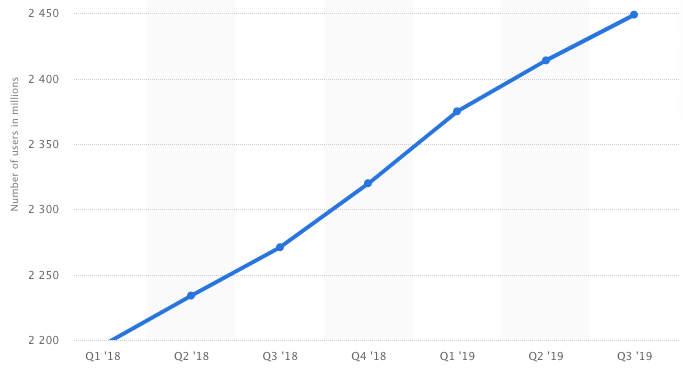
Source: Statista
Moreover, regardless of the outbreak of the scandal in early 2018, revenue growth has remained strong, growing 37.35% in 2018 to $55.8 billion, and the current TTM revenue (until Q3 2019) stands at $66.5 billion. Hence, these trends suggest that the scandal has had little impact on users’ trust as more people flock to the platform.
But one should consider the fact that perhaps the reason why the scandal hasn’t deterred users from the platform is because users hardly faced any direct costs or consequences from it. While they may have become more conscious of their activity on the platform, they haven’t faced any severe damage to their personal lives that would discourage them from using Facebook.
However, investors should not naively take this to mean that trust will not be an issue when they roll out Facebook Pay worldwide. While mishandling of users’ data may not have discouraged consumers from using the platform, there is a good chance they will think twice before sharing debit/credit card details, or any sensitive payment data with the platform, especially amid its eroding public image due to the constant bashing of the company by government bodies and presidential candidates.
While monthly user data may portray that users have been unaffected so far, the true test of users’ trust in Facebook will be through the rollout of Facebook Pay. The potential lack of consumers’ willingness to share sensitive financial data with Facebook could prove an impediment to its plans to monetize transaction data and boost its ad revenue. As a result, the stock could face a re-pricing if current optimism surrounding new financial services initiatives turns out to disappoint going forward.
Bottom Line
While Facebook’s latest moves to strengthen user engagement and boost top line revenue offers reasons to be bullish on the stock, investors should tread cautiously as they bid the stock price higher, and should stay prepared for scenarios where the company’s plans to expand into financial services fall through due to a fundamental lack of trust. When evaluating the potential success of such initiatives, investors should ask themselves, ‘Would I trust to keep personal financial data with a company that is only recently learning to handle my other data responsibly?’. Such questions should help investors step into the shoes of users worldwide and help determine how successful Facebook will really be with these new initiatives. Don’t get too sucked into the rosy story offered by the company, and take any limitations into consideration when investing in the growth stock.
Comments
Log in or sign up to join the conversation.