

ExxonMobil (XOM) doubled its net profit and more than tripled its free cash flow as oil prices climbed. A local correction is possible after such a strong run, yet a breakout above 158 USD could open the way for XOM shares to reach 177 USD.
In Brief
ExxonMobil doubled its net profit in Q2 2026 compared with Q2 2025.
The XOM share price is closely tied to the direction of oil prices.
Higher oil prices create the conditions for further growth in company earnings.
ExxonMobil actively returns capital to shareholders through dividends and share buybacks.
A breakout above resistance at 158 USD could act as the trigger for the next move up in XOM shares.
The highest analyst target price for XOM stands at 185 USD.
Trade Idea Parameters
Below are the specific parameters for the ExxonMobil trade idea.
Parameter | Value |
|---|---|
Instrument | Exxon Mobil Corp (NYSE: XOM) |
Ticker in MobileTrader / MT5 | XOM |
Idea Date | August 04, 2026 |
Time Horizon | 1 to 3 months |
Direction | ↑ Buy (Long) |
Entry Level (trigger) | 159.00 USD |
177.00 USD | |
151.00 USD | |
Risk per Trade | No more than 3% of account · Medium risk |
ExxonMobil Earned 14.5 Billion USD on the Oil Rally
When oil prices climb, ExxonMobil's earnings climb faster. Q2 2026 is the clearest illustration of that.
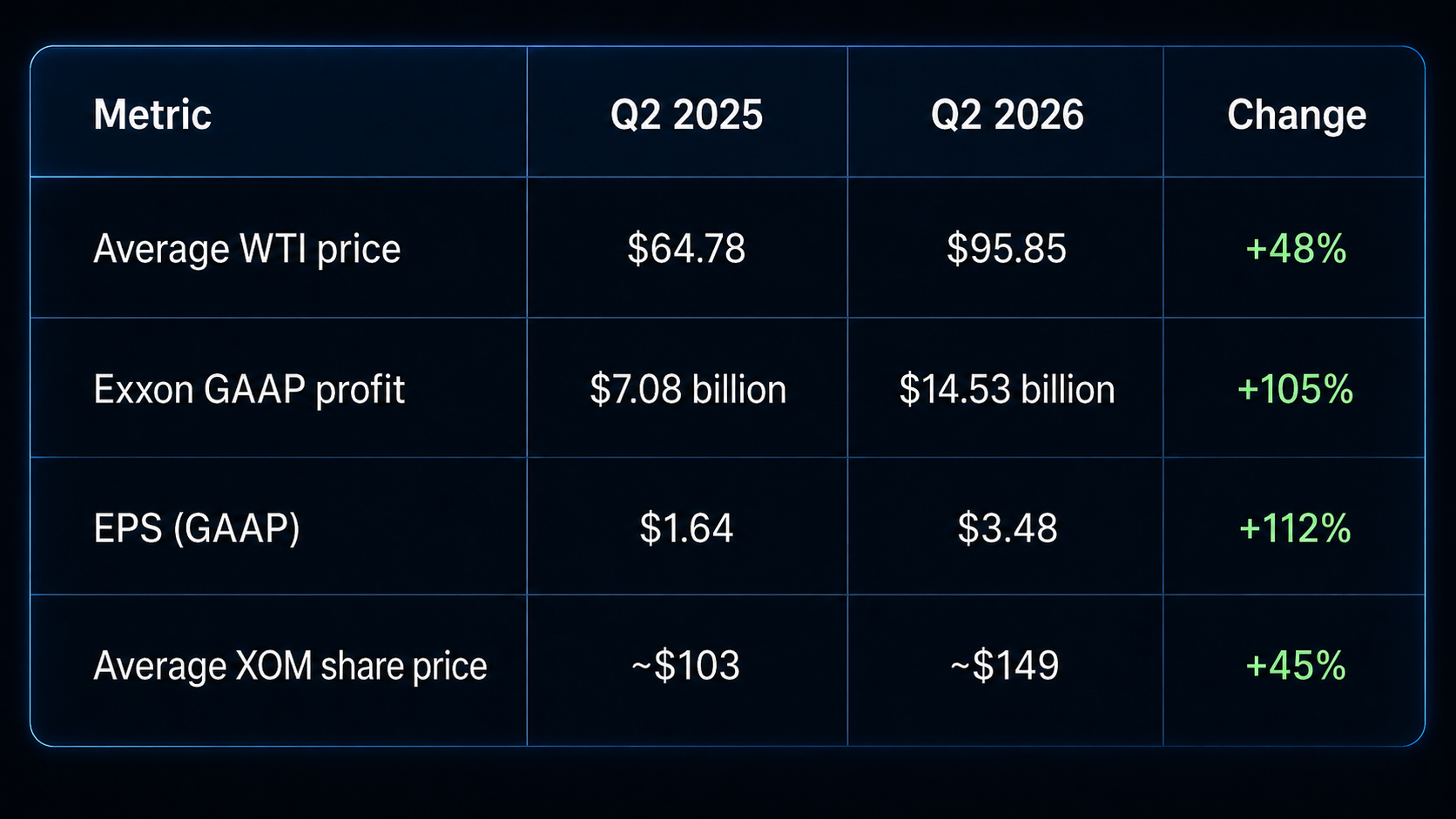
A year ago, analysts were expecting a slowing global economy and a growing surplus of oil. WTI averaged around 65 USD per barrel, and ExxonMobil's quarterly profit held near 7 billion USD. Against that background, a return to the kind of earnings the company posted during the 2022 oil shock looked improbable.
Geopolitics then shifted the balance on the oil market once again. Rising tension in the Middle East, shrinking inventories, and steady global demand pushed prices sharply higher. In Q2 2026, WTI averaged 96 USD per barrel, and ExxonMobil closed the quarter with one of its strongest financial results in several years. Net profit doubled to 14.5 billion USD, and free cash flow more than tripled to 17.2 billion USD.
What ExxonMobil’s Q2 2026 Report Showed
ExxonMobil published its results on 31 July, and the figures stand out even for a company with a market capitalisation of 643 billion USD.
Net profit (GAAP): 14.5 billion USD, up 105%.
Revenue: 114.53 billion USD, up 40%.
Operating cash flow: 23.6 billion USD, up 105%.
Free cash flow: 17.2 billion USD, up 219%.
The structure of that growth is the most interesting part of the report. The Upstream segment, which covers oil and gas production, delivered 7.9 billion USD in earnings. Energy Products, the division responsible for refining and fuel sales, added another 5.5 billion USD. A quarter earlier, that same division posted a loss of 1.3 billion USD.
Higher production volumes supported the result as well. ExxonMobil reported record output in the Permian Basin and started up its fifth FPSO vessel in Guyana. In Q4 2026, that vessel is expected to add a further 250,000 barrels per day to the company's production capacity.
How Higher Oil Prices Turned into Higher ExxonMobil Profit
The chart below shows how closely ExxonMobil's profit tracks the price of WTI crude.
Comparison of ExxonMobil financial results and the price of oil. Source: ExxonMobil Investor Relations, FRED (Federal Reserve Bank of St. Louis). Past results do not guarantee future performance.
In Q2 2026, company earnings grew faster than the oil price itself. That is the result of a large-scale restructuring of the business. Over recent years, ExxonMobil has cut structural costs by 16.3 billion USD, streamlined its asset portfolio, and concentrated on its most profitable projects. When oil prices are low, these measures help the company stay profitable. When prices rise, the effect is amplified, and a significant share of the additional revenue converts into profit and free cash flow.
The quarterly picture below shows how rising oil prices strengthened ExxonMobil's financial results. Between the start of 2024 and Q1 2026, when WTI mostly traded in the 60 to 80 USD per barrel range, quarterly profit moved between 4.2 and 9.4 billion USD. In Q2 2026, the average WTI price rose to 96 USD, and ExxonMobil's profit jumped to 14.5 billion USD. Over the same period, the average XOM share price rose from 118 to 149 USD, as investors began pricing in stronger earnings and cash flow.
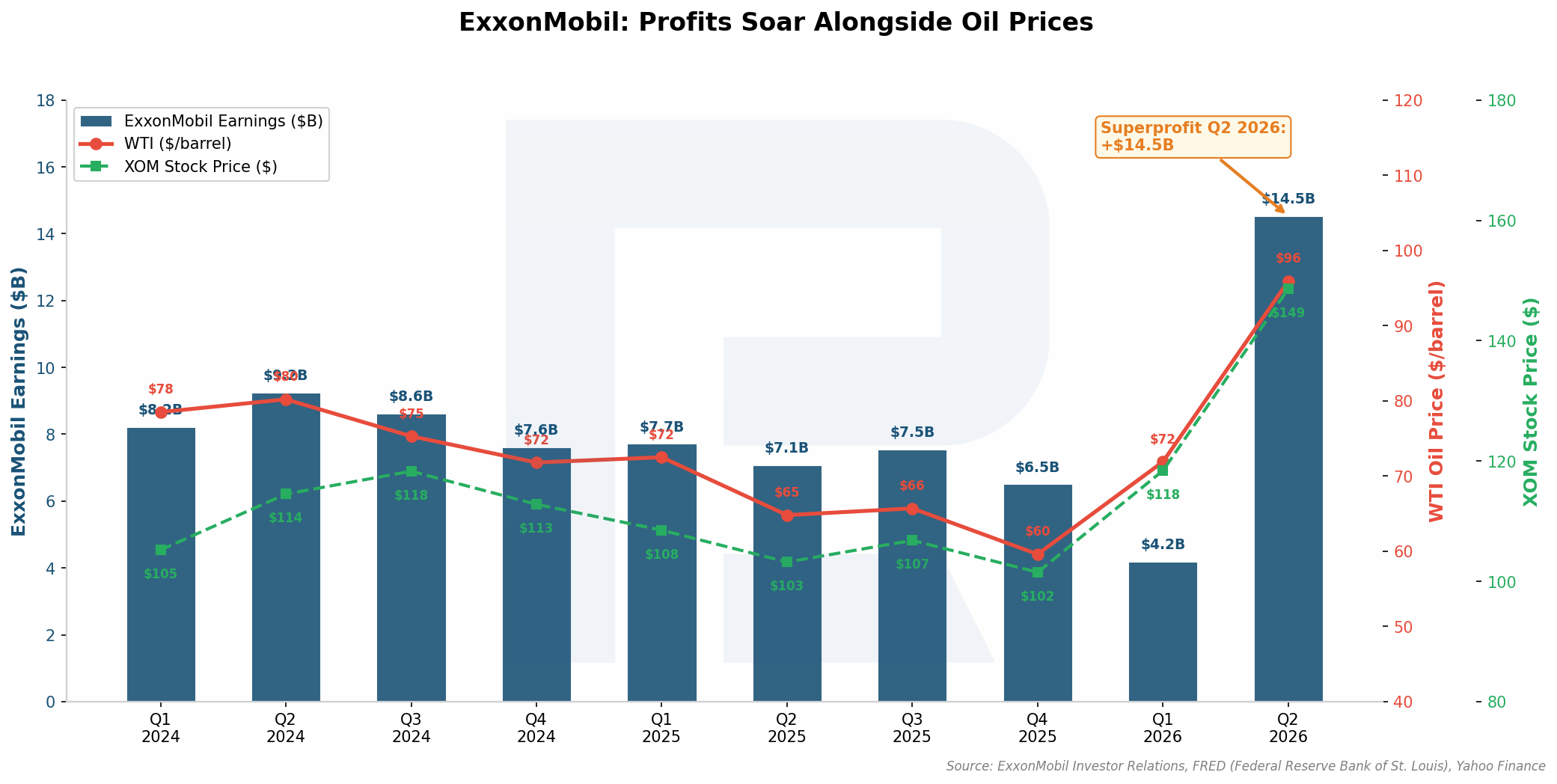
Correlation between ExxonMobil profit, oil prices, and XOM shares from Q1 2024 to Q2 2026. Source: ExxonMobil Investor Relations, FRED (Federal Reserve Bank of St. Louis), Yahoo Finance. Past results do not guarantee future performance.
What Supports the ExxonMobil Investment Case
ExxonMobil depends on the commodity cycle, and it remains one of the most resilient oil and gas companies in the world. Several strengths stand behind that resilience:
Large low-cost assets. A low production cost per barrel allows the company to stay profitable when oil prices fall, and to earn a wider margin when prices rise.
Production growth in the Permian Basin. Rising output in one of the key oil regions of the US supports revenue and helps ExxonMobil improve operating efficiency.
Promising projects in Guyana. New fields give the company long-term production growth at relatively low development costs.
Strong refining operations. Large-scale refining capacity lets the company earn additional profit when margins on petrol, diesel, and other fuels widen.
Solid free cash flow. Strong cash generation gives ExxonMobil room to fund new projects, pay dividends, and strengthen its balance sheet at the same time.
Regular dividends. The company consistently returns part of its profit to shareholders, which makes XOM attractive to investors focused on stable income.
Share buyback programme. Reducing the number of shares in circulation supports earnings per share and increases each investor's stake in the business.
In Q2 2026, ExxonMobil returned 9.4 billion USD to shareholders, including 4.3 billion USD in dividends and 5.1 billion USD in buybacks. That combination appeals to investors who want dividend income alongside share price growth. Strong free cash flow also allows the company to keep investing in future production while continuing to support shareholders.
Where earnings go from here depends largely on oil prices. If WTI holds near current levels, ExxonMobil should be able to maintain high profitability and strong free cash flow. Further gains in crude would lift profit in the production segment and widen the scope for dividends and buybacks. In that scenario, improving financial results would support further growth in the XOM share price.

Comments
Log in or sign up to join the conversation.