


This currency pair has surrendered ground in recent sessions, caught between two central banks that signaled identical rate moves yet are priced entirely differently by markets. The 10-year U.S. Treasury yield has breached 5%, a threshold not seen in five years, and that structural shift in real rates now hinges on whether the Federal Reserve signals an extended tightening cycle or hints at eventual flexibility. The divergence between what policy makers say and what bond yields imply exposes a fundamental mismatch in positioning heading into Wednesday's decision.
The Fed's Expected Move
The Federal Reserve is widely expected to deliver a 25-basis point increase at Wednesday's decision, matching the ECB's move from last week. The nominal alignment masks a critical market divergence in the EUR/USD: traders are pricing the Fed as materially more hawkish than the ECB despite identical policy moves. This suggests a mismatch between what policy makers communicate and market expectations of future tightening. The real tension emerges in forward guidance, specifically, whether Fed officials maintain hawkish conviction or signal flexibility on the tightening path ahead.
The 10-Year Yield is Your North Star
The 10-year Treasury yield breaching 5% functions as the macro bottleneck reshaping capital allocation across all asset classes. At 5%, real yields become punitive enough to demand dollar strength independent of rate decisions - the carry math simply shifts in USD's favor. This level also reveals what market participants genuinely believe about the Fed's terminal rate and how long restrictive policy persists. A sustained move above 5.25% signals markets expect rates held higher for an extended period, amplifying dollar demand. Conversely, any pullback toward 4.7% would indicate recession repricing and trigger a sharp reversal in carry dynamics, favoring EUR.
The Technical Analysis Looks a Bit Different
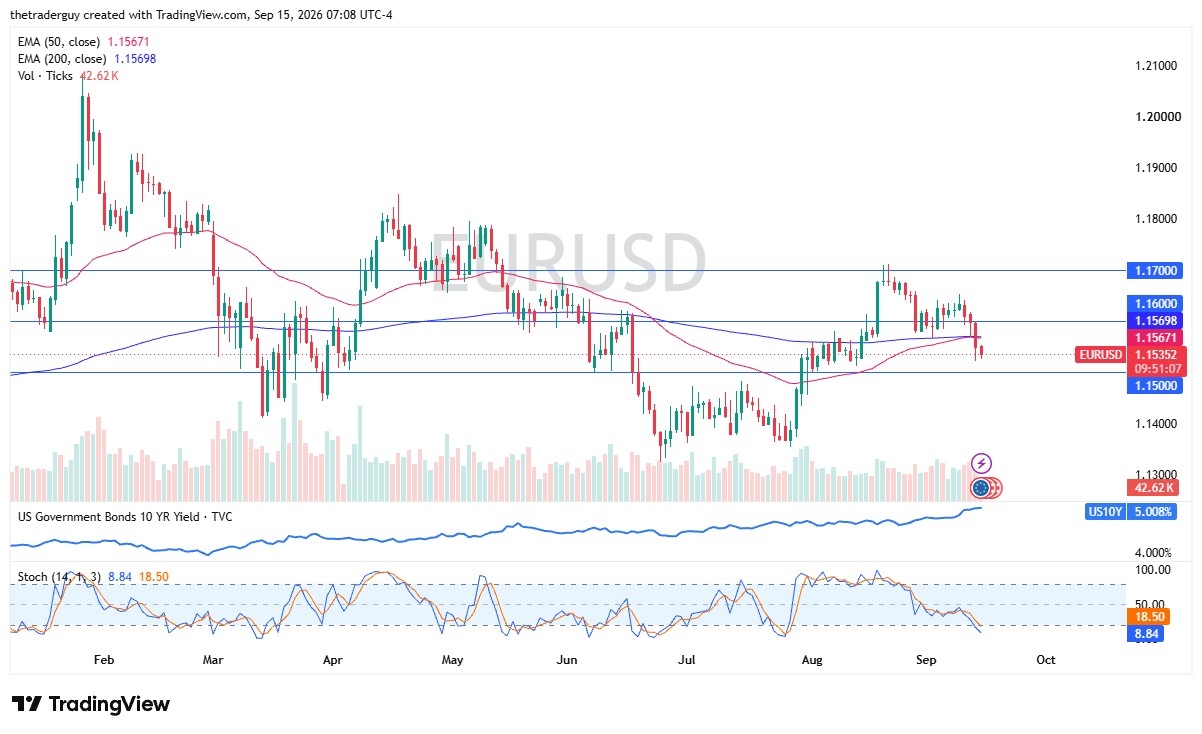
EUR/USD has anchored at 1.15, a level that now represents the threshold between continued dollar strength and tactical relief. The stochastic oscillator shows severe oversold positioning but has not yet generated a crossover signal - this gap between momentum and price action indicates institutional sellers are still active and conviction remains strong. The 50-day exponential moving average sits near 1.17, acting as a secondary resistance layer for any relief bounce. A break below 1.15 would target the 200-day simple moving average around 1.12, signaling that dollar bulls retain structural conviction. Above 1.08, the narrative would shift toward EUR stabilization and Fed hold pricing.
EUR/USD Price Chart
H2 The Divergence Between Central Bank Signals
The ECB raised 25 basis points last week; the Federal Reserve is expected to do the same on Wednesday. But the real divergence emerges in forward guidance and market pricing of future tightening. The 10-year yield now pushing 5%—a five-year high—indicates capital markets believe the Fed will hold restrictive policy far longer than the ECB. This structural gap between communicated policy and bond market expectations masks a vulnerability in consensus positioning. Traders are betting that Fed hawkishness will persist even as growth signals weaken and energy inflation loses momentum. That conviction is priced into the dollar via real yield compression and carries a tail risk: if the Fed hints at flexibility or if recession fear accelerates, positioning unwinds sharply and EUR/USD rebounds.
H2 Three Blind Spots Masking Dollar Strength
Market consensus fixates on Fed-ECB rate parity and near-term technical support, but three structural vulnerabilities persist. First, energy inflation as a EUR headwind has an expiration date; oil supply disruptions or geopolitical escalation in the Middle East could reverse the petro-currency dynamic overnight and support EUR faster than positioning can unwind. Second, a Federal Reserve hold or even a pause signal is priced at roughly 5% probability, yet the economic data—jobs, inflation pulse, credit conditions—does not obviously demand additional tightening; complacency about a hold scenario leaves traders exposed to a surprise policy shift. Third, geopolitical risk in the Middle East and heightened tension over Taiwan muddle long-term energy and growth assumptions, masking the true beta of dollar strength narratives that assume stable geopolitical conditions and predictable Fed tightening.
H2 Thesis Invalidation Levels
The thesis that dollar strength persists and EUR/USD heads toward 1.12 has clear break points. Should EUR/USD close decisively above 1.08 on a Federal Reserve hold signal, the dollar weakness thesis is invalidated and carry relief becomes the dominant trade. A decisive daily close above 1.10 before Wednesday's decision would signal institutional buyers are stepping in ahead of forward guidance, suggesting consensus has turned complacent on Fed hawkishness. On the data side, a 10-year yield break below 4.80% would indicate recession repricing or a shift in Fed terminal rate expectations, triggering a sharp reversal in carry dynamics and sending EUR/USD back toward 1.09–1.10. Any combination of a Fed hold announcement plus a sub-4.85% close in the 10-year would overturn the dollar bull thesis entirely and create a 2–3 day window for EUR/USD to reclaim 1.09–1.11 levels.
EUR/USD consolidates at 1.15 as the 10-year yield holds above 4.95%, signaling sustained dollar demand from real rate compression. The Federal Reserve's Wednesday decision will test whether forward guidance justifies current pricing or exposes complacency about a pause scenario. Watch for a break below 1.14 by early Wednesday as markets front-run the decision; a hold above that level leaves the relief-bounce invalidation scenario still viable, and a close above 1.08 on any dovish surprise would unwind the entire dollar bull positioning.
Comments
Log in or sign up to join the conversation.