

Trade turmoil is affecting Europe in several ways, each with a significant geopolitical dimension. First, the US is imposing tariffs on European goods. This dominated the debate last year and still feels like a looming risk.
Second, there's China, which is increasingly competing with Europe at ever-lower prices in sectors such as electrical vehicles, metals, chemicals and solar panels, while importing less from Europe and exposing some of the continent’s largest industries. This growing competitive pressure, also known as the China Shock 2.0, has been fuelled by China’s rapid technological catch-up and overcapacity at home. But many also point to state support, such as subsidies and favourable funding conditions, while the role of the currency remains a subject of debate.
Third, there is a continued risk that at some point in the future, Europe’s trade in goods and services – be it rare earth imports or exports of ASML machinery– will be restricted for political reasons. This could be the result of a conflict in which Europe is directly involved, or it could just as easily result from one in which it is not. The current rise in energy prices and the blockade of the Strait of Hormuz as a consequence of the war in Iran are clear examples. It may even be an "unknown unknown", posing a challenge for a continent that remains heavily dependent on international trade.
It all goes very much against Europe’s open, rules-based way of working. It also tests European unity, as national interests can often diverge. European manufacturers are particularly concerned, especially those in large sectors that are exposed to both Chinese competition and US tariffs such as vehicles, metals and chemicals. For them, the glass looks very empty. But from a broader perspective, there’s also a half-full side to the story. I will start by looking at how Europe is gaining some ground in the power struggle, then turn to the winners (spoiler: European consumers) and finally explore how all these developments can nudge Europe to focus on the one market that can make it genuinely successful: its own.
Europe is finding its footing in the new power struggle
Europe’s position versus the US may be stronger than many expected
When it comes to US tariffs, the Supreme Court’s decision in February to strike down the Trump administrations emergency tariffs has certainly supported Europe. Not so much because the ruling directly lowered tariffs on European goods, but because it showed that not every tariff threat is durable.
Also, estimates show that, despite the intense focus on the trade war, Europe’s economy was barely impacted by the US tariffs in 2025. To put this in perspective, exports of goods to the US account for only about 3% of EU GDP in gross terms and closer to 2% in value-added terms. Over the last two years, I’ve come to realise that very few people are aware of these basic facts. Many people I quizzed assumed that US demand for European goods would make up at least 10% of European GDP.
Second, American buyers frontloaded a significant share of goods imports in 2025, supporting economic growth in Europe. And finally, about 90% of the tariff burden appears to have been borne by American buyers rather than foreign exporters.
For most European countries, the impact on GDP is estimated to have been between -0.1 to +0.15 percentage points in 2025. Obviously, beneath the calm surface there have been deeper losses in specific sectors and companies too, but from a macro perspective this has been less a crisis than a slow grind.
Looking ahead, it is good to be aware of the significant mutual dependencies. Both in goods, where Europe matters for American value chains, and for services, where Europe matters as a buyer of US digital services. For many reasons, the impact of the US tariffs so far has been less severe than many feared at the very outset.
Europe is making progress on its diversification path
As relations with the US come under pressure, Europe is making new friends. And the European Union’s track record on trade deals is not bad. Deals with New Zealand and Chile were brought into force in 2024 and 2025. The long-running Mercosur agreement has been provisionally applied since this year, opening a market of roughly 270 million consumers. Negotiations with India, the fastest growing major economy, have resumed. Talks continue with Indonesia, Australia, Thailand and Malaysia.
The counterargument is that these markets are relatively small and geographically distant. Closer to home, a landmark package with Switzerland was agreed in 2024, lowering regulatory barriers and deepening economic integration. The relationship with Canada has clearly been strengthened. And closer cooperation with the UK is also firmly back on the table again, with the UK prime minister floating the option of rejoining the EU. Aggregate trade relative to GDP has also been on the rise lately. To cut a long story short, in most of the world, trade openness continues to be the preferred option. Europe’s outward orientation has strengthened, which matters not only economically, but also geopolitically, as stronger trade ties strengthen global relationships.
Europe is taking a de-risking approach on China
Europe’s stance on China has changed, in a balanced way. It is tackling unfair trade practices, while staying open for business. This takes time, also because it is not easy to determine whether trade practices are indeed unfair or part of a long-term industrial policy. But Europe has started to act. It has imposed duties on Chinese electric vehicles, with tariff rates differentiated according to the level of state support and the extent of market distortions identified by the European Commission.
Beyond economic fairness, security considerations are also increasingly in focus. Europe has started to scrutinise incoming investments for risks to security and public order, while also reviewing outbound investments in sensitive technologies. Europe aims to diversify its supply of rare earths and other strategic minerals. In public procurement, it is working on a minimum ‘Made in Europe’ requirement in all contracts. Emmanuel Macron and Friedrich Merz are proposing a ‘last-resort instrument’ to fully cut off access to the European market. In short, Europe is working to reduce critical dependencies without abandoning openness to trade. It is a delicate balancing act, and one where Europe is gradually finding its footing.
Europeans get cheap stuff
Meanwhile, cheap Chinese imports are continuing to gain market share in Europe. Here’s where we need a dose of ‘Economics 101’ so we do not lose sight of a simple fact: trade creates not only losers, but winners too.
For all the concerns of European companies, it’s worth acknowledging that all these cheap imports have bought European consumers a lot of affordable stuff. Europe imported just over one million cars that were made in China in 2025. And these were cheaper than the domestic made alternative would have been: Chinese EVs for example are estimated to be some 20% cheaper. The import bill for solar panels has been kept low as Chinese exporters dramatically lowered their prices. In 2024, the EU imported 2% more panels than in 2023, while paying 43% less, saving roughly €8 billion on its solar panel import bill. These are just two examples.
The European Central Bank estimates that Chinese competition has kept prices low in Europe, with inflation of non-energy industrial goods almost 0.3 percentage points lower as a result. This has supported household purchasing power.
The issue with trade is that the losses are often concentrated, very visible and easy to attribute. In this case, much of the pain is felt in Germany’s industrial heartland and the many corporates in that supply chain. The wins are spread out thinly across many consumers and very few people will celebrate them.
There are winners even on the supply side, be it specific companies that successfully adapt or countries like Spain and Czech Republic that offer a lower cost base. They do exist and they add up. From an economic macro perspective, then, it is hard to say exactly whether this is a net win or a net loss, as the picture is very nuanced.
From a security and sovereignty perspective, greater reliance on Chinese imports can create new dependencies. These dependencies are mutual and temporary in many respects, and in that sense, they compare favourably with fossil fuels, which require recurring imports year after year. However, they can still create vulnerabilities, such as the risk that prices may rise over time. Europe is not fully at the steering wheel. So, let’s turn to a very different perspective on all this.
Finally: an incentive to focus on Europe for Europe
European corporate decision-makers often see being a global goods exporter as the ideal position. And policy makers follow that thinking when discussing the options. But being a net exporter of goods, which Europe has long been, is not necessarily an advantage. A trade surplus means a country sells more abroad than it buys. It creates a dependence on foreign demand and on foreign borrowers' ability and willingness to repay. Europe's trade surpluses have resulted in the accumulation of a large amount of foreign assets (loans, bonds, equities and direct investment). That can be profitable, but it also exposes Europe to external risks that are beyond its control. A country may not be willing or able to pay back what it owes Europe.
Persistent surpluses may also reflect weak domestic demand. Consumers may spend less than they could, wages may lag productivity, firms may underinvest, and governments may focus on reducing debt by restricting growth-enhancing investments. All of this has happened at some stage or place over the last few decades: Germany’s weak economic growth, to take an important example, has also been analysed through this lens. The argument is that policies aimed at wage restraint dampened domestic consumption and investment, leaving growth overly dependent on foreign demand. Another example: French and Dutch households have recently been saving a high share of their incomes, which has limited domestic consumption.
As a result, Europe produces more than it is willing to consume itself.
Looking ahead, an export-led, manufacturing-based growth model may not only be a source of vulnerability, but will also become harder to sustain. Services in general, and digital services in particular, are becoming a larger share of consumption. At the same time, ageing populations will make labour scarcer and shift spending towards services such as healthcare, leisure and hospitality. Energy-intensive manufacturing is also unlikely to remain a European strength.
This raises the question of what a more domestically-driven growth model might look like. Europe, the continent, remains a large market of over 500 million consumers. One option would be to allow wages to rise faster, boosting purchasing power and encouraging productivity-enhancing investments. In the past, higher minimum wages in Germany have led to a net gain for workers.
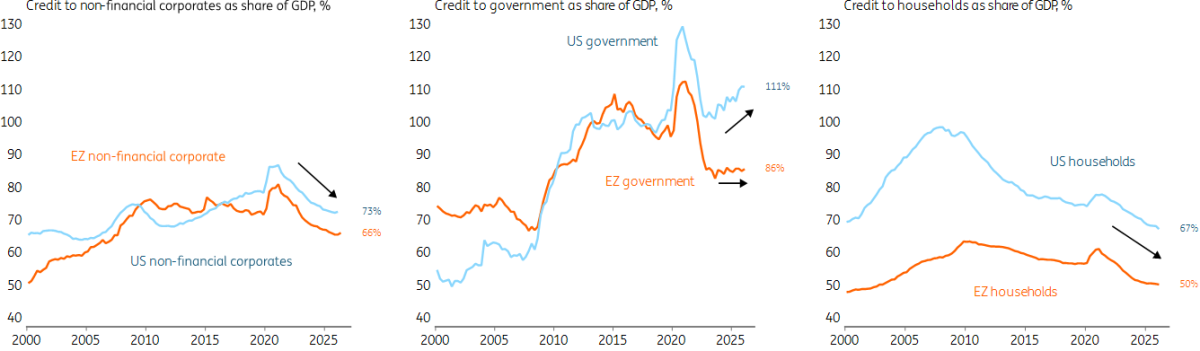
Many of the other options are supported by relatively strong balance sheets – Europe’s governments, companies and households have reduced their debt levels (see graphs). The first approach would be to reduce excessive household savings and channel more wealth into productive investments. Tax treatment of mortgages and pensions and better financial education can play a role in directing more household savings towards investments.
Europe has more room to invest, spend and grow than often assumed
The big bang could come from increasing corporate investment. This would require a stronger focus on integrating the European market, especially for services, allowing corporates to expand across borders. It would also require a greater domestic focus on labour market institutions that allow for more corporate agility. All these can be engines of growth.
Fiscal policy could also play a larger role when private demand is weak, provided public finances allow it and spending is focused on investment. In economies with persistently high private savings, public investment can stimulate private investment rather than crowd it out. Two developments already point in this direction: Germany has broken with a tradition of fiscal austerity and is focusing its additional spending on investments in infrastructure. The resulting growth is slowly becoming visible, for now mostly in its construction sector. The Recovery and Resilience fund is investing €650bn and is estimated to add almost €900bn to European GDP by 2030. Its impact is expected to be very strong in the markets where the money is spent, but the benefits are also likely to spill over to other countries.
Of course, ideally Europe should both strengthen its international position as well as its own domestic demand. The focus on domestic demand could prove more resilient and future-proof than the continued focus on the challenges for incumbent industries.
While Europe is finding its footing in the geopolitical power struggle and there are some winners too, trade tensions remain a real challenge in the short run. But a longer-term playbook is starting to emerge. These pressures are a trigger for Europe to rethink old habits and strengthen the one place where it is truly at the steering wheel: its own market.
Comments
Log in or sign up to join the conversation.