

The first article in our new series offering a glass-half-full perspective on Europe's economic reality
This summer has felt like a metaphor for Europe's broader troubles. Heatwaves have swept across the continent. Many holidays, including mine, have been disrupted while vast areas have been destroyed by wildfires. Drought has threatened river transport and crops and has slowed growth before it even had a chance to get going. Refugees arrived in Ceuta in numbers that instantly became political ammunition. And to add to the drama, a solar eclipse darkened the skies. If a Hollywood screenwriter had pitched this storyline, the editor might have suggested toning it down.
For many, the default image of Europe is a continent in decline, overwhelmed by crises, under continued political strain.
It is now two years since Mario Draghi published his landmark report on European competitiveness. The report was alarming. Europe, Draghi argued, risked falling behind unless it fundamentally changed course.
The report identified genuine challenges. Europe does invest too little. Productivity growth has disappointed. Energy costs remain a handicap. Capital markets are fragmented. Demographics are not exactly working in our favour. The call to political action was desperately needed.
But over these two years, I’ve become more and more concerned about an unintended side effect: Europe is almost exclusively viewed through the lens of weakness, risks and threats.
While that may be necessary to build political momentum (the Draghi report was deliberately alarming as European politicians often need a sense of crisis before they’re willing to compromise), it also comes at a cost. Let me repeat myself on the economic point: If households become excessively pessimistic, they spend less. And it’s clear that household spending continues to be muted. Pessimistic firms invest less. And investors need to see some upside before they commit capital. Pessimism can become self-fulfilling.
But it’s not just that. Another side effect is panic politics.
Fearing that they could capsize the European economy, politicians have been turning away from some of the Union's core principles. We see state aid becoming more common, protectionism is no longer off the table, merger guidelines are being reviewed, and policymakers seem increasingly willing to accept swift, if painful, trade deals. Perhaps most strikingly in this scorching summer, climate policies are being watered down too, from EV standards to delaying and relaxing the Emissions Trading Scheme. Someone needs to tell our politicians to take a deep breath.
This is why I’ve written my Pitch Book for Europe – a series of articles offering a glass-half-full perspective. This is not an "everything is fine" argument. Europe faces serious economic and geopolitical challenges.
My point is different. I believe the European storyline has become systematically more negative than the underlying reality. Can such a persistent skew exist? For three reasons it can.
First, bad news sells. A factory closure attracts more attention than a factory expansion. A crisis generates more clicks than steady progress. The media is forced to live this reality, and social media amplifies it.
Second, in my profession, pessimism is often rewarded more than optimism. Doom gets attention, and few people will blame you if you turn out to be wrong. Have you ever noticed that the risks in almost every economic outlook are tilted to the downside? An optimistic economist would probably find another profession. Being too optimistic is a risk: if decision-makers act on your advice and things go wrong, they’re likely to remember who encouraged them to be hopeful.
And finally there’s a political angle. If you’re a corporate, lobbying for policy change requires some urgency. If you're an opposition politician looking to win votes, talking down the economy is often the easiest way to persuade voters to abandon the incumbents. And criticism of Europe is increasingly coming from across the Atlantic, adding to a long-standing tendency to fault 'Europe' in national political debates.
So, we are continuously drawn to the half-empty part of the glass.
This series is my attempt to rebalance the conversation. I will compare perception with reality. I will explain where the criticism is justified but also add nuances that may be missing from the debate. In my research, I found positives that do not receive the attention they deserve. I found weaknesses that could become future strengths. And when comparing Europe with the United States (the main comparison in the Draghi report), I found many challenges for the US that we tend to ignore, so the relative position of Europe versus the US is better than commonly assumed.
I will start with what I call ‘the bad stuff’: demographics and productivity. From there, I’ll offer a different perspective on the ‘five ugly challenges’: defence, energy, digital technology, trade and the financial landscape. Then I’ll move on to the good, starting with a group of countries that deserve more attention than they receive: Poland, Spain, Italy and Romania. I’ll end with health and happiness. By then, it will be December. I’ll be publishing one article a week, and just before Christmas I’ll wrap up.
When preparing this series, I came across quite a few statistics that were more positive than I had expected. Here’s the first. My assumption was that Americans are proud to be American while Europeans feel less strongly about being European. Well... look what’s happened.
Europeans increasingly feeling European while pride in being American declines
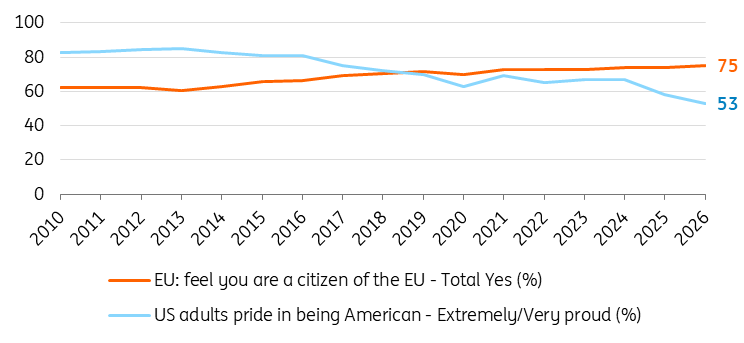
Source: Gallup, Eurobarometer, ING
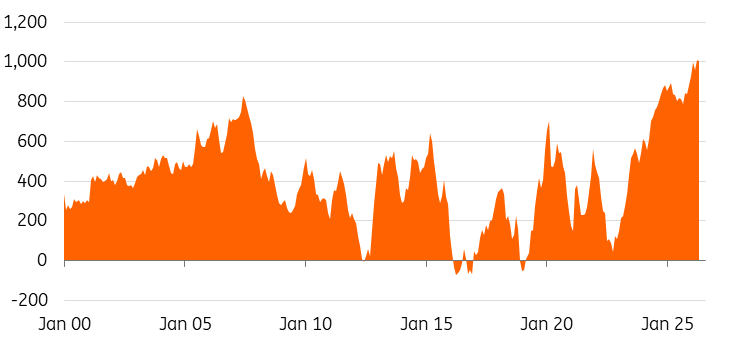
And there’s more: investors continue to allocate more capital to European countries (See graph below). Iceland may be coming back to the negotiating table with the EU after the 29 August referendum, while many Brits seem to have changed their minds on Brexit. Paul Krugman is challenging the narrative of European decline (with, admittedly, two Europeans ready to reconfirm that stagnation is real).
So, while the challenges are real, there are also signs that the momentum may be starting to turn. Working on this series has helped me find the evidence for this.
Back from the summer break, I'm setting off on this journey. I hope you'll come along for the ride.
Foreign buying of eurozone assets at a peak of 1 trillion in 12 months
12m foreign buying of EZ equities and debt combined (€bn), last datapoint: May 2026

Comments
Log in or sign up to join the conversation.