


In this episode of Finance U, Paul Kiker and I once again note how the current US equity markets ‘feel’ like they did in February 2020 when they were studiously ignoring Covid. Whereas in times past, equity markets were both discounting machines and a source of early warnings about future events, they have somehow become lobotomized.
Placid, dull, and reactive, not forward-looking.
The core takeaways: A truly unprecedented energy-supply destruction event is underway; an inflationary is “in the pipeline,” yet paper markets remain distorted. Prudent preparation in the forms of portfolio risk management and physical resilience are called for over passive buy-and-hold and ‘eyes wide closed’ approaches.
The Energy Shock
With oil and NG, and an entire circus of downstream related products such as fertilizer and ethylene, suddenly missing from the global economy, the world has never experienced a shock of this magnitude.
The Strait of Hormuz near-closure, plus Russian export losses, has already removed ~12 million barrels/day of crude/condensate, which is 35% of global exportable oil (a more important number than it being 20% of global daily supply).
If oil prices weren’t being actively suppressed in the paper futures markets by US and possibly Japan (as rumored), they would certainly be far higher. When the snap-back happens, the explosive rise in oil prices will shock the overly complacent markets.
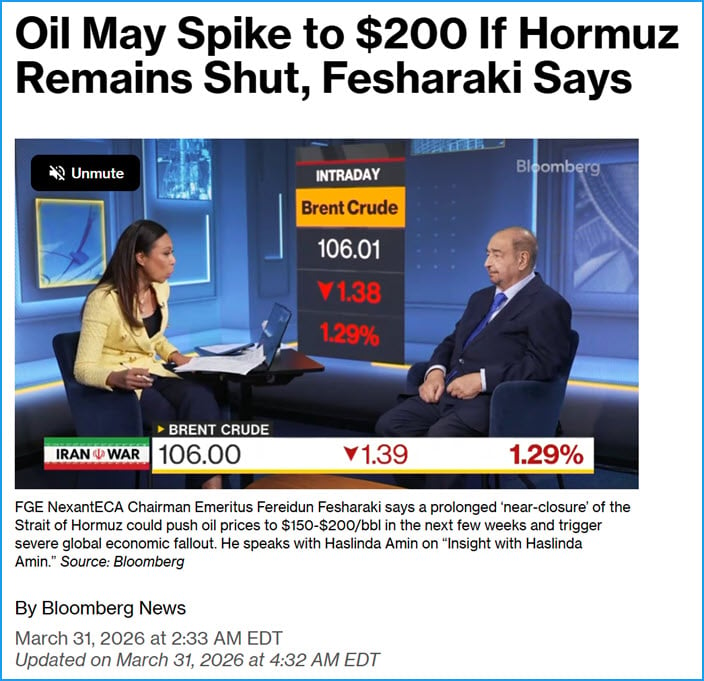
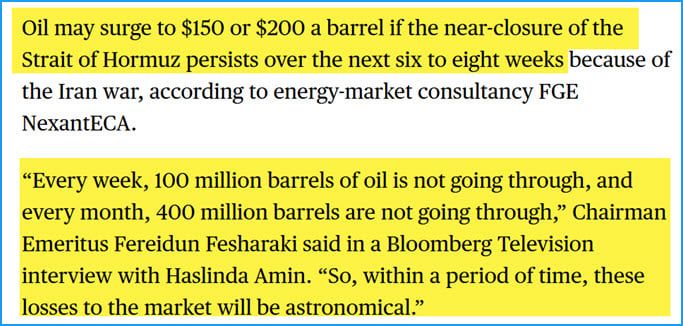
Even if the war suddenly ended, repairing all the damage and sorting out all the supply shocks will take years, up to 5 years in the case of LNG exports from Qatar.
Inflation and Demand Destruction
Jet fuel shortages and price hikes have already forced thousands of flight cancellations, the grounding of 20 Lufthansa jets, emergency shipping surcharges (e.g., Maersk’s emergency bunker fees), and fertilizer and chemical shortages.
Demand destruction is already confirmed in the form of canceled flights, idled fleets, and spreading work-from-home mandates.
Europe, many Asian countries, and Australia are already experiencing severe diesel shortages with unpredictable (but observable) impacts on economic activity.
Petrodollar and Treasury Risks
Foreign central banks have reduced NY Fed Treasury holdings by ~$100B, back to 2012 levels, despite U.S. debt having doubled over that time frame.
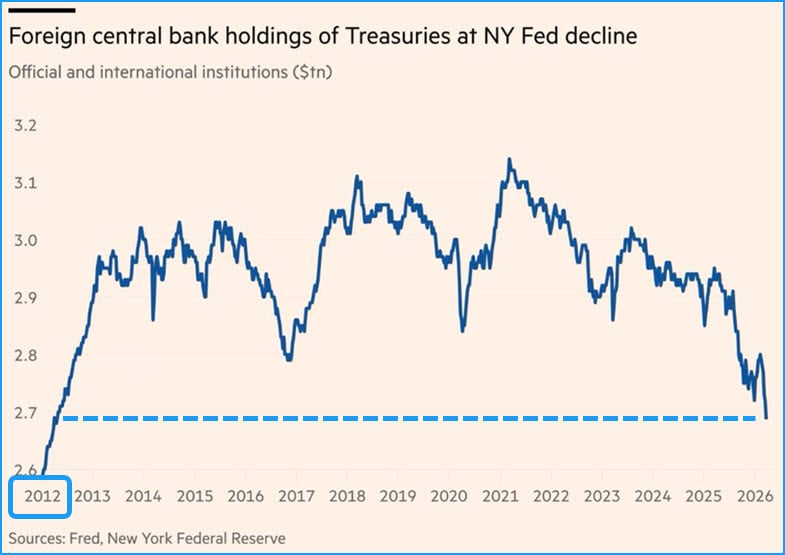
If more foreign holders (beyond central banks) also cut their exposure to US Treasuries, that will put upward pressure on interest rates…and a particularly awkward time for the US government, which was already running a massive deficit before the war against Iran.
Iran is quite provocatively – at least to the existing world order – linking Hormuz transit fees to the Chinese yuan, accelerating both sides of the petrodollar equation; the linking of Gulf oil purchases to the dollar as well as the round-trip reinvestment of those dollars back into US markets.
To call this a profound shift is to understate it severely.
It is against this backdrop that US equity markets remain “priced for perfection” while risks (energy shock, inflation, fiscal irresponsibility) continue to mount daily.
Again, this is a time for prudence and caution, two things which passive investing strategies completely ignore.
If you’ve been thinking, “I may give Paul Kiker and his team a call someday,” don’t put it off any longer. We all need help navigating these turbulent times, and at a minimum, you’ll come away with a sharpened understanding of your financial position and options.
Comments
Log in or sign up to join the conversation.