

Elon Musk hasn’t just been busy building a flying car.
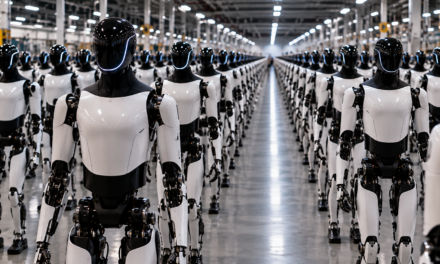
He wants Tesla (TSLA) to eventually build 10 million Optimus robots every year.

That might sound crazy, but it’s not entirely unrealistic. And if he can accomplish it, humanoid robots will become as common as cars.
They’ll work in our factories and warehouses. They’ll stock shelves, deliver packages and eventually help us with everyday tasks around our homes.
They could even become our companions.
But before that happens, Musk has to deal with a more immediate problem.
He needs enough memory chips to build them.
The Challenge of Building Optimus
Musk recently revealed that Tesla made a surprising change to the chips that will power future versions of Optimus.
They’re cutting back on memory.
Tesla’s upcoming AI5 chip was originally expected to have 144GB of memory. Now it will have half of that. And the AI6 chip that follows it has been reduced from 216GB to 144GB.
That means less memory for a machine that’s supposed to become much smarter. But Musk says the change should have a “negligible effect” on Optimus’ performance because how quickly the robot can access its memory matters more than how much memory it has.
And the underlying reason it’s happening is that Tesla needs a lot of chips.
Musk said reducing the memory was the “only way” the company could get enough to manufacture Optimus at scale.
And it should also significantly reduce the cost of each robot.
But memory is just one component of the Optimus buildout. Each robot also needs cameras to see, batteries for power, computers to think and dozens of motors and joints to move around.
In other words, figuring out how to build Optimus is one challenge. But figuring out how to manufacture millions of them is another challenge entirely.
Tesla has reportedly increased Optimus production roughly 10X in recent months. But it’s still having trouble manufacturing the robots at scale.
And one of its biggest headaches is Optimus’ hands.
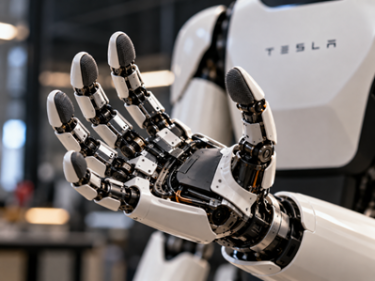
A human hand has 27 bones and more than two dozen joints. Replicating that kind of movement in a machine requires an incredible amount of precision. And Tesla’s robotic hands are reportedly proving difficult to manufacture consistently as production increases.
The company has also run into problems with automated equipment and suppliers.
And Tesla isn’t the only company dealing with this problem.
Apptronik is another American company trying to mass produce humanoid robots. Its Apollo robot is designed to work in factories and warehouses, where it can do things like move boxes and deliver parts.
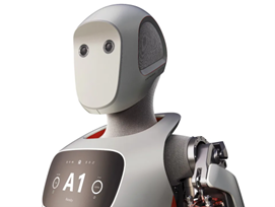
Apptronik CEO Jeff Cardenas recently warned that America doesn’t have enough of some of the important components his industry will need.
He specifically pointed to precision gears.
Every time a humanoid bends an elbow, turns its wrist, takes a step or moves its fingers, something has to create that movement.
Those systems are called actuators. They’re like a robot’s muscles, combining motors, gears, sensors and electronics to turn electrical energy into physical movement.
And a humanoid needs a lot of them.
That’s one reason actuators are the most expensive part of many humanoid robots. McKinsey estimates they can account for 40% to 60% of the total cost of the hardware.
The problem is that American manufacturers can’t yet produce enough of the specialized actuators needed to build millions of humanoid robots.
The industry is also exposed to potential shortages of the rare-earth materials used in electric motors.
That’s why robot makers around the world are already lining up suppliers to make sure they have the parts they need.
British robotics company Humanoid signed a five-year agreement with German manufacturer Schaeffler that will provide more than half of the actuators it needs for its robots.
And China’s XPeng (XPEV) has signed agreements with suppliers for joint modules, actuators and precision structural parts ahead of plans to begin mass producing its IRON humanoid.
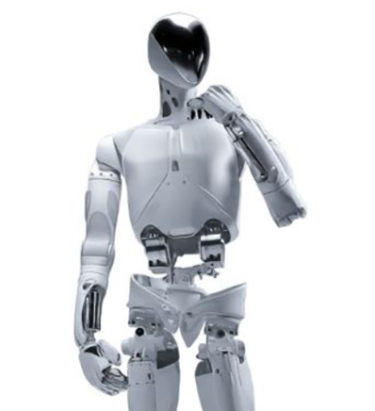
Image: XPeng
But other companies are taking the Tesla approach and building their own critical components.
Apptronik has designed more than 80 different electric actuators since the company was founded, while China’s Unitree develops its own motors, reducers and joint modules.
That shows you how new this industry is.
Automakers don’t have to invent every component inside the cars they build. They rely on enormous global supply chains that have been built out over more than a century.
But humanoid robotics companies don’t have that luxury yet.
The AI inside of these robots is getting better incredibly fast. But if humanoids are really going to become as common as cars, we’re going to need to manufacture them more like cars too.
That means producing millions of motors, gearboxes, cameras, batteries, sensors and processors every year.
And it also means finding ways to make all these components much cheaper.
Here’s My Take
I’m convinced AI could trigger a Cambrian explosion in robotics, with machines appearing in all kinds of shapes and sizes depending on the job they’re designed to do.
The challenges facing humanoids are another reason why this could happen.
I’m not saying Musk can’t reach his goal of producing 10 million humanoid robots a year. And I believe humanoids have an enormous future ahead of them.
But I also believe we’ll see plenty of simpler, cheaper robots designed for specific tasks.
And some of the biggest opportunities in the robot revolution could come from the companies supplying the hardware that makes it possible.


Comments
Log in or sign up to join the conversation.