

I’ve said it for years, and I’ll keep saying it: Americans are the most generous people in the world. No nation on earth gives more.
Last year, U.S. charitable giving hit a record $617.20 billion, according to Giving USA. That’s the first time it’s ever topped $600 billion. Individuals gave $394.2 billion of that, foundations gave $117.15 billion, bequests added $62.19 billion and corporations contributed $43.67 billion.
It isn’t just the dollar amount, either. A recent Bank of America study found that nearly nine in 10 wealthy Americans gave to charity in 2025, and 49% volunteered their time, up from 42% in 2023. Among the world’s ultra-wealthy, North American donors gave $115 billion last year, and $107 billion of that came from the U.S.
Giving USA credits “strong financial markets” for the record and says a strong stock market lifted individual giving 4.1%.
What this tells you is that capitalism and charity aren’t opposites. They go hand-in-hand. When Americans build wealth, they share it.
A New Wave of Wealth Looking for a Home
Today, the artificial intelligence (AI) boom is creating fortunes faster than anything I’ve seen in my career, and some of the people at the center of it are already working out how to give it away.
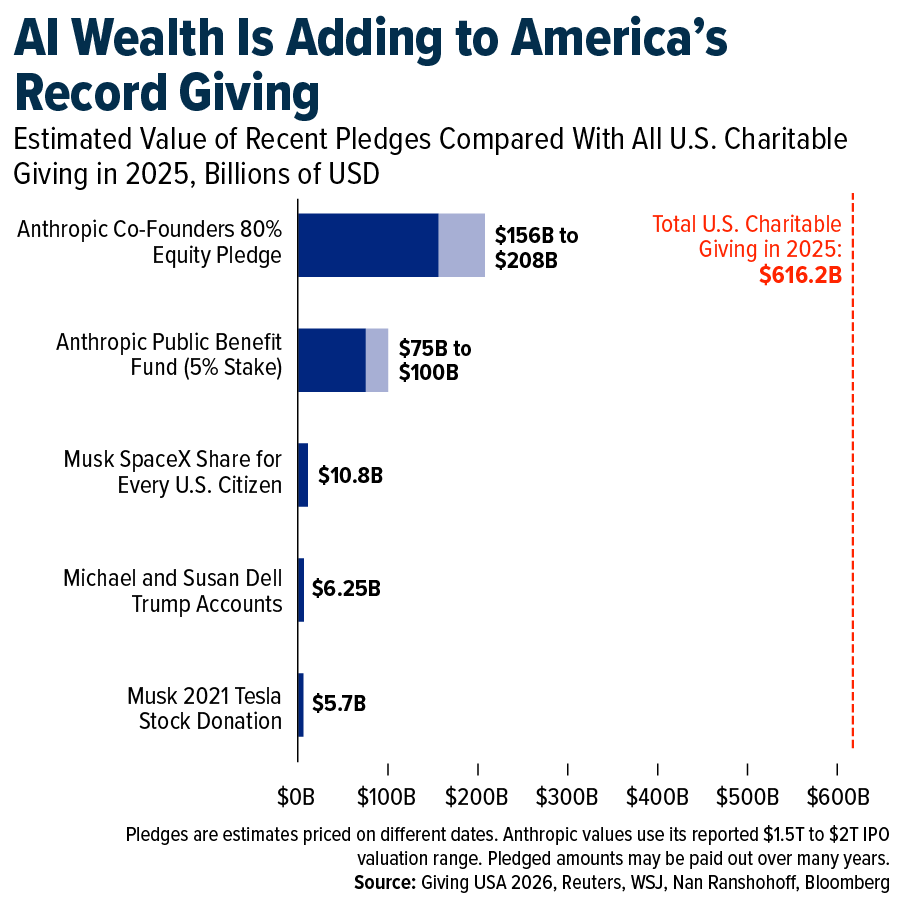
Anthropic, the maker of the Claude AI models, said last week that it’s committing 5% of its shares to a new Anthropic Public Benefit Fund, subject to stockholder approval. The board can add another 2% for every 50% increase in the company’s value above a set baseline. Anthropic is preparing what could be one of the largest IPOs in history, at a valuation of $1.5 trillion to $2 trillion. Reuters puts that 5% stake at $75 billion to $100 billion.
On top of the corporate pledge, each of Anthropic’s cofounders has pledged to give 80% of their personal Anthropic equity to philanthropy, according to the company’s draft prospectus.
Writer Nan Ransohoff calls this the “third wave of American philanthropy.” She estimates that AI wealth could add $37 billion to $100 billion a year in new charitable spending, a 6% to 17% boost to what Americans already give.
Shares, Not Checks
And then there’s Elon Musk, who last Monday had this to say:
With roughly 73 million children in the U.S. and SpaceX closing at $147.96 that day, Musk’s gift works out to nearly $11 billion. The world’s richest man plans to deliver the shares through the new Trump Accounts. He argues that the best way to spread the AI windfall is by “giving the shares directly to the public.”
He isn’t alone. SpaceX President Gwynne Shotwell and her husband pledged in July to donate SpaceX stock to the accounts of more than 2 million low-income kids. Michael and Susan Dell have pledged $6.25 billion to Trump Accounts for underprivileged children. And Musk is no stranger to big gifts. Back in 2021, he gave roughly $5.7 billion worth of Tesla (TSLA) shares to charity.
I love this idea. A check can get spent immediately, but a share of stock is a stake in American ingenuity, and it can keep growing for decades. It also teaches a lesson I wish every young person learned early. You build wealth by owning things that produce value.
If you haven’t looked at Trump Accounts yet, here’s the short version. The Treasury automatically opens one for eligible children under 18 with a Social Security number, though a parent or guardian has to claim it. Kids born from 2025 through 2028 may qualify for a one-time $1,000 federal deposit. Families can add up to $5,000 a year, the money grows tax-deferred and it’s invested in low-cost U.S. stock index funds. At 18, the account converts to a traditional IRA. Approved philanthropic stock gifts like Musk’s don’t count toward the annual limit.
You Don’t Need to Be a Billionaire
The good news is that the principle behind these gifts works at any scale.
I looked at every 18-year period in the S&P 500 Total Return Index going back to 1989, assuming $1,000 invested at birth and $100 added every month. That’s $22,600 in total contributions. In every single period, the account finished ahead.
The worst outcome, which ended at the bottom of the financial crisis in February 2009, was still $27,914. The typical result was about $54,500. The most recent period, ending this September, came to $104,704.
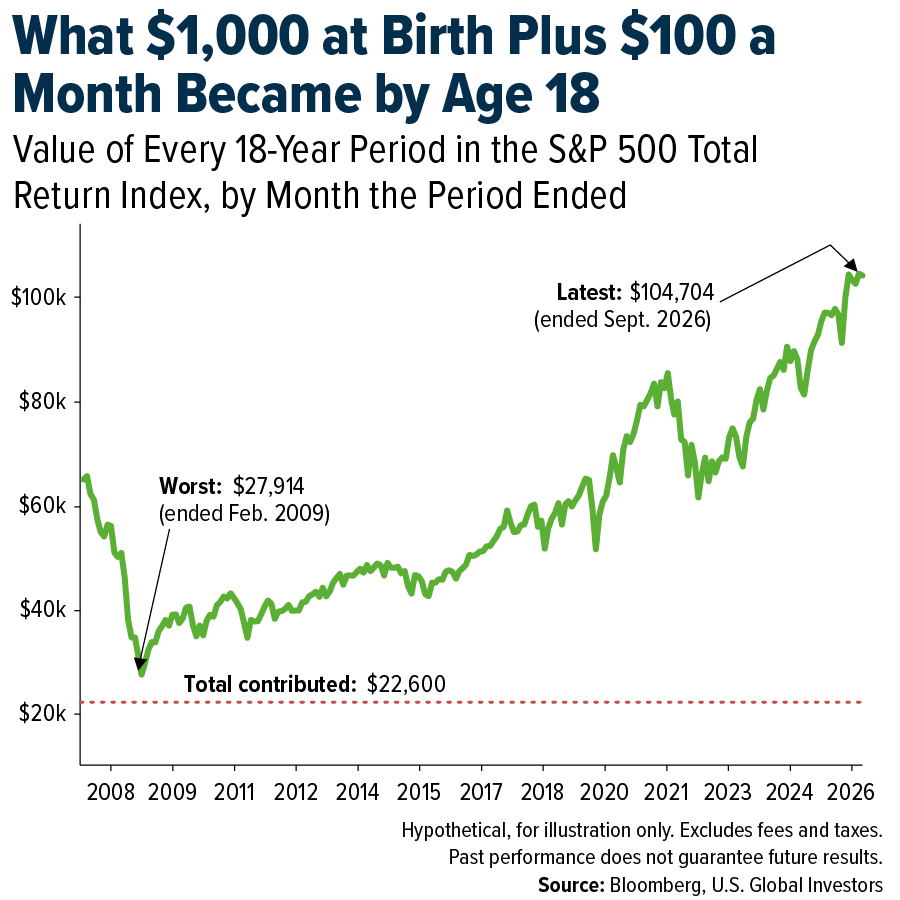
Compare that with $1,000 left alone for 18 years, which typically grew to about $4,150. The seed money helps. The habit of adding to it is what really builds wealth.
If you’re a parent or a grandparent, you can contribute to a child’s Trump Account. And if you’d like to put that same discipline to work for yourself or your family, our ABC Investment Plan lets you start with $1,000 and add $100 a month, automatically. It uses dollar-cost averaging, buying more shares when prices are low and fewer when they’re high, and it takes the guesswork out of market timing.
America’s generosity has always grown out of its prosperity. The AI boom is adding a new chapter, and some of the people building it want the next generation to own a piece of it. I can’t think of a better gift this upcoming holiday season.


Comments
Log in or sign up to join the conversation.