


The front of an eBAY office by Valeriya Zankovych via Shutterstock
eBay, Inc. (EBAY) delivered strong revenue and significantly higher FCF and FCF margins. But EBAY stock is at a peak, so can it still move higher? Maybe, but analysts don't believe so. One play is to short OTM puts.
EBAY is one of the few stocks that rose Friday, Oct. 30, closing up slightly at $121.64. Since its Oct. 28 Q3 earnings release (post-market), it's up 3.0% ($118.02) and 15.5% over the last month since Sept. 29 ($105.21).
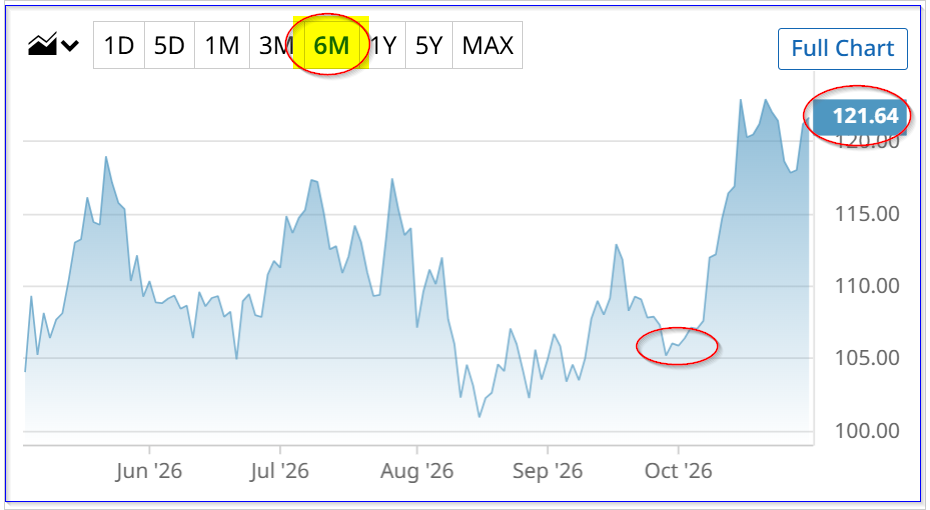
EBAY - last 6 months - Barchart - As of Oct. 30, 2026
The Barchart chart above shows that EBAY is near a 6-month peak. But can this continue? Let's look at its results.
Strong FCF Generation
eBay, Inc. reported that Q3 revenue was 14% higher YoY, which was 3.1% higher than analysts' forecasts. Over the past 12 months, it rose 15.68%, according to Stock Analysis.
However, although non-GAAP Q3 operating income (OI) rose 10.9% YoY, the margin decreased from 27% of revenue to 26.3%. Nine-month OI margins dipped from 28.3% to 28.0%.
Nevertheless, Q3 non-GAAP net income was up 8.2%. Earnings per share (EPS) rose more (+11.85% to $1.51 from $1.35), due to share buybacks. (EPS was lower than in Q1 and Q2).
More importantly, eBay generated $749 million in free cash flow (FCF). That represented 23.36% of revenue, up from 9.57% FCF margin in Q2, but lower than in Q1 and a year ago.
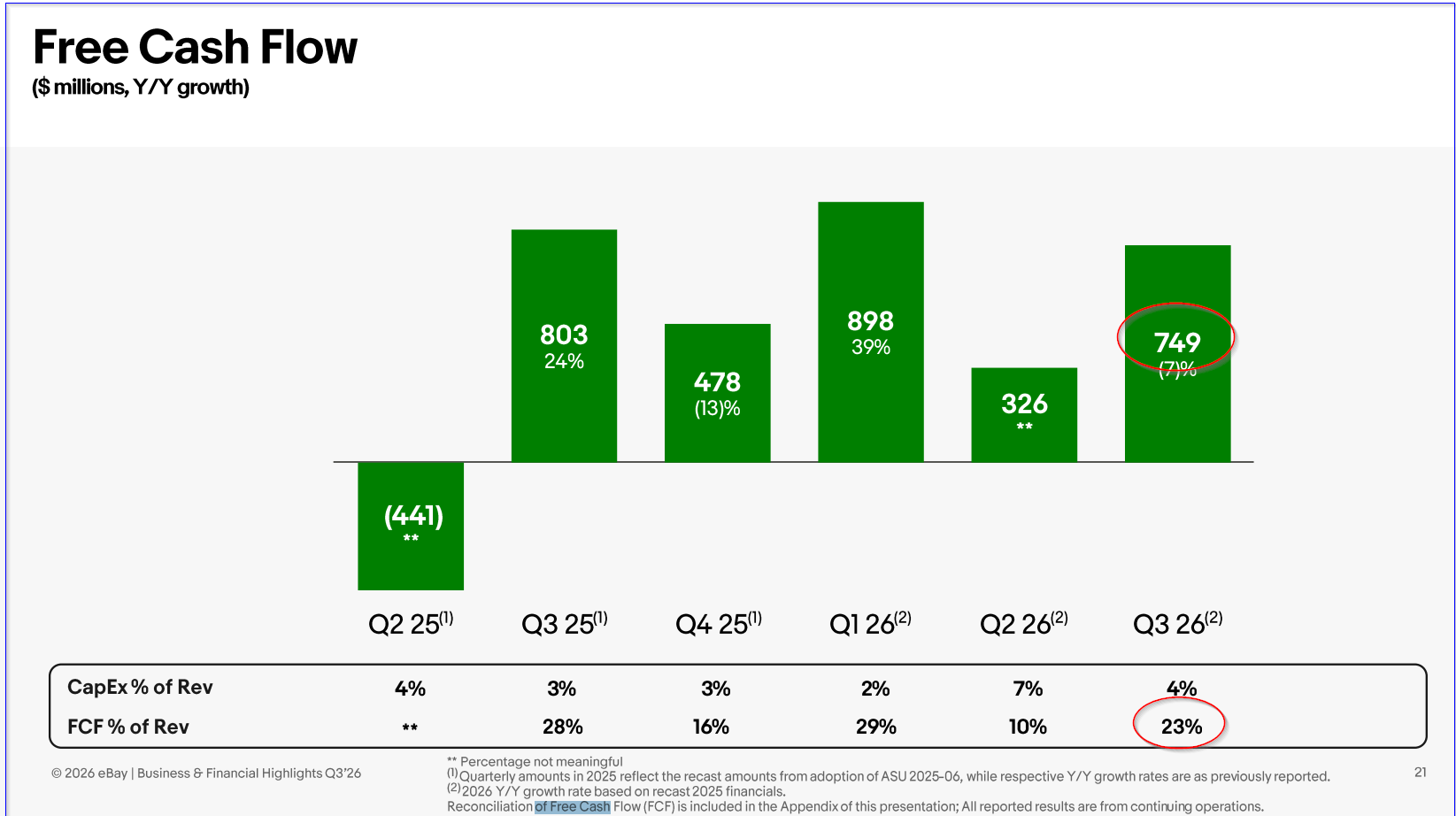
eBay quarterly FCF - page 21 of deck
The chart above from page 21 of eBay's deck shows FCF remains strong, despite a dip in Q2. In fact, for the nine months, FCF was $1.973 billion, representing 20.9% of revenue, up from 12.37% last year.
For the trailing 12 months (TTM), its FCF is higher at $2.451 billion (19.78% of revenue), vs. $2.505 billion last quarter (20.86% margin. So, in Q3, its TTM margin dipped slightly.
Nevertheless, it seems possible to assume at least a 20% FCF margin going forward.
Forecasting FCF and Fair Market Value (FMV)
Analysts now project 2027 revenue will rise 7.1% from $12.65 billion this year to $13.55 billion in 2027. So, if eBay can maintain a 20% FCF margin next year, its FCF could rise to $2.71 billion.
That's 10.6% higher than its TTM FCF of $2.451 billion. Moreover, that could push its fair market value (FMV) higher. To do this, I assume that the market will give the stock a 5% FCF yield, its typical metric (i.e., 20x FCF)
$2.71b FCF x 20 = $54.20 billion FMV
That is only slightly above its present $53.4 billion market cap, according to Yahoo! Finance (i.e., +1.50% higher).
As a result, the price target (PT) is 1.5% higher: $121.64 x 1.015 = $123.46 PT
That's similar to other analysts' PTs. For example, Yahoo! Finance reports that the average of 32 analysts is $126.11, and Barchart's mean survey PT is $125.00.
Those PTs are only 3.2% higher on average. Not much to write home about.
The bottom line is that EBAY stock is close to fair value. So, what is the best way to play it?
Shorting OTM EBAY Puts
One attractive play is to sell short out-of-the-money (OTM) puts in near-term expiry periods. That way, an investor can collect income while also setting a potentially lower buy-in point.
For example, look at the Dec. 4, 2026, expiry period. The $115.00 put option, which is 5.46% below Friday's close (i.e., “out-of-the-money”), has a $2.19 midpoint premium.
In other words, an investor can collect a one-month yield of 1.90% (i.e., $2.19/$115.00). That assumes EBAY stays above $115 by Dec. 4.
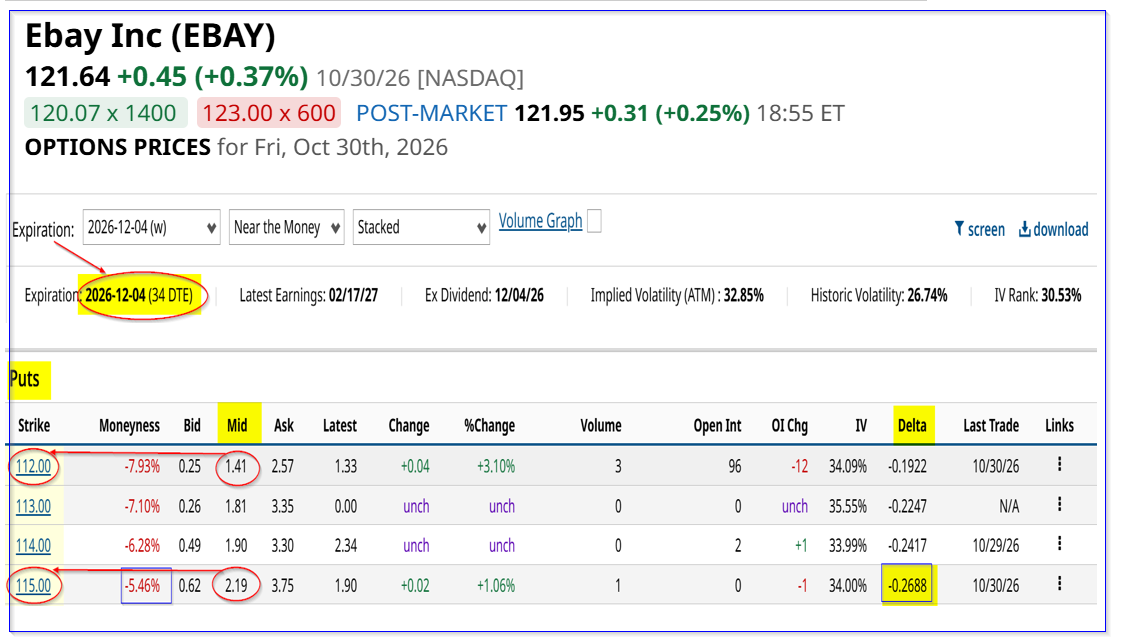
EBAY puts expiring Dec. 4, 2026 - Barchart - as of Oct. 30, 2026
If it doesn't, the sellers' $11,500 account collateral will be assigned to buy 100 shares at $115.00.
But since the account has already collected $219 (i.e., $2.19 x100), the breakeven buy-in is $11,281 (i.e., $112.81 per share). That's 7.26% below Friday's close, giving the investor an attractive buy-in point.
There also appears to be a good chance this will remain OTM, since the delta ratio is just -0.2688, implying a 73% chance this will occur.
EBAY Put Credit Spread
For investors willing to take on more risk, a put credit spread play provides much higher returns. For example, in addition to shorting the $115 put, an investor would buy the $112 put.
That means the net credit collected is:
$219 - $141 = $78
However, the brokerage firm would only require $300 in collateral for this play (i.e., ($115 - $112) x 100). That's much lower than the $11,500 required for a short-put play at $115.
That means the at-risk capital is just $222 ($300-$78), and the expected return (ER) is high:
$78 / $222 = 0.351 = 35.1%
This 35% one-month ER provides huge leverage. For example, the investor could do 3 put credit spreads and collect a similar amount to 1 short-put play:
3 x $78 = $234 (with $900 collateral required) and $666 at risk, vs.
$219 (with $11,500 collateral required)
However, the risk is substantially higher. If EBAY falls below $114.22 (i.e., $115-$0.78), the breakeven point, the investor starts to lose money. At $112, the whole $300 collateral ($222 at risk) is lost. With a short-put play, the worst that can happen is an unrealized loss, not a realized loss.
The bottom line is that given that EBAY is near a peak, EBAY investors have other plays than just “buy and hold”.



Comments
Log in or sign up to join the conversation.