

Last Thursday Diageo (DEO), the biggest spirits company on earth, stood up and told the market that its sales had gone backwards, that it was going to spend $1.2 billion tearing up its own operating model to save a billion a year, that thousands of people would lose their jobs, and that it was rewriting the dividend policy while it was at it.
That is always worth a few minutes of your attention. When a company delivers news that bad and the shares rally, the market is telling you it had already priced something considerably worse.
What Actually Happened to the Booze
Let me first be completely fair to the bears, because the case against this sector is not stupid. It is the opposite of stupid. Four separate things have hit these companies in four years, and every one of them is real.
Americans are drinking less, and not by a rounding error. Gallup has the share of US adults who drink at 54%, down from 67% in 2022. That is a collapse of thirteen percentage points in three years and the lowest reading in the near-ninety years Gallup has asked the question. Gen Z is not picking up the slack. It is the generation least interested in the product.
Then the drugs arrived. A randomised trial published in JAMA Psychiatry found that people on semaglutide drank significantly less on the days they drank at all, had fewer heavy drinking days, and reported lower craving week after week. Small trial, and I am not going to pretend otherwise. But hundreds of millions of prescriptions are now circulating globally, and a drug that quietly turns down the volume on wanting things is not a tail risk to a business built on wanting things. It is the business model in reverse.
Then China. In retaliation for European tariffs on Chinese electric cars, Beijing went after European brandy with anti-dumping duties, and cognac took the full weight of it. Then, fourth, COVID’s hangover, in the literal sense. The pandemic pulled years of premiumisation demand forward, distributors ordered against a party that was already ending, and the destocking has been grinding through the numbers ever since.
Add it up and you get one of the ugliest four-year stretches any consumer sector has produced. A Bloomberg index of around fifty listed drinks companies has shed something like $830 billion of market value and sits 46% below its June 2021 peak. Diageo, Pernod Ricard and Rémy Cointreau have all traded at their lowest levels in at least a decade. The index changes hands at roughly fifteen times forward earnings, less than half where it was valued in 2021.
So yes. Putrid. Which is precisely why I am looking at it.
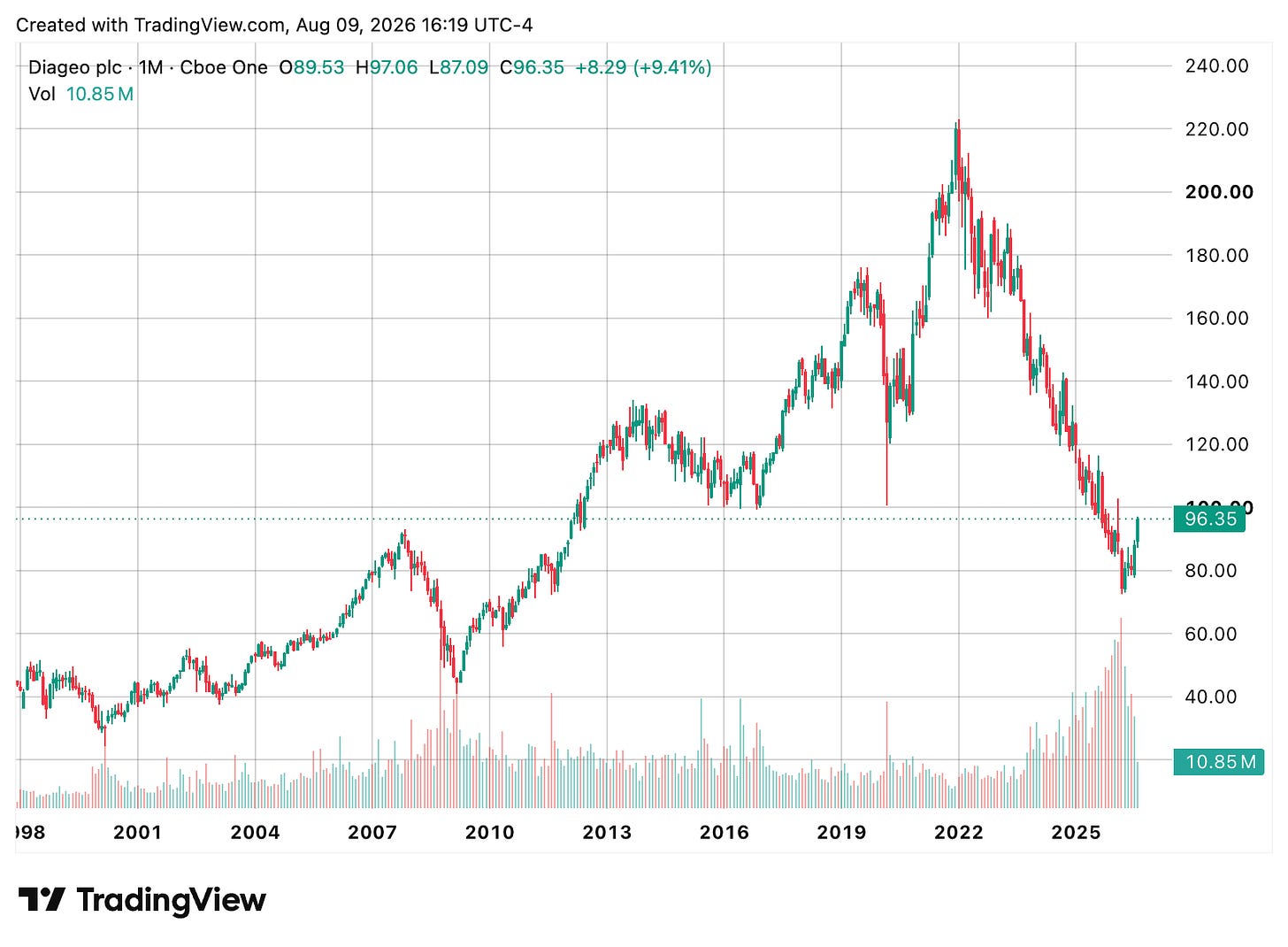
This chart shows the monthly share price of Diageo plc…the company behind spirits brands like Johnnie Walker and Guinness…from 1998 to August 2026. For investors, Diageo is considered a stable, defensive stock, so sharp price swings signal something meaningful about the business or the broader market. The stock climbed steadily for over a decade, peaking near $225 around 2021-2022, then collapsed dramatically, falling roughly 65% to around $80 by mid-2026. This is one of the steepest and most prolonged declines in the company's modern history, erasing years of gains. The most recent bar shows a strong monthly bounce to $96.35, up 9.4%, hinting at a possible early recovery…but the price remains near multi-decade lows.
The Only Question That Matters
Here is where I part company with the consensus, and it is not on the facts. It is on one word.
Structural.
Every bear case on this sector leans on that word, and every one of them stretches it across all four problems at once, as though a generation that never started drinking and a warehouse full of unsold cognac were the same kind of thing. They are not. They are four separate problems wearing one coat, and their half-lives are wildly different.
Gen Z drinking less is structural. GLP-1 suppressing consumption is probably structural, or at least durable enough that you should underwrite it as though it is. Fine. Price those in.
But post-COVID destocking is inventory. Inventory always ends, because warehouses are finite and eventually somebody has to order again. And the China tariff, the one that gutted cognac and took Rémy down with it? Look at what actually happened when Beijing finalised the ruling in July last year. It set the duties at 27.7% to 34.9%, and then exempted Pernod Ricard, Rémy Cointreau and LVMH (LVMUY)’s Hennessy outright, in return for nothing more than an agreement on minimum prices. The catastrophe that had been priced as permanent was negotiated down to a cost line inside twelve months.
Nobody re-rated anything.
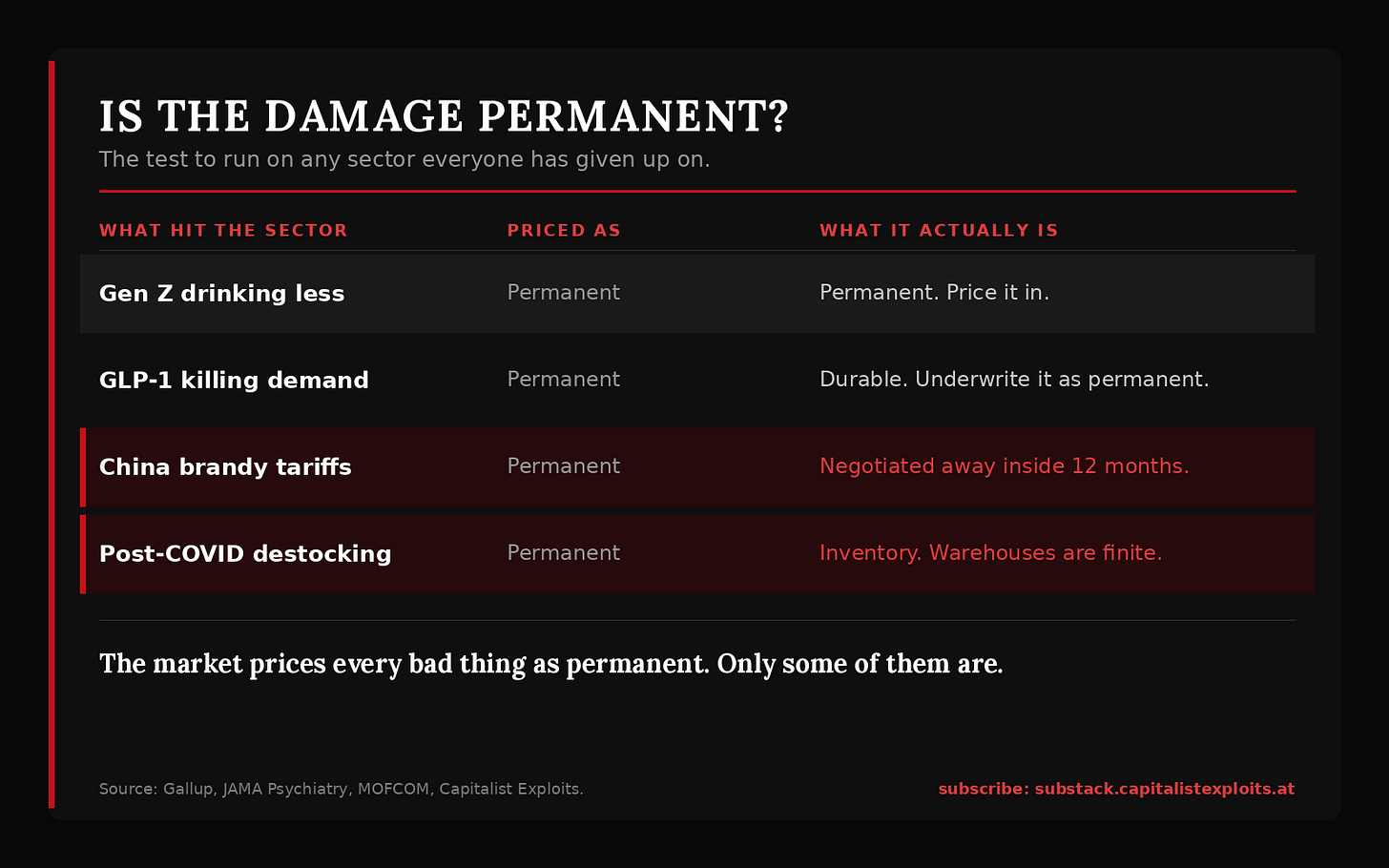
This infographic breaks down four headwinds hitting the alcohol/spirits sector and asks whether each one is truly permanent or temporary. The market tends to price every piece of bad news as if it will last forever…but that is often wrong. Two factors (Gen Z drinking less and GLP-1 weight-loss drugs reducing appetite for alcohol) are judged genuinely long-lasting and should be fully priced in. Two others (China brandy tariffs and post-COVID inventory destocking) are flagged as temporary…tariffs likely negotiated away within 12 months, and destocking simply ending when warehouses empty. The key takeaway: investors who can distinguish permanent structural damage from short-term noise may find mispriced opportunities in beaten-down spirits stocks.
We Have Read This Page Before
There is a sector that spent forty years in documented, undeniable, terminal volume decline. Every year fewer customers than the year before. Regulators against it, advertising bans, litigation, taxes designed explicitly to kill demand, and a product that a majority of the public agreed was harmful.
That sector was tobacco, and over the long run it produced the best returns of any industry in the American market. We wrote about the arithmetic of it in 265,528,900%, and the number in the title is not a typo. It is Altria (MO)’s total return over ninety-eight years.
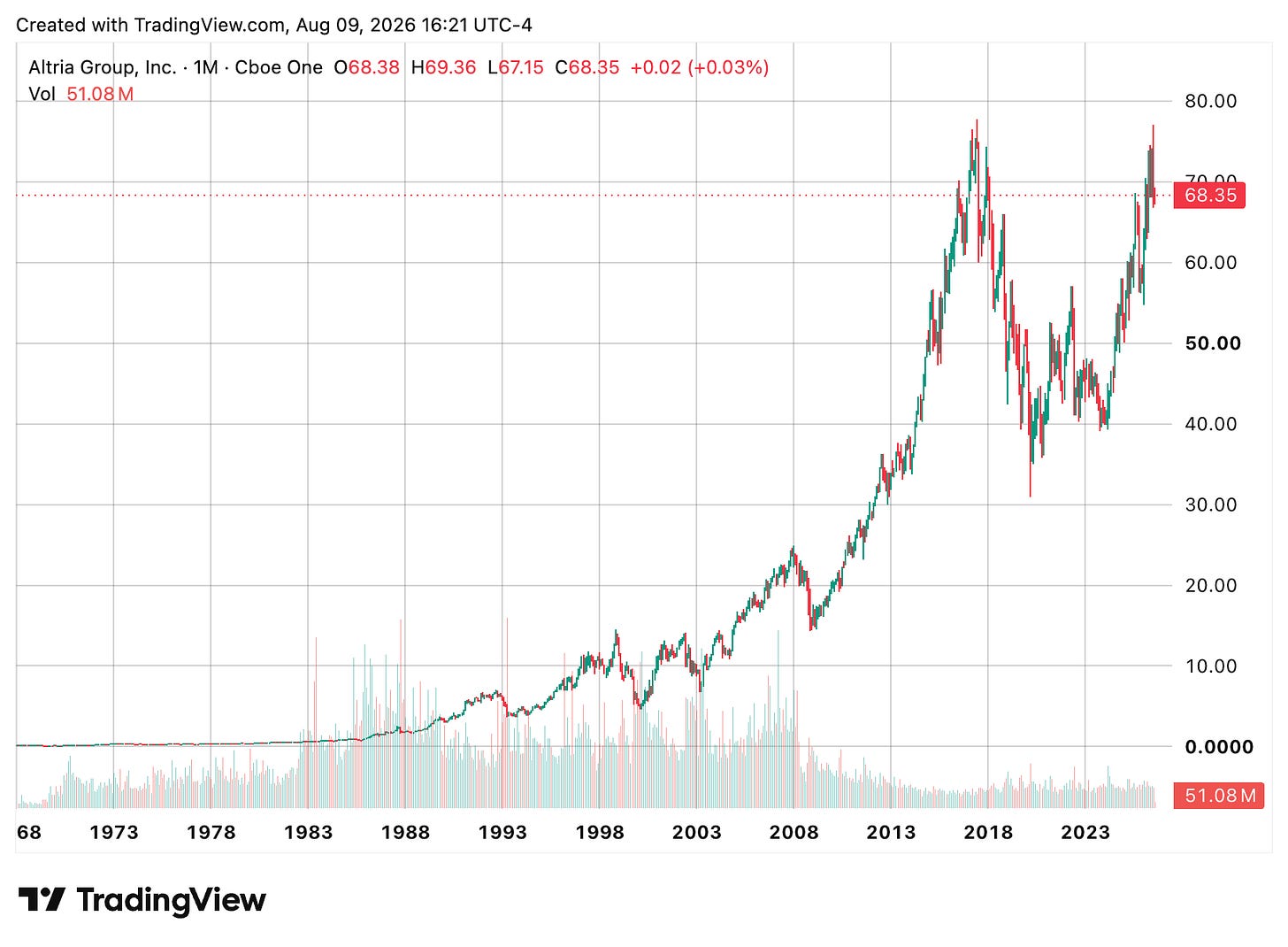
This chart shows the monthly share price of Altria Group (the maker of Marlboro cigarettes) from 1968 to August 2026. For investors, Altria is a classic 'dividend income' stock…it pays generous regular cash dividends, making the price history important for judging total returns. The most striking feature is the dramatic long-term rise from near zero in the 1960s to a peak around $75–80 in 2017, followed by a sharp and prolonged decline to roughly $40 by the early 2020s. The stock has since recovered strongly back to around $68, approaching but not yet reclaiming its all-time highs…a notable comeback after years of underperformance. The big drop after 2017 was driven largely by Altria's costly investment in e-cigarette maker Juul, which turned out to be a major financial loss.
The lesson was never that volumes did not fall. They fell, exactly as everyone said they would. The lesson is that a business with an unbreakable distribution moat, pricing power over a loyal remnant, and a share count shrinking every year does not need volume growth to compound. It needs to be bought at a price that assumes the funeral.
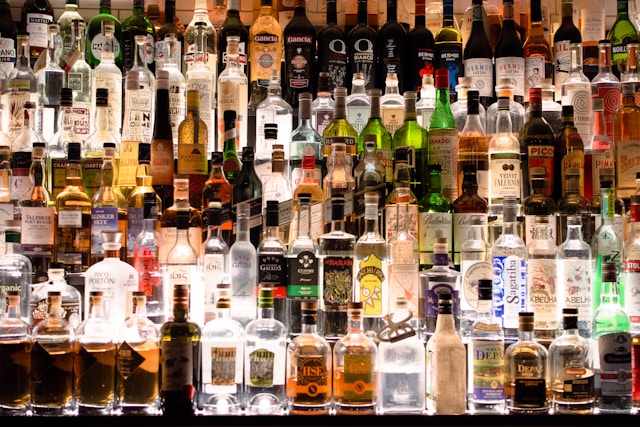
Now look at what this sector owns. Walk into any decent bar anywhere in the world and roughly half the bottles on the top shelf belong to just six listed houses. Six. That is not a brand portfolio, it is a distribution network that took a century to build and that no new entrant can replicate with a marketing budget. Marketing and distribution moats of exactly that kind are what the tobacco majors had.
And on the numbers, Diageo’s forward earnings multiple is now creeping toward ten, on a stock down some 80% from its 2022 high. The company has just handed the job to Sir Dave Lewis, who spent his last turnaround dragging Tesco out of an accounting scandal and a hole considerably deeper than this one.
What We Are Doing About It
We went through all six of those houses in the current issue of the Insider Newsletter, eleven days before Diageo stood up and reported. Not because we knew what the numbers would say. We had no idea. We flagged them because the price already assumed the worst version of every one of those numbers, which is the only thing we are ever really trying to establish. They sit there as ideas to explore rather than as anything resembling a recommendation. Do your own research, keep any position small, and understand that a bottoming process in a sector this hated will very probably take longer than you would like. They always do.
What makes this one interesting to us is not just the valuation. It is that it correlates with nothing else we look at. Whisky brands have precisely no relationship to coal miners, oil service stocks, tankers, Argentina, Brazil or the Chilean equity market. If you have spent two years being told to diversify and have quietly built a portfolio holding a dozen different ways to be long the same commodity cycle, then a cheap asset that moves to its own clock is worth considerably more to you than its upside alone would suggest.
Nothing here is investment advice and none of it is a recommendation. Do your own research. Everything carries risk, and what suits us may be entirely unsuitable for you.
The market has decided this sector is dying. It decided that about tobacco too, and it has been wrong for ninety-eight years.
If you want the six names and the maths behind them.
The current issue of the Insider Newsletter carries the full teardown of this sector, the analyst numbers on all six houses, and the reasoning on where we think the structural damage stops and the cyclical damage begins.
It also carries the rest of the issue, which has nothing to do with liquor at all:
The arithmetic on AGI that IBM (IBM)’s own chief executive put on the record. One gigawatt of data centre costs $80 billion to fill. The industry is chasing a hundred gigawatts. That is eight trillion dollars of capital expenditure requiring roughly $800 billion of annual profit just to service the interest, against a technology he gives a 0 to 1% chance of getting there.
Why the cavalry is not coming for oil, and what the Permian actually looks like now that tier-one acreage is drilled out.
The most extreme short positioning in Brent in fifteen years, sitting on top of the lowest onshore crude inventories ever recorded. A corner of the chart that nothing else in the data occupies.
And the story of Jean-Marie Eveillard, who was right about the dot-com bubble, lost two thirds of his shareholders for it, was called half senile by his own colleagues, and then watched the Nasdaq fall 80%.
Free readers get the argument. Paid subscribers get the evidence, the charts, the numbers and the names.

Comments
Log in or sign up to join the conversation.