


After three years of contraction, Dutch manufacturing is expected to see growth again in 2026. Increased demand for chipmaking equipment, as well as support from higher defence and infrastructure spending, should significantly boost production
Manufacturing production to return to growth in 2026 after a disappointing 2025
Differences between manufacturing subsectors remain substantial, but Dutch manufacturing as a whole has proved resilient amid major international turbulence. The renewed increase in demand for chipmaking equipment is the main driver behind the stronger growth outlook. Higher energy prices caused by the Iran war and the blockade of the Strait of Hormuz have weighed on consumer and producer confidence; as a result, expectations for exports, investments, private consumption, and consequently industrial orders in general, have been somewhat tempered.
Stronger demand for chipmaking equipment, temporary inventory build-up and less Chinese competition
Nonetheless, the volatile chipmaking equipment market is providing enough counterweight to expect growth. After a period of stagnation and slower growth, chipmakers have gained momentum this year. The large network of suppliers in the production chain is also seeing market demand pick up. In addition, the Iran war has led to extra inventory build-up and less Chinese competition for the energy-intensive industry. While both effects are temporary, they are providing some additional production growth this year.
Finally, higher defence spending, German infrastructure investment and EU import restrictions, such as the Carbon Border Adjustment Mechanism (CBAM) and higher steel tariffs, are increasingly supporting growth.
The Netherlands stands out from other eurozone countries
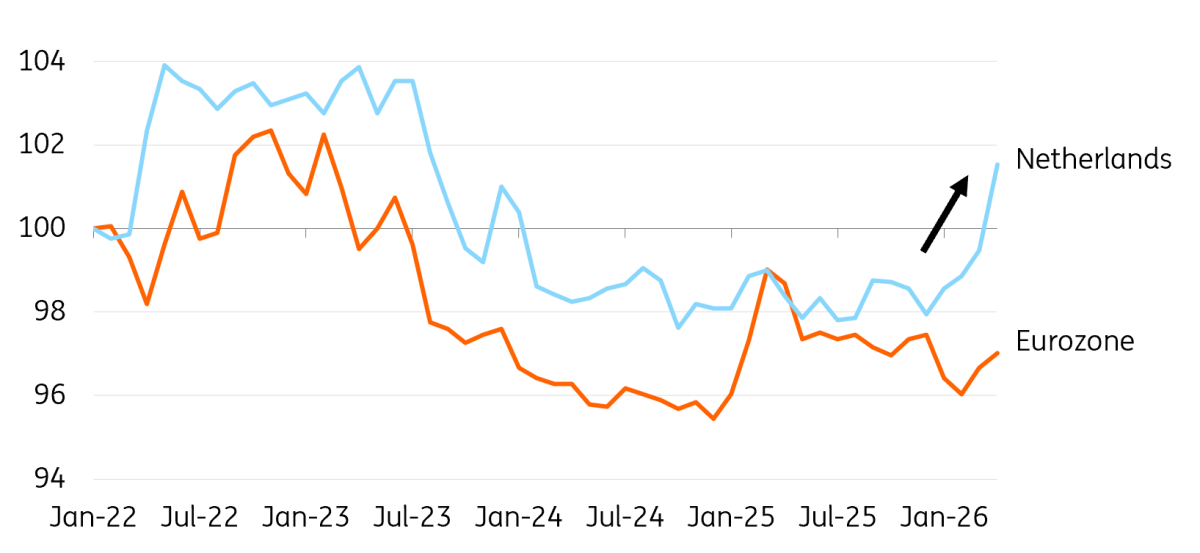
Manufacturing is recovering much more clearly in the Netherlands than in other eurozone countries. Actual production figures have shown a strong increase since December 2025 – something we haven't seen for the eurozone as a whole. The purchasing managers’ index also shows that Dutch manufacturing is outperforming peers abroad. While the PMI for eurozone manufacturers stood at 51.3 in June, the Dutch manufacturing PMI reached 55.5. That is near the highest level in almost four years and points to continued substantial growth.
Dutch production growth outpaces eurozone
Development of manufacturing production level, Jan-22 = 100*
*Season- and calendar-day adjusted, two-month moving average
The US and China are no longer strong growth markets
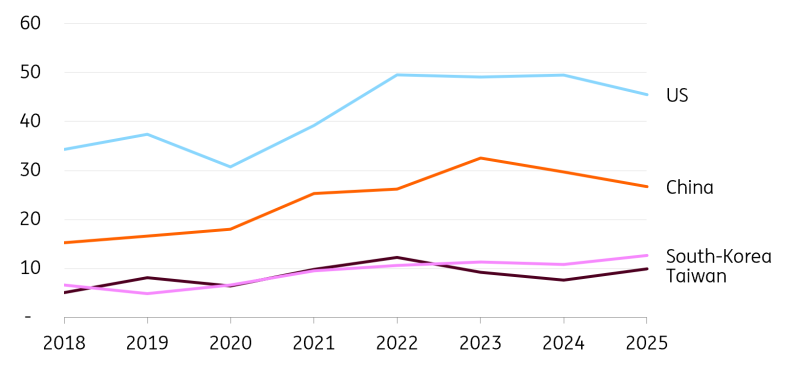
US import tariffs weighed on manufacturing in 2025 and will continue to do so in 2026. The 50% tariff on steel and aluminium particularly weakens the competitive position of Dutch products in the US market, including semi-finished goods and finished products such as vehicles, vehicle parts and machinery. Chipmaking equipment is less sensitive to tariffs due to its strong competitive position and Asian end markets, although ASML is affected by stricter US export restrictions on China. The US and China are no longer expanding as end markets for Dutch goods in general. Smaller, chip-related markets such as South Korea and Taiwan are gaining importance instead.
US and China are no longer growth markets, South Korea and Taiwan still are
Development of Dutch export value of goods for major markets
Source: Statistics Netherlands
Price increases are only modestly weighing on demand
Price increases are mainly set to weigh on product demand this year and next year at the start of the value chain. Energy-intensive basic goods, such as refined petroleum products, polymers, fertilisers and chemical products, have already become significantly more expensive. Supply disruptions from the Middle East allow Dutch producers to pass on higher raw material costs in part, but demand is weaker than during the 2022 energy crisis.
As a result, price increases are likely to remain moderate and to feed through only to a limited extent into prices for semi-finished and finished products. Contracts, forward purchases and hedging of energy and raw material prices also diminish and smooth the pass-through along the chain. If the ceasefire between the US and Iran holds and transport flows to and from the Gulf region continue to recover, the impact is likely to remain temporary and limited. However, a full recovery in oil production and maritime transport could still take months, and the situation remains fragile.
More positive on orders and inventories, but the divide is widening
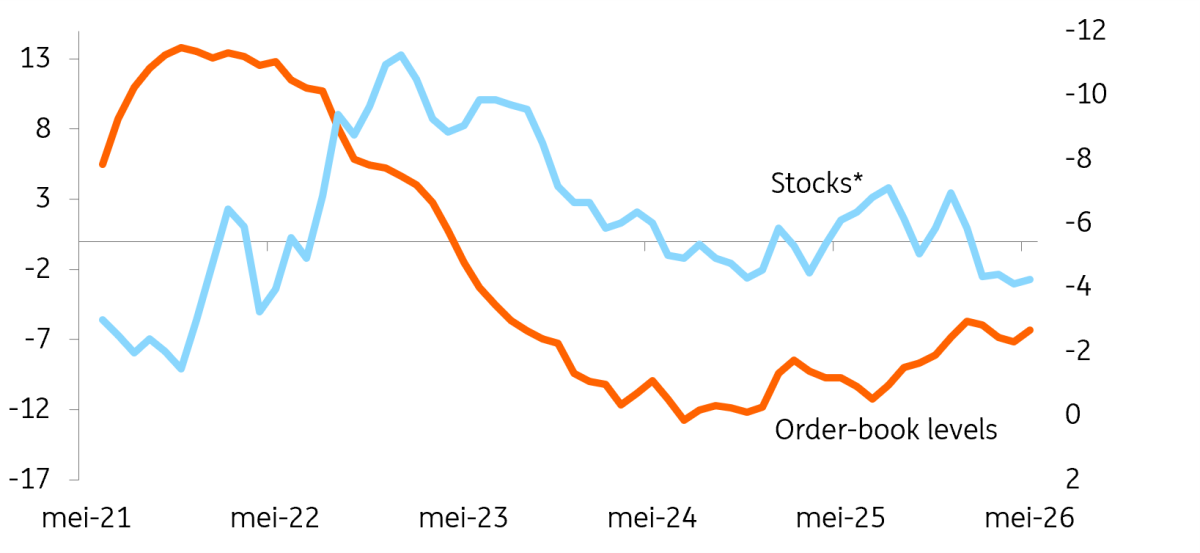
The increase in industrial activity is reflected in stronger order and inventory positions. Even so, expected activity has fallen below its long-term average for the first time since July 2025, likely due to uncertainty around energy prices, geopolitics and the economy. Industrial investment expectations for 2026 have also shifted from growth of more than 5% last autumn to a 3% contraction this spring. This reflects a widening divide. Parts of the metals, machinery and electrotechnical industry are benefiting from semiconductors, electrification and defence, while trucks, automotive parts and energy-intensive basic industry remain under pressure. It is precisely in that last sector that the largest industrial investments typically take place.
Producers more positive about order-books and stocks
Industrial producers' assessment of order-books and stocks of finished products*
Source: Statistics Netherlands
EU leaders are walking a fine line in tackling cheap imports from China
Major European markets such as chemicals, steel, cars and machinery are under pressure from the rapid rise in cheap imports from China. Low labour costs, technological progress, subsidies and an undervalued currency are strengthening China’s competitive position. In 2025, this was compounded by the diversion of Chinese goods originally destined for the US to Europe as a result of high US import tariffs. This pushed the EU trade deficit with China up to almost €1 billion per day. European leaders are looking for measures to counter unfair competition, such as a mandatory diversification of suppliers of crucial components, but remain divided and fear Chinese countermeasures. Moreover, Europe will remain dependent on China for rare earths and critical components, such as chips, for the time being.

Comments
Log in or sign up to join the conversation.