

The world is not running out of oil.
It’s running out of ways to move it, refine it, and pay for it…
One week you read that oil markets are headed for a record surplus. The next week you read that Europe could run short of diesel before Christmas.
Both stories are true.
Here’s Bloomberg on July 20:
Diesel Squeeze in Europe Set to Deepen, Morgan Stanley Says
“A diesel squeeze is playing out across Europe as a slew of major supply challenges coincide, according to Morgan Stanley, which flagged record refining margins in the region and slumping stockpiles.” The bank expects European diesel inventories to fall to roughly 299 million barrels by November, the lowest for that time of year since at least 2015, and its analysts write that “the real bottleneck in the oil system right now is refining, more so than crude.”
So the crude itself isn’t the problem.
Now, the numbers. In its June Oil Market Report, the IEA projects that world oil supply will fall 3.9 million barrels per day to 102.4 mb/d this year because of the Iran conflict, then rebound by 8 mb/d to 110.3 mb/d in 2027 while demand reaches just 105.3 mb/d. That’s a surplus of roughly 5 million barrels per day waiting on the other side of this war. Refinery runs, meanwhile, contract by 2 mb/d this year to 82 mb/d.
Plenty of oil… but not enough working refineries in the right places.
Here’s what the crude market itself has been saying:
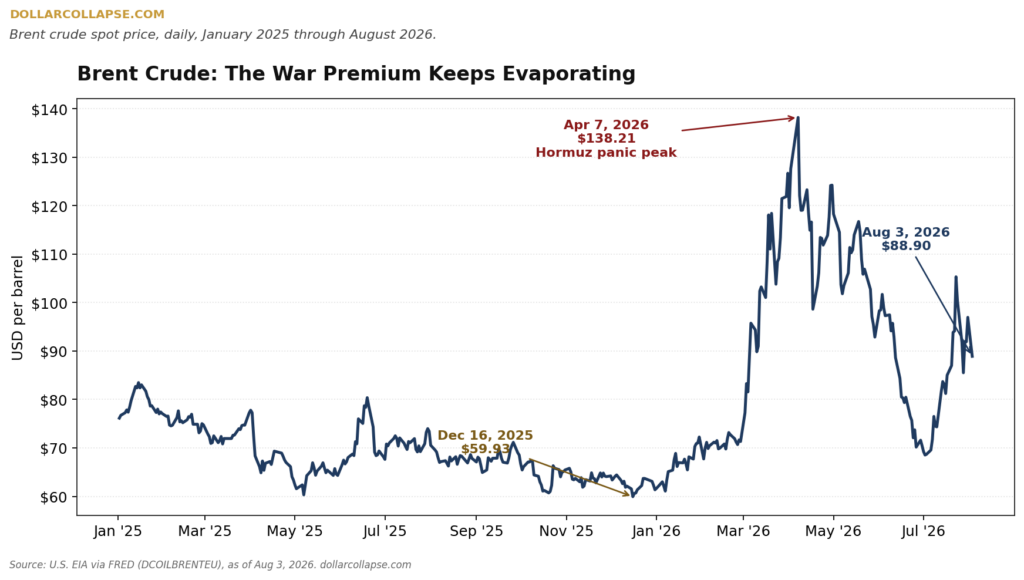
Brent touched $138.21 on April 7, when the Strait of Hormuz was all but shut. By August 3 it was back to $88.90. Every time the shooting pauses, the war premium drains out, because traders can see the surplus waiting behind the blockade.
And they can watch the strait reopening in real time. The IEA counted shipments through Hormuz rising from a May low of 9.6 million barrels per day to around 12 million in early June as the interim US-Iran framework took hold.
You see, Hormuz matters because it concentrates risk in one place: about a fifth of the world’s oil moves through a channel 21 miles wide at its narrowest point.
So the oil is there; it’s just whether or not it can get through a strait, past a sanctions regime, into a refinery that still runs, and out the other side as diesel before somebody’s inventory hits zero.
Oil. It’s abundant globally. Yet, scarce locally.
Natural gas has been running this exact experiment for four years.
Here’s the picture:
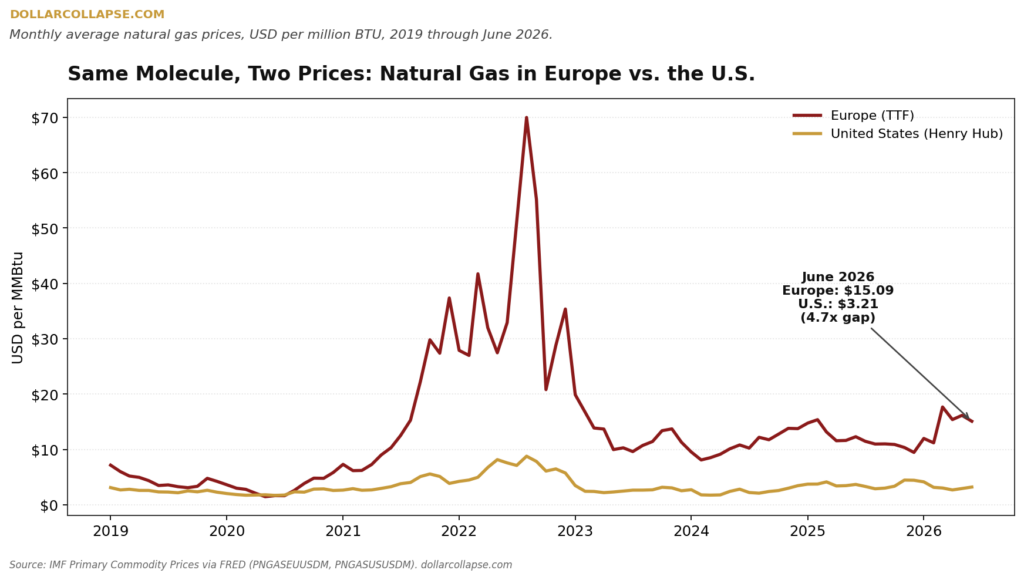
The same oil sells in Europe and America. In June, Europe paid $15.09 per million BTU while Americans paid $3.21. That 4.7x gap isn’t caused by a shortage of gas on planet Earth. In fact, there is a shortage of pipelines and LNG terminals connecting the gas to the buyer.
Diesel is now the next chapter of the same book. US retail diesel hit $5.26 a gallon on August 10, within sight of its 2022 record of $5.81, while crude sits under $90.
So what does a sound-money reader do with this?
First, stop pricing energy as one global market. Location is the trade now. Refiners, pipelines, LNG shippers, and storage operators sit inside the bottleneck, and bottlenecks collect tolls.
Second, watch what governments do when energy gets scarce locally. They subsidize, they cap prices, they drain reserves. OECD government oil stocks already fell 163 million barrels this spring, to their lowest level since December 1990. Every one of those responses gets paid for with borrowed and printed money, and that is why gold keeps making higher lows while crude round-trips from $60 to $138 and back.
Third, remember what energy insecurity does to currencies. A country that runs a permanent energy deficit ends up printing to cover it. A country with barrels to sell starts asking what it wants to be paid in, and more of those sellers now settle in local currencies and gold instead of recycling every petrodollar into Treasuries. The strait isn’t the only chokepoint under pressure. The dollar’s toll booth is the other one…
But the pattern is set. Energy insecurity doesn’t arrive as empty wells…
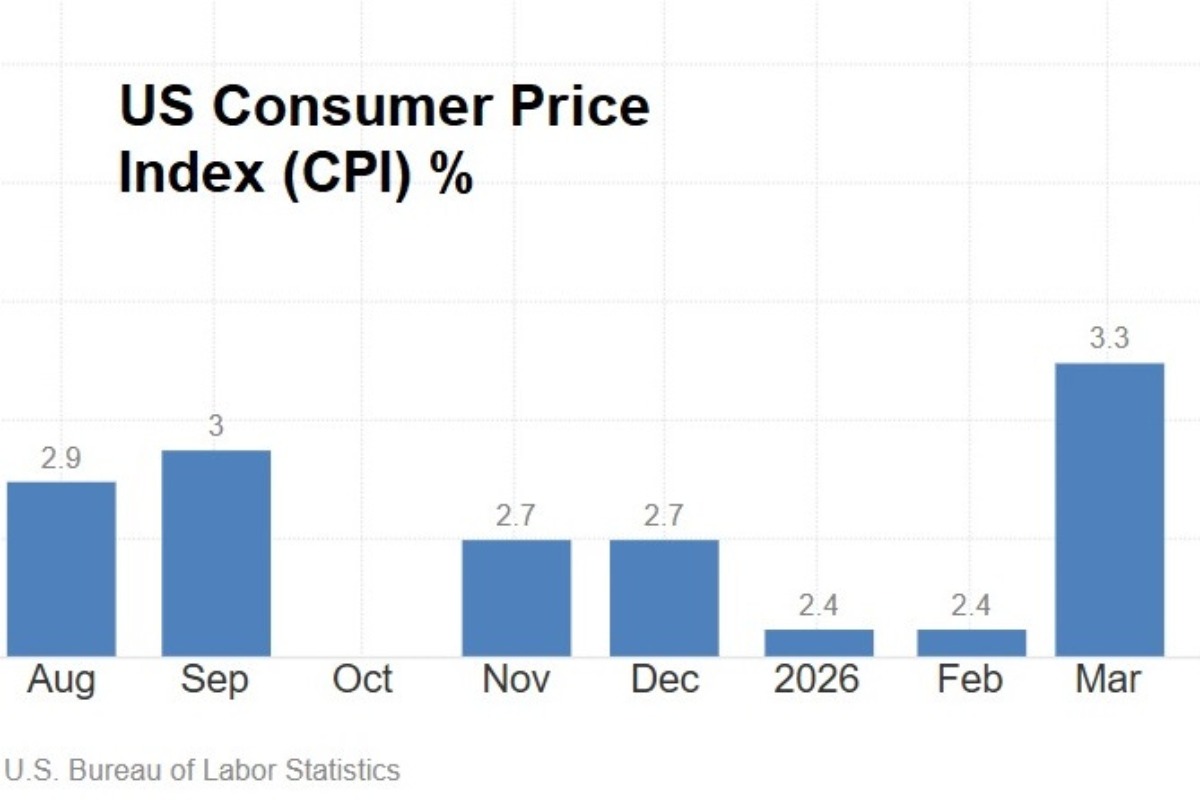
It arrives as inflation.
And inflation is the one shortage central banks always know how to deliver.
That’s the truth about oil prices: the world is drowning in oil, and still dying of thirst.

Comments
Log in or sign up to join the conversation.