

US futures
Dow futures -0.7%, S&P futures -1.11% & Nasdaq futures -1.55%
In Europe
FTSE -1.78% & DAX -2%
U.S stocks fall, led lower by tech.
Treasury yields jump to 4.54% as inflation worries rise
Chip Stocks fall after the U.S.-China summit failed to discuss the chip export bans.
Oil is rising 8% across the week
US stocks fall as AI rally cools and inflation fears build
US stocks are falling sharply on Friday, led lower by technology shares, as the recent AI-driven rally shows signs of fatigue while Treasury yields climb amid mounting inflation concerns linked to the ongoing closure of the Strait of Hormuz.
The US 10-year Treasury yield rose to 4.54%, its highest level since May last year. Bond yields globally are also moving higher as investors reassess inflation risks stemming from the economic fallout of the Iran war.
Comments from Donald Trump overnight that he was “losing patience” with Iran heightened concerns over rising tensions and the lack of progress towards a diplomatic agreement.
As a result, oil prices are pushing higher, adding to inflation worries in a week that already saw both US CPI and PPI come in hotter than expected.
Markets are now pricing in a roughly 40% probability of a Federal Reserve rate hike by year-end, according to CME FedWatch data.
While equities had previously managed to shrug off inflation concerns amid enthusiasm surrounding AI and strong earnings, that optimism appears to be fading, particularly after discussions between Trump and Xi Jinping failed to address semiconductor export controls.
Investors will continue to monitor developments from the US-China summit, which wraps up today without any major breakthroughs after discussions spanning trade, tariffs, Iran and Taiwan.
Corporate movers
Applied Materials is falling 2% pre-market despite posting fiscal Q2 results that beat forecasts on both revenue and earnings. The company reported EPS of $2.86 on revenue of $7.91 billion.
Chip stocks remain under pressure, with the semiconductor ETF on track to snap a six-week winning streak. Intel, ASML, Arm Holdings and Advanced Micro Devices are down between 3% and 4% after chip export controls were reportedly not discussed during the Trump-Xi talks. Critical minerals and market access for US technology firms are expected to remain key sticking points.
Cerebras Systems is down 1% after surging 68% on Thursday during its Nasdaq debut.
Magnum is jumping 17% on reports that Blackstone and Clayton, Dubilier & Rice are among firms considering a takeover bid.
Dow Jones – Technical analysis
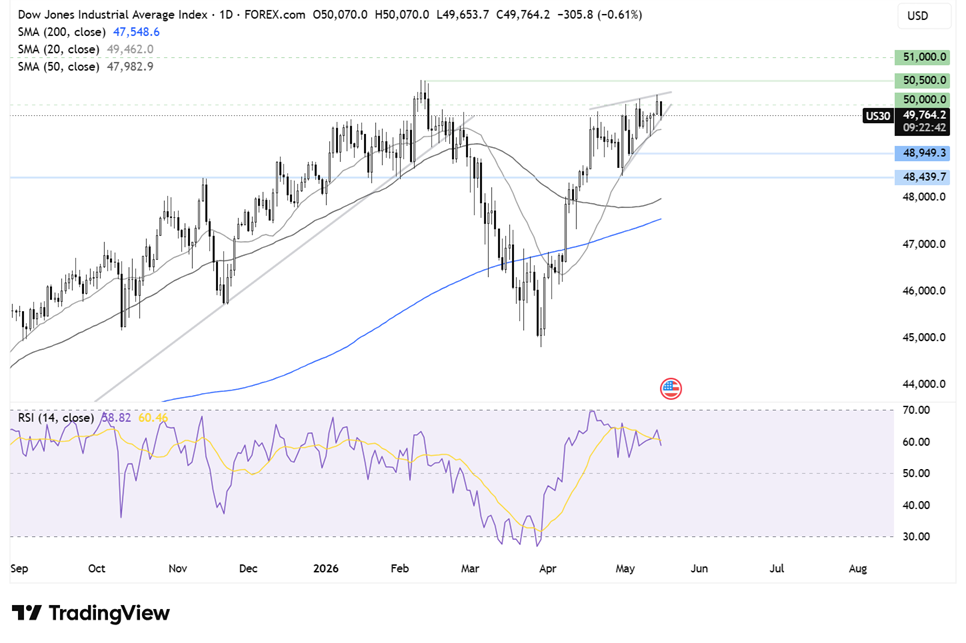
The Dow Jones continues to trade within a rising wedge bearish reversal pattern. The index rebounded from rising trendline resistance near 50,200 before easing back to test trendline support around 49,650.
A break below this level could open the door towards the 20 SMA at 49,450, confirming the reversal pattern. Below there, attention turns to 48,950, the May low, ahead of 48,500, the April 30 swing low.
Should support hold, buyers would need to break above 50,250 and rising trendline resistance to invalidate the bearish wedge pattern and bring the record high around 50,500 back into focus.
FX markets – USD rises, GBP/USD falls
The US dollar is strengthening, tracking Treasury yields higher and climbing to its highest level in 18 days. The rally comes amid persistent US-Iran tensions and stronger-than-expected inflation data, which have fuelled speculation that the Federal Reserve may ultimately need to tighten policy further.
EUR/USD has fallen to its lowest level since early April as widening US-German yield spreads and higher energy prices weigh on the euro. ECB chief economist Philip Lane warned that the oil shock from the Iran war could force the European Central Bank to raise interest rates, potentially as soon as June. However, tighter policy risks further slowing Eurozone activity, with PMI data already pointing to contraction.
GBP/USD is also weakening, not just against the dollar but across major peers, amid mounting domestic political uncertainty. Keir Starmer has pledged to remain in office, but pressure within the Labour Party continues to build. Markets are increasingly concerned about the prospect of Andy Burnham emerging as a challenger, with fears that a more left-leaning leadership could reignite concerns over UK fiscal credibility.
Oil jumps as Middle East tensions intensify
Oil prices are rising more than 3% on Friday and are up roughly 8% for the week amid growing concerns over the lack of progress towards a peace agreement that would reopen the Strait of Hormuz.
Following talks with Xi Jinping, Trump said both sides agreed Iran should not be allowed to obtain nuclear weapons and that the Strait of Hormuz must reopen. He added that he was “losing patience”, fuelling concerns over further escalation.
Around 30 vessels reportedly crossed the Strait between Wednesday and Thursday. However, traffic reportedly slowed to just 10 vessels over the past 24 hours, well below the roughly 140 daily crossings seen before the conflict began.


Comments
Log in or sign up to join the conversation.