DocuSign Tests The Software Upsell

DocuSign is pivoting to AI-driven contract management to escape the commodity trap of basic e-signatures.

Source: DepositPhotos

The software world treats basic digital signatures as a commodity. When everyone offers an electronic pen, pricing power vanishes. For DocuSign to escape that trap, it needs to turn those static documents into active data. The latest quarter shows early signs that this pivot is working. By deploying artificial intelligence to read and manage contracts, DocuSign is beginning to convince enterprise customers to pay premium prices again. The question is whether this new growth engine can outpace the anchor of its legacy business.

Main Note

Can Artificial Intelligence Save DocuSign?

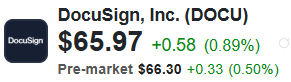
DocuSign (DOCU) Quote

Verdict: DocuSign is showing that a broader agreement management platform can gain traction with its customer base. Intelligent Agreement Management now represents 15.1% of total annual recurring revenue, but it is still too small to materially change the company’s overall growth rate on its own.

What happened

DocuSign reported second quarter revenue of $875.7 million and adjusted earnings of $1.16 per share, beating Wall Street estimates. Shares moved roughly 4% higher in after hours trading Thursday, trading around $68.

Management also raised full year revenue guidance to a midpoint of $3.503 billion. The new Intelligent Agreement Management platform reached 15.1% of total annual recurring revenue, up from 12.6% in the prior quarter.

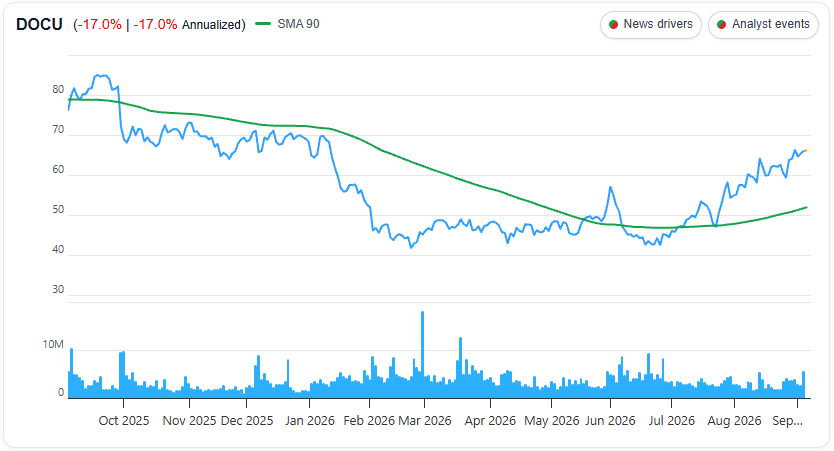
DocuSign (DOCU) 1 Year Price Chart

DocuSign (DOCU) 1 Year Price Chart

Why it matters

The core mechanism here is the upsell. DocuSign’s public web plans price Intelligent Agreement Management above basic electronic signature packages, but those published prices vary by billing option and promotion, while larger enterprise accounts are sold through negotiated contracts. The higher priced platform combines signing with artificial intelligence search, contract analysis, renewal tracking and automated workflows. That gives DocuSign a way to sell more software into its installed base instead of competing only on the price of a signature. The opportunity is real, but this quarter’s disclosures do not tell us how much of IAM growth came from higher prices, customer upgrades or new customers.

What changed in the thesis

Investors now have stronger financial evidence that Intelligent Agreement Management is becoming a meaningful part of the business. Its share of total annual recurring revenue rose from 12.6% to 15.1% in one quarter, while the number of customers spending more than $300,000 in annual contract value increased 14% to nearly 1,300. That does not prove DocuSign has broadly migrated its user base or regained pricing power, but it does show that the platform is gaining traction with larger customers. Management now expects Intelligent Agreement Management to represent 18% to 19% of total annual recurring revenue exiting the fourth quarter of fiscal 2027.

What the market may be missing

The cash cushion is enormous while this transition happens. The company generated $295.8 million in free cash flow, representing a strong 34% margin. DocuSign used that heavy cash generation to reduce share count, buying back over $300 million in stock during the quarter. This capital allocation strategy helps defend the valuation while the new business scales.

Valuation and expectations

The stock continues to trade at a compressed multiple of roughly 3.5x enterprise value to sales. That discount exists because total revenue growth is still anchored in the single digits at 9%. Foreign exchange added about 1.3 percentage points to the reported result, while a temporary comparison against last year’s digital add on revenue reduced growth by about 1.6 percentage points. For the multiple to expand, the Intelligent Agreement Management platform must become large enough to pull the company’s overall growth rate higher. The catch is that the platform still represents only 15.1% of total annual recurring revenue, so it is not yet large enough to change the growth profile on its own.

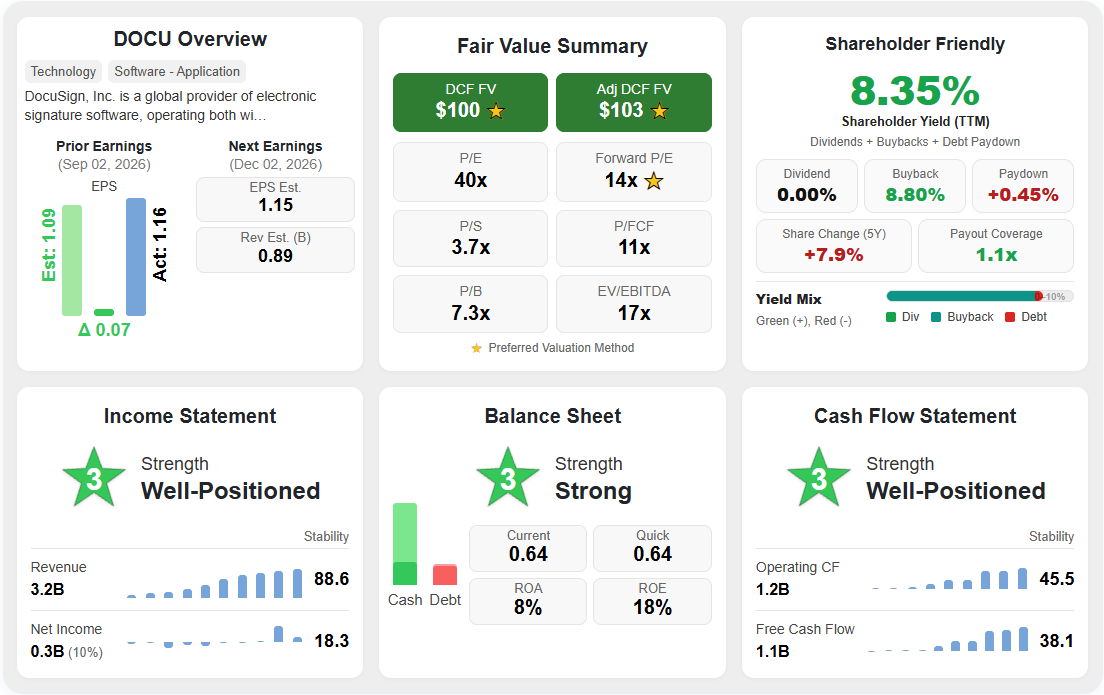
DocuSign (DOCU) Summary Scores

DocuSign (DOCU) Summary Scores

Bottom line

The product pivot is showing real financial proof and the margin profile provides a highly efficient safety net. Until the math shifts and the new artificial intelligence platform overcomes the drag of the legacy business, the stock multiple will likely remain compressed.

Pre Market Pulse

  • Investors are focused on the August nonfarm payrolls report due at 8:30 AM ET today

  • Economists expect roughly 56,000 new jobs after a 23,000 decline in July, with the unemployment rate holding steady at 4.1%

  • Major index futures are mixed to slightly higher as traders wait for the labor data, while Brent crude remains near $95 a barrel amid renewed U.S. Iran tensions

Why it matters this morning

This jobs report can still move the market, especially if hiring lands far outside expectations, but it is not setting the size of an expected interest rate cut. Traders are split between a Federal Reserve rate hold and a rate hike later this month, and next week’s inflation data may matter more. A weak jobs number would strengthen the case for holding rates steady, while a strong report could keep a hike in play.

Peer Read Through

Adobe (ADBE)

Adobe Acrobat Sign targets enterprises and individuals needing comprehensive PDF toolkits. The base plans start around $14.99 per month, keeping pressure on the low end of the market.

Dropbox (DBX)

Dropbox Sign offers a simple cloud storage integration for small and mid sized businesses. Its essential plans run $15.00 per month, serving as a cheap alternative for straightforward workflows.

PandaDoc (PRIVATE)

This competitor focuses heavily on sales and revenue teams for proposal creation. It offers a $19.00 per user per month starting tier, reflecting the intense pricing competition in the space.

Group takeaway

The basic electronic signature space is saturated with cheap alternatives from established giants and nimble upstarts. This competitive pricing environment is exactly why DocuSign is forced to build deep contract lifecycle management features directly into business systems to secure premium enterprise software budgets.

What to Watch

  • Whether Intelligent Agreement Management reaches management’s target of 18% to 19% of total annual recurring revenue exiting the fourth quarter of fiscal 2027

  • Direct dollar net retention from direct customers, currently 103%, and the number of customers spending more than $300,000 in annual contract value, which reached nearly 1,300

  • The pace of ongoing share repurchases as management deploys its remaining $2.1 billion authorization

Bottom line

The next proof point is simple. If Intelligent Agreement Management stalls before reaching 18% to 19% of total annual recurring revenue exiting the fourth quarter, or if direct dollar net retention falls back from 103%, the bet that DocuSign can escape the commodity trap will quickly look much weaker.

STOCKS IN THIS ARTICLE

Also Mentions:

Comments