

The divergence within China's economy is widening. Retail sales and fixed asset investment growth both plummeted to the lowest levels since the pandemic as domestic demand remains soft. But industrial production remains a bright spot, supported by strong external demand
Retail sales growth fell into negative territory in May
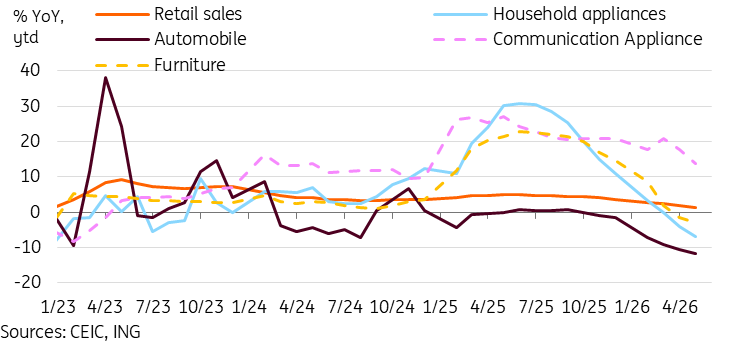
China's retail sales growth fell to -0.6% year-on-year in May, down from 0.2% in April. The data was in line with our forecasts, but weaker than market consensus (market -0.2%, ING -0.6%). It’s the lowest level since pandemic-skewed 2022.
We continued to observe the impact of the trade-in policy on related categories, which dragged down overall consumption. Beneficiary categories such as household appliances (-15.6%), autos (-16.1%), and furniture (-8.7%) saw outsized drops on the month. We’re now seeing the flip side of frontloading consumption.
Gold and jewellery sales also performed poorly on the month at -8.9% YoY amid the continued drop in gold prices. Despite the hike in gasoline prices, petroleum sales also dropped 3.2% YoY.
Consumer staples such as grains and oils (1.9%) and beverages (6.1%) outperformed on the month.
Consumer confidence remains quite soft in China, as wage growth slows and household balance sheets continue to be impacted by the property price downturn. This year's smaller stimulus push is also leading to disappointing year-to-date retail sales growth. Given the prominent role of boosting domestic demand in China's Five-Year Plan, more measures to boost consumption could be rolled out moving forward.
Trade-in policy beneficiary sectors are now heavily dragging growth
Fixed asset investment continues to plummet amid uncertainty
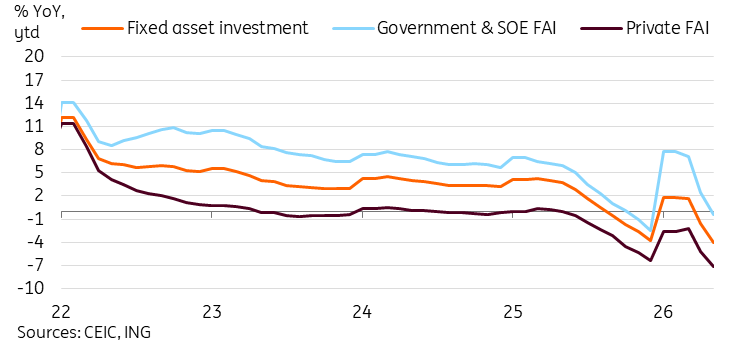
Fixed asset investment dropped to -4.1% YoY ytd, down from -1.6% YoY ytd in April. This was well below forecasts (market: -2.3%, ING: -2.8%) and marked the lowest level since 2020.
Private sector investment continued to lag heavily, down -7.1% YoY ytd, compared to a smaller drop of -0.4% YoY ytd for public investment. Decision makers may have preferred caution amid global geopolitical uncertainty, adding to an already weak investment environment.
By industry, there was substantial divergence. We continued to see solid investment into sectors such as rail, ships, and aerospace (23.6%), textiles (10.8%), transportation (7.1%), and computer and electronics manufacturing (6.7%), which are currently benefiting from strong external demand. Hi-tech investment continued to grow at 4.5% YoY ytd. However, most other industries saw negative investment growth.
The lack of investment appetite is one of the factors impacting markets, translating into low borrowing demand and, consequently, banks parking more funds in government bonds. Policymakers have expressed an intention to stabilise investment this year. It looks like they have their work cut out.
Private sector investment continues to heavily underperform
Industrial production remains the lone bright spot
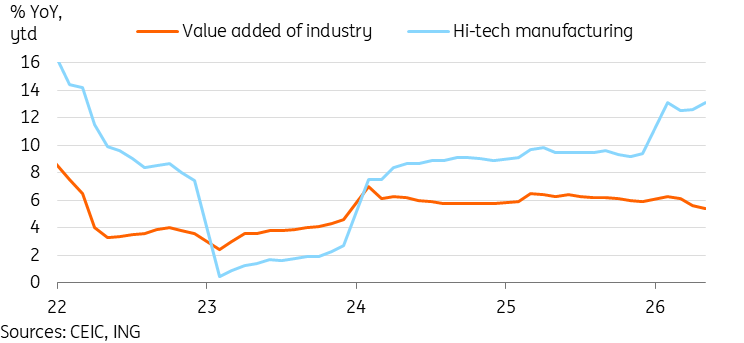
Industrial production grew by 4.5% YoY in May, up from 4.1% in April. It was the lone indicator this month that came in stronger than forecasts (market: 4.4%, ING: 4.3%).
Industrial production continues to be supported by strong external demand, and the data show that the outperforming sectors are the same ones that see strong export growth. Autos (8.3%), rail, ships, and aerospace (7.4%), and computer and electrical equipment manufacturing (17.0%) all solidly outpaced headline growth.
Amid China's efforts toward industrial modernisation and tech self-reliance, hi-tech manufacturing has also outperformed at 15.1% YoY in May. Industrial (27.9%) and service (19.8%) robotics production continued to grow strongly.
In contrast, sectors traditionally buoyed by domestic real estate and infrastructure investment, such as cement (-8.1%), steel (-2.8%), and glass (-6.3%), all continued to struggle.
Hi-tech manufacturing continues to drive industrial activity
Property prices continued to see mild decline
China's National Bureau of Statistics released its 70-city sample of property prices for May. New home prices fell by -0.20% month-on-month, while used home prices dipped by -0.26%.
Looking at the city-level breakdown, we had a slightly softer read in May than last month's data, but positive momentum in tier-1 and tier-2 cities generally continued. This is an important development toward eventually finding a trough in property prices. In the primary market, 18 cities saw prices stabilise or rise in May (up from 21 in April), versus 13 in the secondary market (down slightly from 16 in April).
It remains too early to confidently call a bottom for the property market, as prices continue to decline, and inventory levels remain high. Property investment, already down -16.2% YoY ytd, will remain a major drag on growth for some time.


Comments
Log in or sign up to join the conversation.