Dell And The Backlog Bottleneck

Dell Technologies surged on a record $95 billion AI server backlog, dismissing fears of an infrastructure spending slowdown.

Source: DepositPhotos

The market has spent the past few months debating whether the AI hardware build-out was starting to slow. High interest rates and questions about how quickly customers will earn a return on all that spending gave the slowdown argument some credibility. Then Dell (DELL) released its quarterly numbers. The company booked a record $60.9 billion in AI server orders and finished the quarter with a $95 billion backlog. That does not eliminate demand risk, but it is strong evidence that the build out has not hit a broad pause. For Dell, the near term bottleneck has moved toward supply, deployment and the ability to turn that order book into profitable cash flow.

Main Note

Dell Challenges the Hardware Pause Narrative

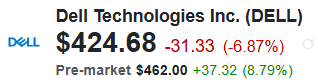
Dell Technologies (DELL) Quote

Verdict: The size of Dell’s AI backlog is strong evidence that customers are still trying to secure computing power. But the order book is not all traditional enterprise demand. It also includes large AI cloud providers and sovereign customers, and some large buyers are placing orders earlier because supply is tight. The next question is whether Dell can convert that backlog into revenue, margins and reported cash flow without creating too much financing or delivery risk.

What happened

Dell reported second quarter fiscal 2027 earnings after the close yesterday. Revenue reached a record $47.0 billion and adjusted earnings came in at $7.04 a share. The company booked a record $60.9 billion in AI server orders, recognized $16.4 billion of AI server revenue and finished with a $95 billion AI backlog. Dell also raised full year revenue guidance by $25 billion to $192 billion and lifted its adjusted earnings outlook from $17.90 to $25.50 a share. Shares were up nearly 10% in premarket trading this morning.

A backlog this large pushes back hard on the idea that AI infrastructure spending is about to fall off a cliff. But it does not prove every part of enterprise hardware demand is accelerating. Dell said demand is broadening across newer AI cloud providers, sovereign buyers and traditional enterprises, while also noting that large customers are ordering further in advance to secure scarce supply. That makes the order book impressive, but it also makes the timing and profitability of those shipments important.

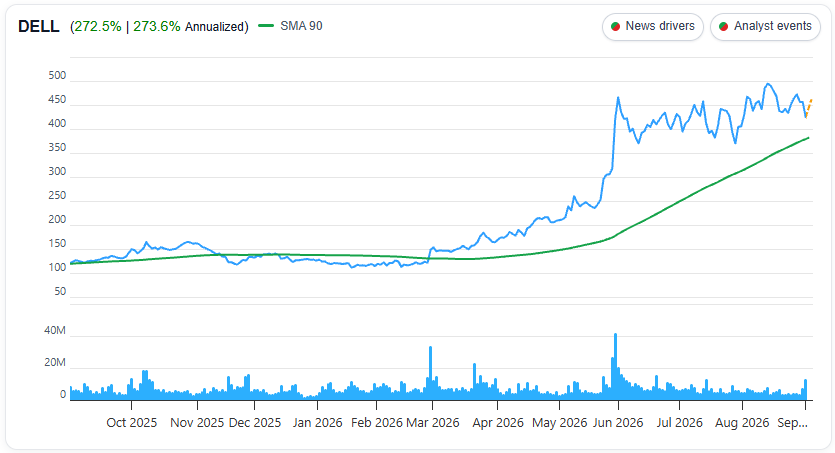
Dell Technologies (DELL) 1 Year Price Chart

Dell Technologies (DELL) 1 Year Price Chart

Why it matters

The economic variable that matters most here is how efficiently Dell converts orders into revenue, profit and cash. Component availability and shipment timing are only part of that equation. Pricing, margins, working capital and customer financing matter too. Dell reported $2.2 billion of operating cash flow and $986 million of free cash flow. Its much larger $8.1 billion adjusted free cash flow figure adds back $6.7 billion tied to financing receivables and another $496 million tied to equipment under operating leases. That does not make the adjusted number wrong, but investors should understand that it is not the same as reported free cash flow.

What changed in the thesis

Investors had been focused on whether demand would dry up. That risk has not disappeared, but the near term focus has clearly shifted toward supply chain execution and customer deployment readiness. Management said DRAM, the working memory used inside servers, remains the biggest constraint, followed by NAND flash storage. It also cited spot shortages in CPUs, disk drives, optical components, power chips, cooling distribution units and power racks. The challenge is not just getting one part. It is getting every part of a complex rack scale system in the same place at the same time.

What the market may be missing

A backlog is not cash in the bank until the product ships and the customer pays. Dell also said large customers are ordering further in advance to lock in scarce supply, so backlog can grow faster than near term deployments. The balance sheet is expanding rapidly as Dell prepares for that demand. Inventory more than doubled from the end of January to $21.3 billion, while financing receivables climbed from $14.3 billion to $20.4 billion. That is not automatically a warning sign in a fast growing business, but it makes shipment timing, customer readiness and credit discipline important.

Valuation and expectations

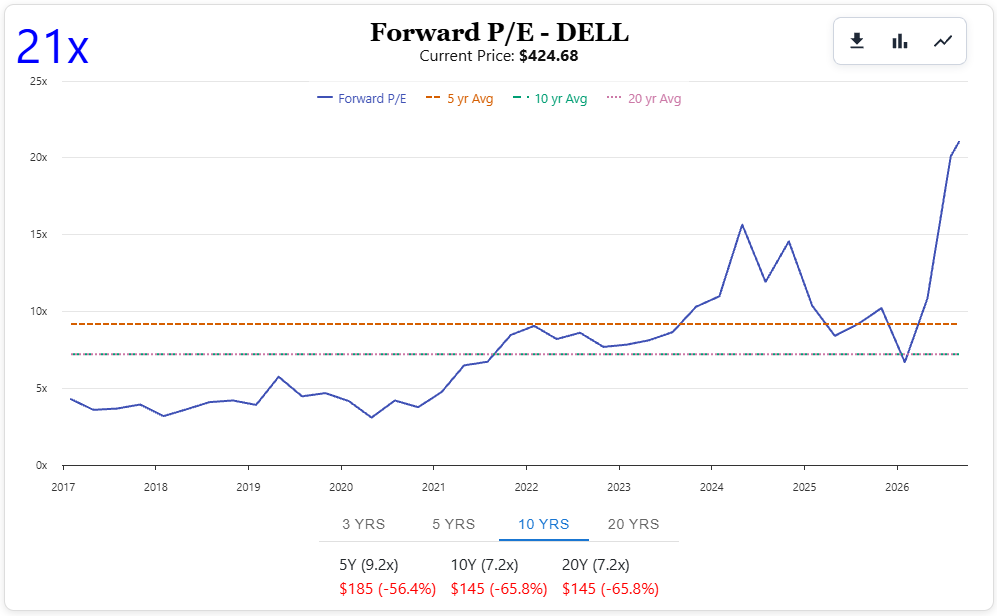
Dell’s own guidance already moved much higher. The company raised full year revenue guidance from $167 billion to $192 billion, lifted AI server revenue guidance from $60 billion to $74 billion and raised adjusted earnings guidance from $17.90 to $25.50 a share. The encouraging part is that margins improved at the same time, with Infrastructure Solutions Group operating margin reaching 15%, up from 8.8% a year earlier. The valuation question is whether that margin strength can hold as memory costs rise and the business scales through a constrained supply chain.

Dell Technologies (DELL) Forward PE Ratio

Dell Technologies (DELL) Forward PE Ratio

Bottom line

Raw demand is not the main near term risk for Dell. Execution, backlog conversion and cash conversion are. Dell has to prove it can work through component shortages, help customers get data centers ready and deliver complex systems without giving back the margin gains that made this quarter so strong.

Pre Market Pulse

  • A global bond selloff pushed the ten year Treasury yield near 4.80%, keeping broad market sentiment cautious and weighing on growth stocks.

  • Oil prices surged past $90 a barrel following renewed military strikes in the Middle East, reigniting inflation fears and pushing up expectations for a September rate hike.

  • Dell reported a massive guidance raise, setting up a battle today between company specific fundamental strength and top down rate fears.

Why it matters this morning

Broad macro anxiety usually pressures hardware stocks. But a massive order book creates a buffer against top down fears. The battle today is whether raw demand for computing power can override rising capital costs across the broader market.

Peer Read Through

Hewlett Packard Enterprise (HPE)

The company reports earnings this afternoon. This will help prove if enterprise hardware strength is truly an industry wide phenomenon or a Dell specific share gain.

Super Micro Computer (SMCI)

The server maker shares the same component bottlenecks and liquid cooling challenges, making Dell execution commentary highly relevant for its own gross margin profile.

Nvidia (NVDA)

The massive server backlog relies heavily on specialized accelerators, reinforcing the idea that enterprise demand for high end chips remains exceptionally strong.

Group takeaway

Dell’s results show that much of its infrastructure business is dealing with a supply problem, not a lack of demand. That is a positive read through for the group, but it is not proof that every hardware company will benefit equally. The winners will be the companies that can secure components, deliver complete systems and protect margins while customers finish the power and cooling work needed to bring those systems online.

What to Watch

  • Hewlett Packard Enterprise earnings later today to see if the server demand trend holds across the industry.

  • Gross margin disclosures in the coming quarters to verify if rising memory costs are eroding profitability.

  • Management commentary on the conversion speed of the backlog and any easing in the memory supply chain.

  • Customer data center power readiness, which dictates when rack scale systems can actually be delivered and recognized as revenue.

Bottom line

The story is no longer about winning the order. The next few quarters will test whether hardware companies can physically deliver the goods in a constrained global supply chain.

STOCKS IN THIS ARTICLE

Also Mentions:

Comments