


Global equities extended their recovery as renewed enthusiasm around artificial intelligence revived confidence in semiconductor demand and the durability of the capex cycle. The MSCI All Country World Index posted a fourth consecutive gain, rising to a two-week high, while Asian equities advanced 0.7% for a fifth straight session. The rally has shifted the tone from last week’s inflation-driven caution toward a more constructive risk backdrop, although the support is still heavily concentrated in AI-linked technology names.
Samsung Electronics and SK Hynix rallied in line with Monday’s Wall Street strength, where sentiment was boosted by Meta’s launch of a new AI agent. The positive momentum continued after Alibaba unveiled a next-generation AI chip designed to compete with Nvidia, while Tencent released its latest image-generation model. The message from markets is clear: after a brief wobble over regulation, safety concerns and valuation discipline, investors are again willing to price ongoing AI investment as a structural demand driver for semiconductors, cloud infrastructure and high-performance computing.
European equity futures pointed to a stronger open, while S&P 500 futures were broadly unchanged and Nasdaq 100 contracts edged 0.1% higher. The stabilisation in US futures after Monday’s rally suggests investors are not abandoning risk, but they are becoming more selective. AI remains the clear leadership theme, but with central banks turning more hawkish and long-end yields still elevated, the breadth of the equity rally will be important. A market led only by mega-cap technology can continue higher for a time, but it remains vulnerable if rates, oil or earnings expectations turn against it.
Oil prices rebounded after four consecutive days of losses. Brent crude rose 1.4% to around $101.70/bbl as traders reassessed the balance between improving Middle East shipping flows and still-fragile geopolitical conditions. Saudi crude shipments from the Persian Gulf increased sharply over the weekend, with the number of vessels at the country’s main Gulf port reaching the highest level since June. That has helped ease immediate supply fears, but the market is not yet willing to remove the geopolitical risk premium entirely.
The oil move matters because crude remains the main transmission channel between geopolitics and global monetary policy. Brent near $101.70/bbl is lower than last week’s peak, but still high enough to keep inflation expectations sensitive to headline risk. If the recent improvement in Saudi exports and Hormuz flows continues, the inflation impulse should moderate. But any deterioration in the US-Iran conflict, further Houthi-Saudi escalation or renewed disruption to Gulf shipping would quickly push energy back to the centre of the macro narrative.
Bitcoin pulled back after surging more than 7% on Monday and briefly moving above $87,000, as investors rotated back into higher-beta assets. The move reflects improving risk appetite, but also the fragility of speculative positioning in a higher-rate environment. Crypto can benefit from liquidity optimism and risk-on flows, but with the Fed, ECB, BoE and BoJ all leaning hawkishly, the asset class remains exposed to any renewed tightening in financial conditions.
In the UK, August public-finance data showed the fiscal position continuing to drift away from the Office for Budget Responsibility’s Spring Forecast assumptions. Public sector net borrowing stood at £18.3bn for the month, taking fiscal-year-to-date borrowing to £77.3bn, which is £8.1bn above the monthly profile envisaged by the OBR. The overshoot is less severe on some other measures, but the direction is still uncomfortable ahead of the 28 October Budget.
The current budget balance, which excludes investment spending and serves as the government’s reference series for the fiscal rule, showed a £4.8bn overshoot for 2026-27 as of August, with cumulative borrowing at £51.9bn. The central government net cash requirement, the measure most directly relevant for financing arithmetic, is overshooting OBR plans by a narrower £2.9bn. Tax receipts have held up relatively well, likely reflecting the resilience of the economy in the first half of the year, but spending has been higher than expected across benefits and debt interest.
The timing is important. The next monthly fiscal release will arrive too close to the Budget to be included in the OBR’s new projections, meaning today’s data effectively form the baseline for the October forecast round. Given the headwinds from higher gilt yields and rising debt-servicing costs, it is unsurprising that borrowing is running above the pre-Middle East forecast. The more important point is that these higher deficit numbers are likely to be baked into revised Budget projections rather than dismissed as temporary timing effects.
For UK markets, that keeps the interaction between fiscal credibility, gilt yields and Bank of England policy firmly in focus. Last week’s BoE communication helped gilts by combining a hawkish Bank Rate signal with a more market-friendly QT structure, including no long-dated gilt sales and a temporary pause in active QT. But the fiscal backdrop remains challenging. If the Budget fails to reassure investors on the debt path, the long end of the gilt curve could come under renewed pressure, particularly if oil remains elevated and inflation expectations stay vulnerable.
Euro area macro risk has also moved back into the spotlight. Germany is dealing with renewed political uncertainty after poor regional election results raised questions about Chancellor Merz’s grip on power. That has added another layer of concern to an economy already facing weak growth, energy sensitivity and structural competitiveness pressures. At the same time, France came under pressure after Scope downgraded its sovereign rating to A+ last Friday, just as headlines around the 2027 budget process begin to build.
The political and fiscal backdrop matters because the European Central Bank is already confronting a less comfortable inflation picture. Yesterday’s ECB business survey, which focused partly on access to finance and the impact of the Middle East conflict, offered a notable warning. Firms, whether highly exposed or less exposed to the conflict, consistently expected upward pressure on wages. That is an important signal because it suggests the energy and geopolitical shock may be feeding into broader cost expectations rather than remaining isolated.
This follows last week’s ECB wage tracker, which again pointed to modestly upward-sloping pay expectations. Taken together, the survey evidence strengthens the case that the Governing Council may feel compelled to hike again before year-end. The risk for the ECB is that wage-setting behaviour becomes more defensive in response to higher energy costs, supply uncertainty and geopolitical risk. If firms and workers begin to embed those pressures into pay negotiations, the ECB will find it harder to argue that the shock is temporary.
That creates a difficult policy mix for Europe: political uncertainty in Germany, fiscal pressure in France, sticky wage expectations and an ECB that may still need to tighten. Unlike the US, where AI investment and resilient consumption continue to support the growth narrative, Europe’s backdrop looks more fragile. A further ECB hike could support inflation credibility, but it would also tighten financial conditions into an already uneven growth environment.
Macro to Micro, the market is enjoying a renewed AI-led risk rally, helped by lower oil versus last week’s highs and optimism around US-China technology talks. But beneath the surface, the macro constraints remain tight. Brent is still above $100/bbl, fiscal pressures are building in the UK and Europe, and wage data are keeping central banks on alert. The key question is whether AI optimism can continue to offset the drag from higher-for-longer policy and elevated long-end yields. For traders, the focus should be on the breadth of the equity rally, Brent’s ability to stay near or below $100, and whether bond markets remain calm as fiscal risks return. Watch semiconductors, the Dollar, Gold, European spreads and long-end yields: they will show whether this is a durable risk rebound or another relief rally built on a narrow AI foundation.
Overnight Headlines
China And US Discuss AI And Investment On Second Day Of Trade Talks
China And EU Should Avoid Trade Clash, Beijing’s Top Diplomat Says
South Korea Picks First Project To Pursue Under US Investment Deal
UK To Provide Military Support To Saudi Arabia In Its Fight With Houthi
Trump Presses Zelenskyy To Stop Hitting Russian Refineries
Macron And Trump Discuss Kyiv And Moscow Halting Energy Strikes
US To Open Two New Military Bases In Greenland, Sources Say
Fed’s Musalem Says More Rate Hikes Likely Needed To Cool Prices
RBA Set To Hike Rates Next Week As Energy Costs Spiral, BE Says
RBNZ’s Breman Says Higher Oil Prices Point To Firmer Near-Term Inflation
Oil Steadies After Four-Day Drop As Traders Look To Hormuz Flows
US Proposes $5B To Kickstart Fund To Rebuild Gulf Energy Sites
Alibaba Unveils AI Chip To Drive 20GW Of Data Centres By 2032
Jamie Dimon Says Hyperscaler AI Spending Could Hit $1T Next Year
FX Options Expiries For 10am New York Cut
(1BLN+ represents larger expiries and is more magnetic when trading within the daily ATR.)
EUR/USD: 1.1500 (EU1.47b), 1.1800 (EU1.18b), 1.1850 (EU814.5m)
USD/JPY: 158.00 ($1.3b), 157.00 ($923.8m), 160.50 ($497.8m)
AUD/USD: 0.7100 (AUD457.1m), 0.7050 (AUD400m)
USD/CAD: 1.3950 ($335m)
USD/BRL: 5.6000 ($775m), 5.1300 ($472.5m), 5.7190 ($395.2m)
GBP/USD: 1.3900 (GBP632.4m), 1.3800 (GBP404.4m), 1.3380 (GBP324.3m)
USD/KRW: 1330.00 ($550m), 1370.00 ($510.6m), 1420.00 ($467.3m)
USD/MXN: 17.30 ($600.2m)
CFTC Positions as of 11/9/26
In the latest market updates, equity fund speculators have made notable adjustments to their positions. They've reduced their net short position in the S&P 500 CME by 48,186 contracts, bringing the total down to 288,457. Meanwhile, equity fund managers have also trimmed their net long position in the S&P 500 CME by 8,137 contracts, leaving them with 899,633 contracts.
Turning to the Treasury futures, speculators have significantly cut back their net short positions across various maturities. The net short position for CBOT US 5-year Treasury futures has decreased by 270,127 contracts, now standing at 997,366. The CBOT US 10-year Treasury futures saw a reduction of 13,547 contracts, bringing the total to 821,236, while the CBOT US 2-year Treasury futures experienced a trim of 73,754 contracts, now at 855,353. On a different note, speculators have increased their net short position in CBOT US UltraBond Treasury futures by 63 contracts, totaling 345,203, and added 2,640 contracts to their net short position in CBOT US Treasury bonds, which now sits at 203,157.
In the cryptocurrency realm, Bitcoin has a net long position of 2,468 contracts.
As for currency positions, the Swiss franc is showing a net short position of -28,988 contracts, while the British pound stands at -58,715 contracts in net shorts. The euro has a net short position of -26,993 contracts, whereas the Japanese yen is faring better with a solid net long position of 120,359 contracts.
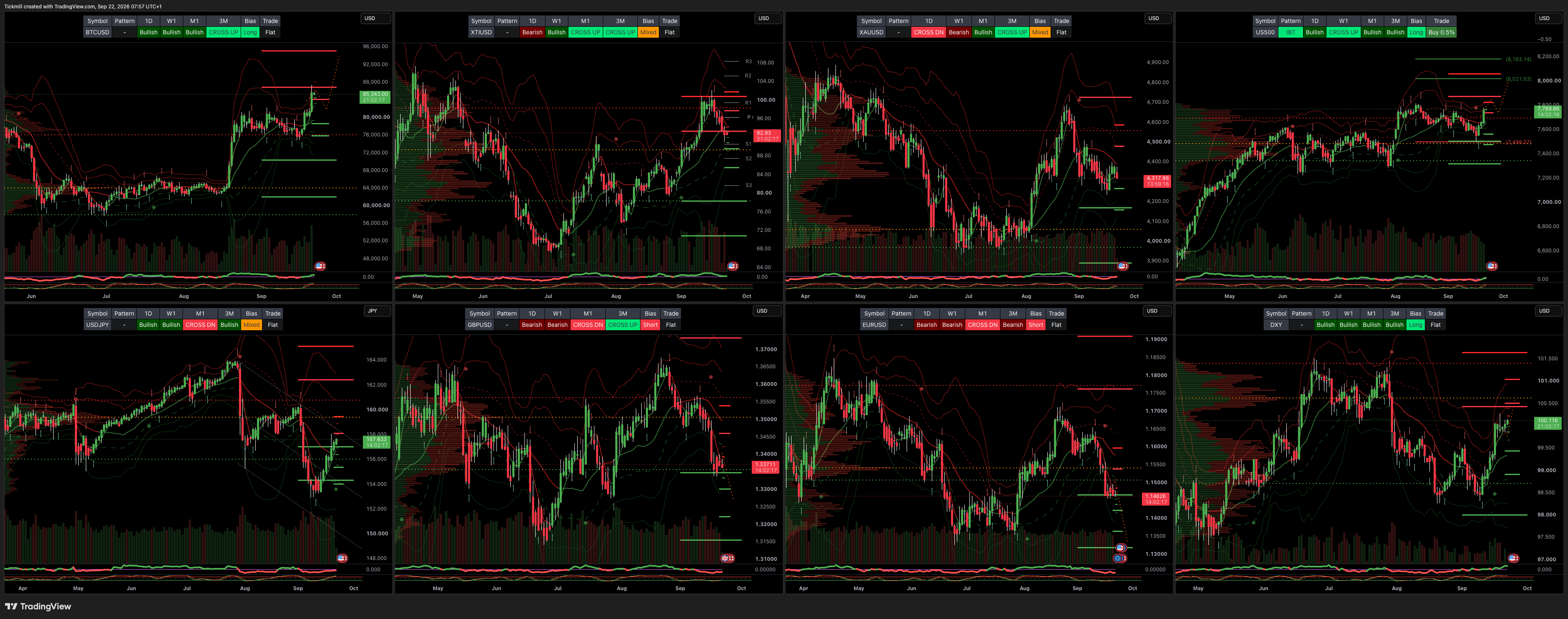
Technical & Trade Views

Comments
Log in or sign up to join the conversation.