


Asian equities rebounded overnight as technology shares in South Korea and Japan recovered, helped by Wall Street breaking a two-day losing streak. The MSCI Asia Pacific Index rose 0.9%, with SK Hynix and Samsung Electronics both gaining more than 4% ahead of their earnings reports. The move suggests that investors are still willing to re-engage with the AI and semiconductor theme after sharp drawdowns, especially when valuations have reset and earnings catalysts are imminent.
However, the rebound already looks more tentative than decisive. Nasdaq 100 futures slipped 0.2% into the London open, while European equities are expected to start around 0.3% lower. That hesitation reflects the broader market reality: the AI trade has not broken, but it is no longer being treated as a one-way macro hedge. Investors are now demanding evidence that capex-heavy AI spending can generate returns, sustain margins and avoid excessive balance-sheet strain. This week is a critical test. Alphabet and Microsoft report on Wednesday, followed by Amazon and Intel on Thursday. The market will look well beyond headline EPS beats. Investors want clarity on cloud growth, AI monetisation, capex trajectories, data-centre utilisation, power and cooling constraints, and whether AI spending is still being funded from operating cash flow rather than increasingly expensive external capital.
The funding side of AI is becoming harder to ignore. Meta Platforms is reportedly aiming to raise as much as $97.5bn through stock offerings, Broadcom is pursuing a $63bn chip acquisition, and SpaceX has entered a $40bn equipment-financing lease. These are enormous numbers, and they underscore a key change in the AI narrative. The question is no longer simply whether demand exists. The question is who finances the infrastructure, at what cost, and with what payback period. That is why the recent rebound should be treated cautiously. AI continues to have powerful structural demand drivers, but the investment cycle is increasingly capital-intensive and interest-rate-sensitive. When real yields rise, oil lifts inflation risk and credit spreads widen, the discount rate applied to long-dated AI cash flows increases. That makes earnings quality, balance-sheet strength and capex discipline more important than theme exposure alone. Oil remains the key macro cross-current. Brent slipped 0.7% but still trades near $115/bbl as senior officials travel to Iran to restart talks aimed at preventing a broader Middle East conflict. Diplomacy has helped reduce the immediate risk premium, but crude remains elevated after recent Houthi attacks on Saudi energy infrastructure and shipping concerns around the Strait of Hormuz. The market is no longer pricing calm; it is pricing a slightly lower probability of escalation.
For much of 2026, investors have effectively had to be oil traders. A view on crude has often translated into a view on inflation, rates, equities, currencies and credit. Higher oil meant higher inflation compensation, higher policy-rate risk, pressure on consumers and renewed questions about earnings margins. That framework still matters, but last week suggested an important shift: rising energy prices are no longer simply pushing yields higher. They are also generating a flight-to-quality bid in Treasuries.That change is important. Concerns about the energy outlook and its inflation consequences have not disappeared, but the second-order effects are becoming more visible. Higher expected real rates and tighter financial conditions are now weighing on risk assets. Whether the pressure appears through moderation in AI-tech exuberance, widening credit spreads, or stress in weaker sovereign credits, these are rational consequences of tighter monetary conditions. This explains the recent Treasury rally despite elevated oil. Normally, stronger crude and inflation fears would push yields higher. But when the inflation shock starts to undermine risk appetite, bonds can rally on growth concerns and safe-haven demand. That is the policy dilemma in one trade: oil raises inflation risk, while the asset-price response tightens financial conditions and threatens growth.
The Fed meets tomorrow and is expected to hold rates unchanged. The decision itself is unlikely to be the event; guidance is the risk. The Fed must decide how to communicate optionality when core inflation remains sticky, oil is elevated, financial conditions have tightened and AI-led equity volatility has increased. Q3 GDP and September core PCE later this week will help determine whether the US economy is still absorbing restrictive policy or whether the lagged effects are finally becoming more visible. If the Fed leans too dovish, it risks loosening financial conditions before inflation is clearly controlled. If it leans too hawkish, it risks amplifying a risk-off move already visible in equities and credit. Chair Warsh’s task is therefore to keep December optionality alive without sounding indifferent to tighter market conditions.
The ECB faces a more immediate political test on Thursday. President Lagarde will almost certainly be asked about recent widening in French government-bond spreads and whether the ECB is prepared to intervene. For now, intervention looks unlikely. Most policymakers would likely view the spread widening as a reflection of underlying fiscal fundamentals rather than disorderly market functioning.That distinction matters. The ECB’s anti-fragmentation tools are intended to address unwarranted, disorderly market dynamics, not to suppress fiscal risk premia where investors are reassessing sovereign credibility. Unless French spreads move in a way that threatens transmission across the Eurozone, the ECB is likely to resist signalling support. But Lagarde will need to be careful: sounding too dismissive could encourage further pressure, while sounding too supportive could weaken fiscal discipline. France remains the Eurozone’s key vulnerability. Political uncertainty, delayed investment decisions and weak demand have already shown up in the PMI data, where France slipped back into contraction. A sustained rise in French spreads would tighten domestic financial conditions and could spill into broader European risk sentiment. The ECB can probably tolerate some fiscal repricing; it cannot ignore fragmentation if market liquidity deteriorates.
In the UK, tomorrow’s Budget is the main domestic risk event. Much of the commentary suggests it will be low-key, and in principle that is plausible. Political signposts point to the Prime Minister’s ten-year plan coming after the fiscal set-piece, implying that the Budget may focus more on fiscal presentation, updated forecasts and financing than major structural decisions.However, low expectations can be dangerous. Markets have been told before to expect uneventful Budgets, only for policy revisions to be much larger than anticipated. The 2024 Budget was the largest OBR-era policy event outside the emergency pandemic response, based on cumulative borrowing changes driven by policy announcements. That experience makes investors cautious about accepting the “low-key” label at face value. A useful benchmark is the historical rolling average for cumulative policy revisions over the OBR forecast horizon, which is just above £50bn. Anything materially above that would challenge the current benign consensus and could trigger a larger gilt and FX reaction than investors are positioned for. In other words, even if tomorrow is not designed to be a market event, it can become one if the gap between expectations and fiscal reality is wide enough.
The market focus will be on three areas: the OBR’s updated growth and debt-interest assumptions, the financing remit and the trajectory of gilt supply. Recent public-finance data showed borrowing running above the OBR’s March profile, while debt-servicing costs remain elevated. Stronger UK activity helps revenues at the margin, but it also supports the case for tighter monetary policy, raising debt-interest pressures and complicating the fiscal arithmetic. For gilts, the supply outlook matters alongside the Bank of England’s policy path. Last week’s stronger labour-market and CPI data, followed by a firm composite PMI, reinforced expectations that the MPC may need to hike again in November. If the Budget also points to higher issuance, gilts could face pressure from both rates and supply channels. The offset would be global safe-haven demand if risk appetite deteriorates further. The Bank of England’s market plumbing also remains relevant. The Short-Term Repo facility has weakened the old post-QT relationship between falling reserves and front-end gilt asset-swap widening. Banks can replace reserves drained through QT with repo funding, meaning asset-swap pricing now depends more on the price and availability of replacement reserves, STR usage and broader funding conditions than on QT pace alone. This helps explain why gilt ASW has not cheapened as much as the old reserve-scarcity model implied.
The Bank of Canada also meets tomorrow, and markets are pricing a hike despite consensus expecting a hold. The key catalyst is a notable rise in inflation expectations in the Bank’s survey. Canada’s decision is a useful global signal: when expectations begin to drift, central banks may tighten even if growth is not especially strong. That is the same dilemma facing the Fed, ECB and BoE in different forms. The Bank of Japan rounds out the week on Friday. Updated forecasts and Tokyo inflation data will be watched for signs that policymakers are becoming more confident in the durability of domestic inflation. With the Yen still weak and imported cost pressures elevated, any hint of further normalisation would matter beyond Japan. A more hawkish BoJ would challenge global carry trades and add another source of pressure to risk assets. China remains an additional uncertainty. The fifth plenum in Beijing is being watched for signals on domestic demand, industrial strategy and technology self-sufficiency. Chinese blue chips have been under sustained pressure, reflecting investor scepticism that exports alone can offset weak consumption and property-sector drag. Any meaningful policy signal could stabilise sentiment, but markets will likely require concrete measures rather than long-term strategic language.
Macro to Micro, markets are balancing a tactical AI rebound against a tougher macro backdrop. Korean chipmakers have bounced, but the real test comes from Alphabet, Microsoft, Amazon and Intel. Brent has eased on diplomacy, yet at $115 it remains an inflation problem. Treasuries are no longer trading only as an oil-inflation proxy; they are also responding to tighter financial conditions and flight-to-quality demand. The ECB faces French spread questions, the Fed must preserve optionality, and the UK Budget could surprise despite low expectations. For traders, the key markers are AI earnings capex guidance, SK Hynix and Samsung results, Brent and Iran diplomacy, US real yields, Treasury safe-haven demand, French spreads, Lagarde’s fragmentation language, UK gilt remit, cumulative Budget policy revisions, BoC inflation-expectations messaging and whether equity weakness remains sectoral or becomes a broader financial-conditions event.
Overnight Headlines
Oil Declines As Diplomatic Efforts Seek To Ease US-Iran Tensions
China’s Industrial Profits Surge Most In Three Months On Oil
Ex-BoJ Gov Backs Further Rate Hikes As Fmr-Deputy Urges Caution
RBNZ Shadow Board Recommends 25bps Rate Hike In Oct
US And Canada Work On Deal To Ease Steel And Auto Tariffs
Germany’s Merz: EU Has Interest In Maintaining Open Market Access
French Students Vow Further Protests Despite Govt Concessions
European Defence Powers Back Ukraine As US Eases Pressure On Russia
Netanyahu Faces Crucial Election As Israel Votes Amid Iran Conflict
Saudi-Led Coalition Intercepts Houthi Missile And Drone Attacks
HSBC Announces $1B Buyback; Q3 Profit Growth Missing Estimates
Broadcom Arranges $63B Financing Deal For Anthropic’s AI Chips
Goldman And Morgan Stanley Secure Leading Roles In Anthropic IPO
Pimco Acquires $4B Of SpaceX’s AI Debt Package
Morgan Stanley Expects Further Widening In Data-Centre ABS Spreads
Whirlpool Heading For Full-Year Loss As Costs Mount And Sales Fall
Nucor Profit Beats Estimates as Higher Steel Prices Lift Results
Novo Nordisk Loses Court Ruling Over Eli Lilly Obesity Drug Ads
Bitcoin Faces Test Of $77,000 Support Ahead Of Fed Decision
FX Options Expiries For 10am New York Cut
(1BLN+ represents larger expiries and is more magnetic when trading within the daily ATR.)
EUR/USD: 1.1250 (EU951.9m), 1.1175 (EU924.4m), 1.1415 (EU728.8m)
USD/JPY: 157.85 ($1.66b), 158.00 ($1.27b), 157.00 ($885m)
AUD/USD: 0.6975 (AUD1.83b), 0.7030 (AUD1.32b), 0.7015 (AUD721.7m)
USD/CAD: 1.3650 ($420m), 1.3830 ($339.7m)
GBP/USD: 1.3260 (GBP512.1m), 1.3200 (GBP493.8m), 1.3300 (GBP456.4m)
USD/MXN: 17.61 ($323.7m)
NZD/USD: 0.5750 (NZD333.5m)
USD/KRW: 1370.00 ($516.2m)
.
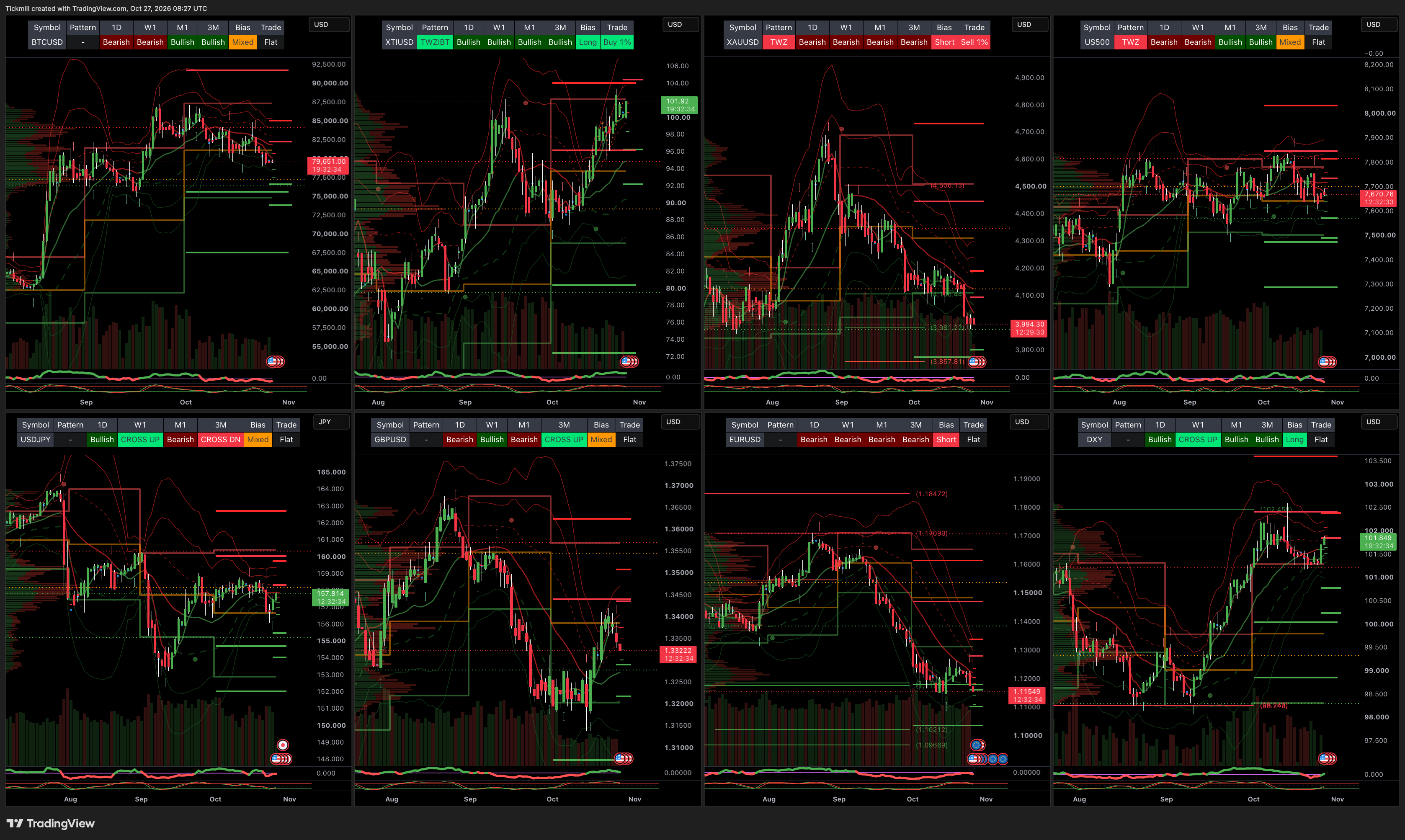
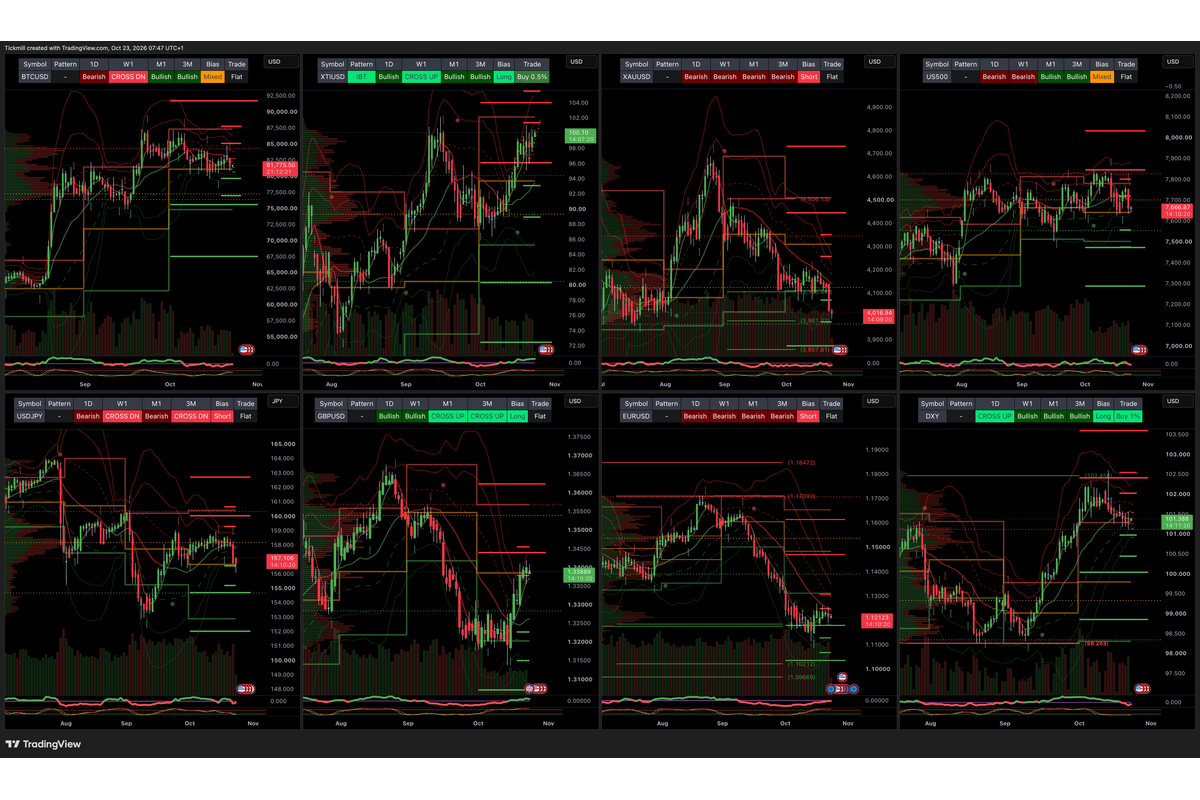
Technical & Trade Views


Comments
Log in or sign up to join the conversation.