


Technology stocks are again under pressure as investors reassess the durability of the AI-led equity rally ahead of a crucial earnings week. The immediate focus remains Asia, where the South Korean Kospi, widely treated as a liquid proxy for the AI hardware cycle, fell 4.2%, with SK Hynix leading the declines and pushing the index toward its lowest close since April. The weakness spread across the region. MSCI’s Asia Pacific Index dropped 1.2%, reversing some of Monday’s tech-led recovery on Wall Street. Nasdaq futures slipped 0.2%, while European futures pointed to a softer open of around 0.6%. The message is clear: markets remain willing to buy dips, but confidence in the AI trade is now much more conditional on earnings delivery.
The selloff is no longer just about high valuations. It is increasingly about financing, capex intensity and whether the expected return on AI infrastructure investment can justify the scale of spending. That is why developments around data-centre names and highly leveraged AI-adjacent balance sheets are attracting more attention. In Seoul, data-centre infrastructure firm Elie plunged as much as 33%, adding to concerns that the AI investment theme may be broadening from a growth story into a balance-sheet risk story. At the same time, SoftBank’s credit-default swaps rose to their highest level in nearly four years, reflecting unease over AI-linked financing exposure and the potential impact of a large acquisition. The market is increasingly asking not only whether AI demand is real, but who is funding it, on what terms and with what margin of safety. This is the key transition in the AI narrative. Earlier in the cycle, investors rewarded exposure almost indiscriminately. Now they are differentiating between cash-generative platform winners, high-quality semiconductor suppliers, capital-intensive infrastructure firms and leveraged financing vehicles. That differentiation is healthy in the long run, but destabilising in the short run because positioning remains crowded.
Currency markets are reflecting a broader cautious tone. The Dollar weakened against all G10 peers as investors reconsidered risk exposure and digested the latest cross-asset moves. The softer Dollar is notable because it comes alongside renewed equity stress, suggesting markets are not trading a straightforward risk-off template. Instead, investors are weighing technology weakness against the possibility that tighter financial conditions reduce the urgency for further Fed action. Gold was broadly steady around $4,145/oz, holding near elevated levels as investors maintained hedges against geopolitical, inflation and fiscal risks. Gold’s resilience continues to fit the broader environment: real yields remain high, but uncertainty around energy, fiscal credibility and central-bank reaction functions keeps demand for portfolio insurance intact. Oil remains the other major macro pressure point. Brent held near $109.80/bbl, close to a five-month high, as traders balanced strong Persian Gulf supply against the risk of further Iranian attacks around the Strait of Hormuz. The market is not currently pricing a major physical disruption, but the risk premium is firmly embedded. At these levels, oil continues to threaten the disinflation story even without a fresh supply shock.
That matters because last week’s US CPI and PPI prints already raised concerns about input-cost pass-through. Producer inflation was particularly uncomfortable, with evidence that price pressures are broader than just energy and are moving through parts of the supply chain. The Fed is now in blackout, leaving markets to interpret the data without official guidance. That makes asset-price moves themselves more important as a proxy for financial conditions. The AI buildout also has inflation implications. Data centres, power infrastructure, semiconductors, cooling systems and specialist labour all add to demand at a time when supply in some areas is constrained. Longer term, AI may be productivity-enhancing and disinflationary. In the shorter term, however, the buildout is a demand shock and a cost shock, especially if firms retain pricing power.
The UK labour market data this morning added another layer of complexity for the Bank of England. The headline message is that employment looks materially stronger and unemployment lower than expected, while pay growth remains sticky enough to keep the MPC cautious. UK employment change on a three-month basis rose by 102k, far above the 5k forecast and up from 67k previously. The unemployment rate fell to 4.7%, compared with expectations for 4.9% and a prior reading of 4.9%. The single-month seasonally adjusted employment change also surprised positively, rising 13k versus expectations for an 8k decline and a previous fall of 26k. That is a clearly stronger labour-market signal than the recent soft survey data had implied. Surveys, aside from the REC report, had pointed to a mild contraction in hiring, but the official data suggest the labour market is not weakening quickly enough to give the MPC much comfort. The unemployment claimant change rose to 30.3k from 27.8k, so there is still evidence of some labour-market friction, but it is not the dominant signal in today’s release.
The wage data are more mixed, but not benign. Average weekly earnings slowed to 3.7% y/y from 3.9%, slightly below the 3.8% consensus. That points to some moderation in total pay. However, average earnings excluding bonuses rose to 3.7% y/y, above the 3.6% forecast and up from 3.5% previously. For the BoE, the ex-bonus measure is often the cleaner read on underlying pay pressure, and today’s upside surprise will matter. The result is a labour report that strengthens the case for a November BoE hike. Growth has already been firmer than the BoE projected, with Q3 GDP tracking well above the July Monetary Policy Report assumption. Now the labour market appears more resilient too, while underlying wage pressure is not easing convincingly. That combination reduces the MPC’s ability to look through the coming winter rise in headline inflation.
Tomorrow’s UK CPI data therefore becomes even more important. The expected rise in headline inflation due to regulated energy costs is largely understood. The key question is whether there are signs of second-round effects in services, wages or broader core prices. If CPI shows persistence on top of today’s stronger employment and ex-bonus pay data, the MPC will find it difficult to avoid a November hike. The fiscal backdrop also matters. UK borrowing figures are due alongside CPI, and recent better GDP data have not obviously translated into stronger revenues. With debt-servicing costs still rising, another drift away from the OBR borrowing path would keep pressure on the Chancellor ahead of the Budget. The UK is not the worst-positioned sovereign on IMF sustainability metrics, but it does not have much room for complacency.
In Europe, markets remain attentive to France. Protests and political unrest are adding to concerns around budget delivery and fiscal credibility. French business confidence later this week will be watched for signs that political disruption is feeding into corporate sentiment. The ECB enters its quiet period this week, limiting official commentary as markets assess whether French spread risk remains contained or becomes more systemic. China’s Q3 GDP beat expectations at 4.5% y/y, but the market response remains cautious. The headline beat helps, yet monthly activity data still suggest the recovery is uneven and reliant on policy support and net exports. Beijing likely still has work to do in Q4 to meet the annual growth objective. For global markets, China’s role is complicated: it is a source of demand uncertainty, a competitive threat in key industrial sectors and a swing factor for commodities.
The broader geopolitical backdrop remains fragile. Tensions in the Middle East are keeping oil elevated, while concerns over US-Ukraine relations ahead of a Russia-US-China summit next month introduce another layer of uncertainty for European energy security and defence spending. Markets are not pricing a full geopolitical shock, but hedging demand remains visible in gold and parts of the rates market. For US markets, the immediate test is earnings. After last week’s chip-sector washout, the bar is no longer simply whether companies beat consensus. Investors want evidence that AI demand remains robust, that supply-chain constraints are manageable, that margins can hold and that capex plans are financially disciplined. Guidance will likely matter more than trailing earnings. If major AI and semiconductor names deliver credible guidance, the market can stabilise quickly because underweight investors may be forced back in. But if results confirm margin pressure, financing concerns or slower monetisation, the selloff could broaden. Given narrow market leadership, the index-level impact of disappointment remains large.
Macro to Micro, the market is caught between dip-buying instincts and growing doubts about the AI investment cycle. Korean tech weakness, SoftBank credit risk and data-centre stress show investors are scrutinising the funding side of AI more closely. Brent near $110 keeps inflation risk alive, while gold remains supported and the Dollar is softer. In the UK, stronger employment and sticky ex-bonus pay reinforce the case for a November BoE hike, with tomorrow’s CPI now critical. For traders, the key markers are AI earnings guidance, Kospi and SK Hynix price action, SoftBank CDS, Brent, US yields, UK CPI, GBP rates pricing and whether tech weakness remains sector-specific or becomes a broader financial-conditions event.
Overnight Headlines
Trump Open To Summit With Xi, Putin To Discuss Nuclear Disarmament
US Envoys To Hold Fresh Ukraine Talks, Energy Crunch Looms Over Midterms
Zelenskyy Says US Decisions On Ukraine Are Hard To Explain
Trump Admin Has Not Approved Interceptor Missile Transfer To Ukraine
Merz Warns Europe Is Underestimating The Russian Threat
Iran’s IRGC: Blockade Could Extend To Bab Al-Mandeb Strait, Suez Canal
Asian LNG Prices Jump To Highest Since 2022 Amid Tanker Attacks
Fed Sees AI Boom Adding To Inflation Pressures, Reports Show
Bank Of Canada Rate-Hike Bets Rise As Inflation Expectations Climb
German ZEW Investor Outlook Set To Fall As Energy Costs Rise
French Bond Sell-Off Intensifies After Riots And Looting
UK Treasury Expected To Examine Closer Economic Ties With EU
China Keeps Loan Prime Rates Unchanged For 17th Straight Month
Japan’s 20-Year Bond Sale Sees Strongest Demand On Record
SoftBank Credit Risk Hits Four-Year High On AI Funding Strain
Oracle, AstraZeneca Partner To Advance AI-enabled Healthcare Innovation
OpenAI Seeks To Accelerate Fundraising Ahead Of Anthropic IPO
Nvidia-Backed Nscale And Anthropic In Talks Over $45B AI Cloud Deal
US Set To Announce Certification Of Boeing 737 MAX 10
Musk Pledges 1 SpaceX Share For Every Child In America
BlackRock Seeks SEC Approval For BTC ETF With Capped Losses, Gains
FX Options Expiries For 10am New York Cut
(1BLN+ represents larger expiries and is more magnetic when trading within the daily ATR.)
EUR/USD: 1.1265 (EU3.13b), 1.1480 (EU1.62b), 1.1375 (EU984.6m)
USD/JPY: 159.00 ($969.2m), 158.00 ($535m), 157.00 ($410.8m)
AUD/USD: 0.6940 (AUD373.9m), 0.6900 (AUD341.3m), 0.6970 (AUD313.5m)
USD/CAD: 1.4200 ($497.3m)
EUR/GBP: 0.8800 (EU318.4m), 0.8600 (EU302.3m)
USD/CNY: 6.6600 ($355m)
USD/MXN: 17.95 ($490m), 17.82 ($328.1m)
USD/BRL: 5.8485 ($780.4m), 5.1200 ($663m)
CFTC Positions as of 16/10/26
Equity fund speculators trim S&P 500 CME net short position by 5,804 contracts to 390,896
Equity fund managers raise S&P 500 CME net long position by 8,186 contracts to 912,542
Speculators trim CBOT US 5-year Treasury futures net short position by 83,327 contracts to 1,080,204
Speculators increase CBOT US 10-year Treasury futures net short position by 91,621 contracts to 988,102
Speculators increase CBOT US 2-year Treasury futures net short position by 58,675 contracts to 911,579
Speculators increase CBOT US UltraBond Treasury futures net short position by 45,258 contracts to 321,597
Speculators increase CBOT US Treasury bonds futures net short position by 6,626 contracts to 126,438
Bitcoin net long position is 2,534 contracts
Swiss franc posts net short position of -22,078 contracts
British pound net short position is -106,964 contracts
Euro net short position is -137,573 contracts
Japanese yen net long position is 50,207 contracts
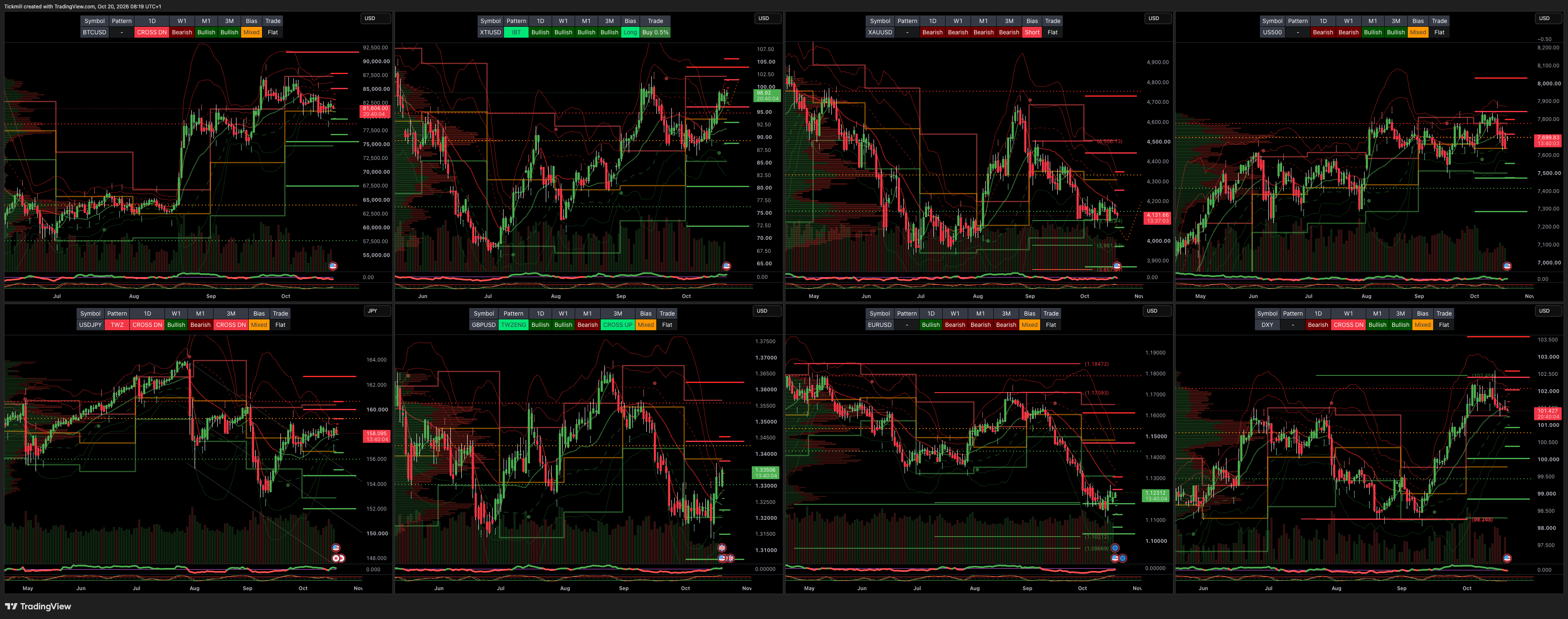
Technical & Trade Views



Comments
Log in or sign up to join the conversation.