


Global bonds remain under pressure as stronger US economic data and weak demand at a five-year Treasury auction forced another reset higher in yields. The US 10-year yield traded around 5.11% in Asia after rising 15 bps on Wednesday, its largest one-day increase since the tariff-driven market shock in April 2025. The move has quickly reaffirmed that, despite the optimism around lower oil prices and US-China diplomacy, the long end of the US rates curve remains the dominant cross-asset variable.
The selloff spread across Asia-Pacific fixed income, with bonds falling in Japan, Australia and New Zealand, and emerging markets also coming under pressure. The average yield on global government debt is now approaching 4%, reflecting the combined impact of sticky inflation, resilient activity, heavy sovereign supply and renewed expectations for further Federal Reserve tightening. After last week’s first Fed hike since 2023, markets are no longer treating higher rates as a distant tail risk. They are actively repricing the possibility that central banks may need to do more before year-end.
Oil offered only limited relief. Brent crude slipped around 0.7% to approximately $102/bbl after its recent rebound, helping to dampen some energy-cost concerns but not enough to change the policy narrative. Crude remains well above levels that central banks would consider comfortable, and the volatility recently reinforces the difficulty of treating the Middle East shock as either temporary or fully contained. The key point is that lower oil is helpful, but not sufficient, if activity data remain strong and price indicators stay elevated.
Asian equities were under pressure, falling around 0.6%, while European equity-index futures pointed to further losses. This is the classic valuation problem for risk assets: stronger growth can support earnings, but if it also forces bond yields materially higher, equity multiples struggle. The AI and semiconductor theme remains structurally supportive, yet even high-growth sectors become vulnerable when real yields rise and discount rates reprice sharply.
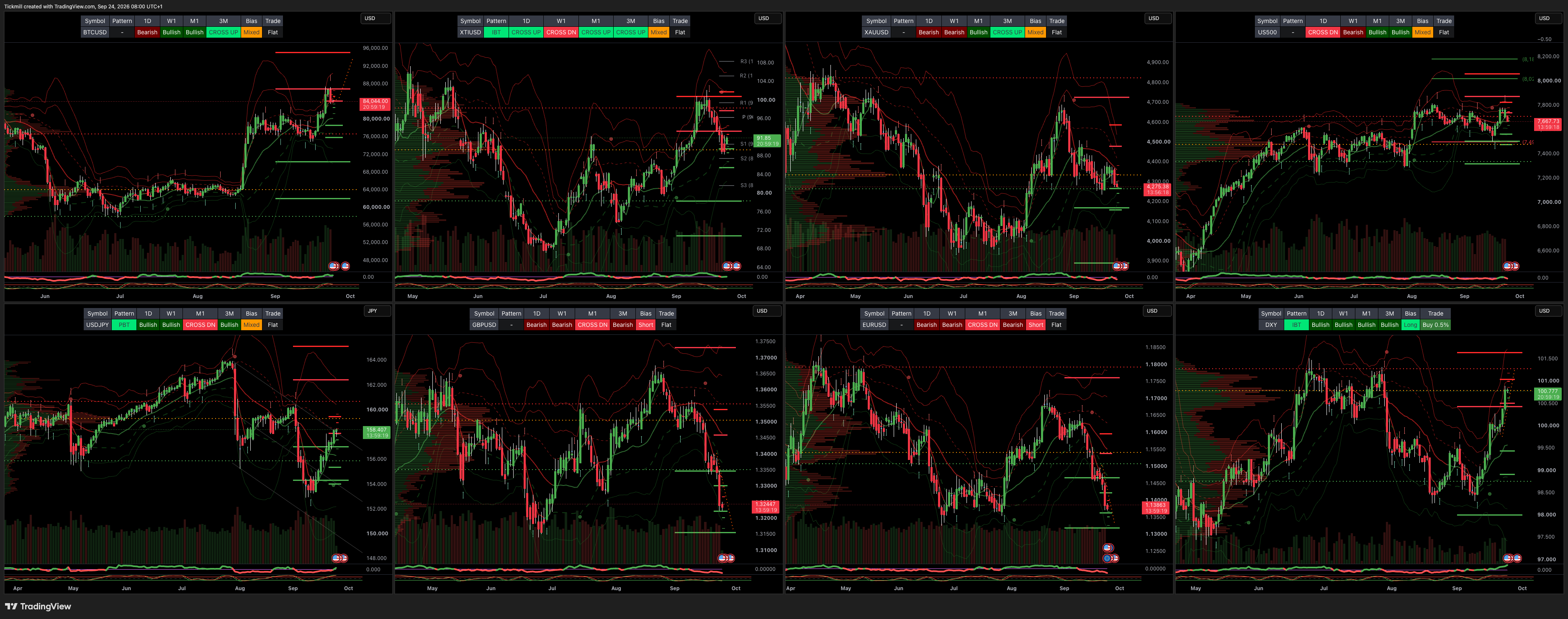
Gold continued to slide after dropping 1.7% in the previous session, trading near $4,290/oz as higher rates reduced the appeal of non-yielding assets. The move is notable because gold has retained strong geopolitical and fiscal support in recent months, but the latest leg higher in Treasury yields has become difficult to ignore. A firmer Dollar and rising real-rate expectations are again challenging bullion’s hedge premium.
Mainland Chinese equities fell more than 1%, despite Treasury Secretary Bessent confirming that the US and China had agreed to extend their trade truce by two months. On paper, that is a constructive development ahead of President Xi’s first state visit to Washington in 11 years. In practice, markets are treating it as a holding pattern rather than a breakthrough. The Trump-Xi meeting remains the more important catalyst, with trade, Taiwan, artificial intelligence and broader economic relations all likely to dominate the agenda.
The US-China truce extension reduces near-term tail risk, but it does not remove strategic uncertainty. Investors will want to see whether the two sides can make tangible progress on tariffs, semiconductor restrictions and AI governance, rather than simply deferring escalation. That distinction matters for Asia’s export-sensitive markets and global technology supply chains. A truce extension helps, but a credible roadmap would help far more.
Energy markets also remain politically sensitive. US diesel futures rose as the Trump administration worked with refiners on voluntary export restrictions designed to ease concerns about overseas shipments. This is another reminder that even if crude prices moderate, refined-product markets can still transmit inflation pressure to consumers and businesses. Diesel matters disproportionately for transportation, agriculture, logistics and industrial supply chains, making it a key input for the inflation outlook.
Yesterday’s flash September PMIs validated the recent hawkish shift from central banks. The main takeaway was uncomfortable for bond bulls: higher energy costs clearly showed up in elevated price indices, but they did not generally weigh on activity. That combination strengthens the case for additional rate hikes from the ECB, Fed and BoE before year-end. Markets may have hoped that the energy shock would produce a visible slowdown, giving policymakers room to wait. Instead, the data suggest economies are absorbing the shock better than expected, while inflation pressure remains persistent.
The US PMI details were particularly important. The headline composite index rose to 58.4, the highest level in five years, and the underlying components supported the stronger-growth narrative. Input prices remained firm, while the employment indicator has staged an impressive rebound from the range lows seen in the middle of the year. This matters because central banks are assessing not just inflation, but the cost of fighting it. If activity and employment remain resilient, policymakers will judge that the marginal hike carries a lower risk of triggering economic volatility.
That is the key policy implication. Even if the recent dip in energy prices extends, central bankers are likely to infer that the trade-off has shifted. The risk of overtightening looks less threatening if the economy is still expanding at a solid pace, labour markets are stabilising and firms continue to report pricing pressure. In that environment, a further rate hike becomes easier to justify, particularly for central banks worried about second-round effects from energy into wages and services inflation.
The UK and euro area PMI market reaction was more muted, but the message was still relevant. Activity has not weakened enough to offset the inflation concern. For the Bank of England, this comes after firmer retail sales, resilient tax receipts and a hawkish set of September minutes. For the ECB, the latest business survey and wage tracker already point to lingering pay pressure. For both, the PMIs add to the evidence that energy shocks are not yet producing the demand destruction needed to neutralise inflation risk.
Macro to Micro, the market is being forced to confront a less comfortable version of resilience. Growth is holding up, AI enthusiasm remains alive, and US-China tensions have eased at the margin, but the bond market is interpreting that strength as permission for central banks to keep tightening. The result is a renewed rise in global yields, pressure on equities, a stronger Dollar and weaker gold. For traders, the immediate focus is the US 10-year yield, Brent crude, payrolls, PCE and Eurozone CPI. If yields keep climbing toward new cycle highs, risk assets will struggle, even with constructive AI and trade headlines. The relief rally needs lower inflation or softer data; right now, it is getting neither.
Overnight Headlines
SNB Set To Hold As Low Inflation Keeps Rate Hikes At Bay
Bessent Says US And China Agreed To Extend Trade Truce To Jan 10
UK And Germany Among Economies Most Exposed To China
UK Tightens Sanctions On Iranian Banks In US Pressure Campaign
Iran, US Remain Far Apart; As Pezeshkian Vows No Surrender
Global Bond Sell-Off Deepens As Oil Holds Above $100
US 10-Year Treasury Yield Hits Highest Since 2007
Japan’s 10Y Bond Yield Hits 30-Year High Following Treasury Sell-Off
Yen Intervention Risk Re-Emerges As 160 Per Dollar Level Nears
Inflation Pressures Raise Prospect Of Further Fed Rate Hikes
Australian Unemployment Surprisingly Rises Despite Job Gains
SoftBank Issues $11.1B In Bonds In OpenAI Financing Push
Nvidia Among Top Traded US Credit Swaps As Hedging Demand Soars
FX Options Expiries For 10am New York Cut
(1BLN+ represents larger expiries and is more magnetic when trading within the daily ATR.)
EUR/USD: 1.1500 (EU1.47b), 1.1575 (EU1.27b), 1.1400 (EU1.21b)
USD/JPY: 156.00 ($1.94b), 157.50 ($1.6b), 156.50 ($1.5b)
USD/CAD: 1.4100 ($1.56b), 1.3375 ($980m), 1.3945 ($700.8m)
AUD/USD: 0.7160 (AUD703.1m), 0.7000 (AUD438.3m), 0.7300 (AUD424.7m)
USD/CNY: 6.7075 ($1.2b)
GBP/USD: 1.3200 (GBP658.3m), 1.3640 (GBP557.8m), 1.3480 (GBP418.2m)
USD/MXN: 17.00 ($1.04b)
NZD/USD: 0.5400 (NZD315.1m), 0.5742 (NZD307.1m), 0.5685 (NZD307.1m)
EUR/GBP: 0.8600 (EU715.8m), 0.8565 (EU334.2m)
CFTC Positions as of 11/9/26
In the latest market updates, equity fund speculators have made notable adjustments to their positions. They've reduced their net short position in the S&P 500 CME by 48,186 contracts, bringing the total down to 288,457. Meanwhile, equity fund managers have also trimmed their net long position in the S&P 500 CME by 8,137 contracts, leaving them with 899,633 contracts.
Turning to the Treasury futures, speculators have significantly cut back their net short positions across various maturities. The net short position for CBOT US 5-year Treasury futures has decreased by 270,127 contracts, now standing at 997,366. The CBOT US 10-year Treasury futures saw a reduction of 13,547 contracts, bringing the total to 821,236, while the CBOT US 2-year Treasury futures experienced a trim of 73,754 contracts, now at 855,353. On a different note, speculators have increased their net short position in CBOT US UltraBond Treasury futures by 63 contracts, totaling 345,203, and added 2,640 contracts to their net short position in CBOT US Treasury bonds, which now sits at 203,157.
In the cryptocurrency realm, Bitcoin has a net long position of 2,468 contracts.
As for currency positions, the Swiss franc is showing a net short position of -28,988 contracts, while the British pound stands at -58,715 contracts in net shorts. The euro has a net short position of -26,993 contracts, whereas the Japanese yen is faring better with a solid net long position of 120,359 contracts.
Technical & Trade Views

Comments
Log in or sign up to join the conversation.