


US equity futures bounced after last week’s technology selloff, as investors looked ahead to a crucial earnings period that may determine whether the AI-led market narrative can regain momentum. Nasdaq 100 futures rose 1.3%, while S&P 500 futures gained 0.8%, reversing some of Friday’s losses after a major semiconductor index suffered its longest losing streak since 2008. The rebound suggests investors are not yet ready to abandon the AI trade, but they are now testing their conviction. The next phase of the rally needs earnings evidence: stronger revenues, resilient margins, credible capex returns and signs that AI monetisation is broadening beyond a narrow group of infrastructure winners. After last week’s chip-led de-risking, guidance may matter more than reported numbers.
Asia was more cautious. MSCI’s Asia Pacific Index dipped 0.2%, trimming earlier losses, while market volatility saw its largest jump since June. That volatility spike is important because it signals that investors are becoming less willing to absorb shocks quietly. Valuation sensitivity has increased, particularly where AI positioning is crowded and macro risk is still elevated. European futures were under pressure, with France again in focus as widespread protests weighed on sentiment and French 10-year bond futures declined. President Macron’s call for “calm and order” comes at a difficult moment, with markets already scrutinising France’s fiscal path, budget process and political capacity to deliver consolidation. Social unrest adds another layer to the credibility question.
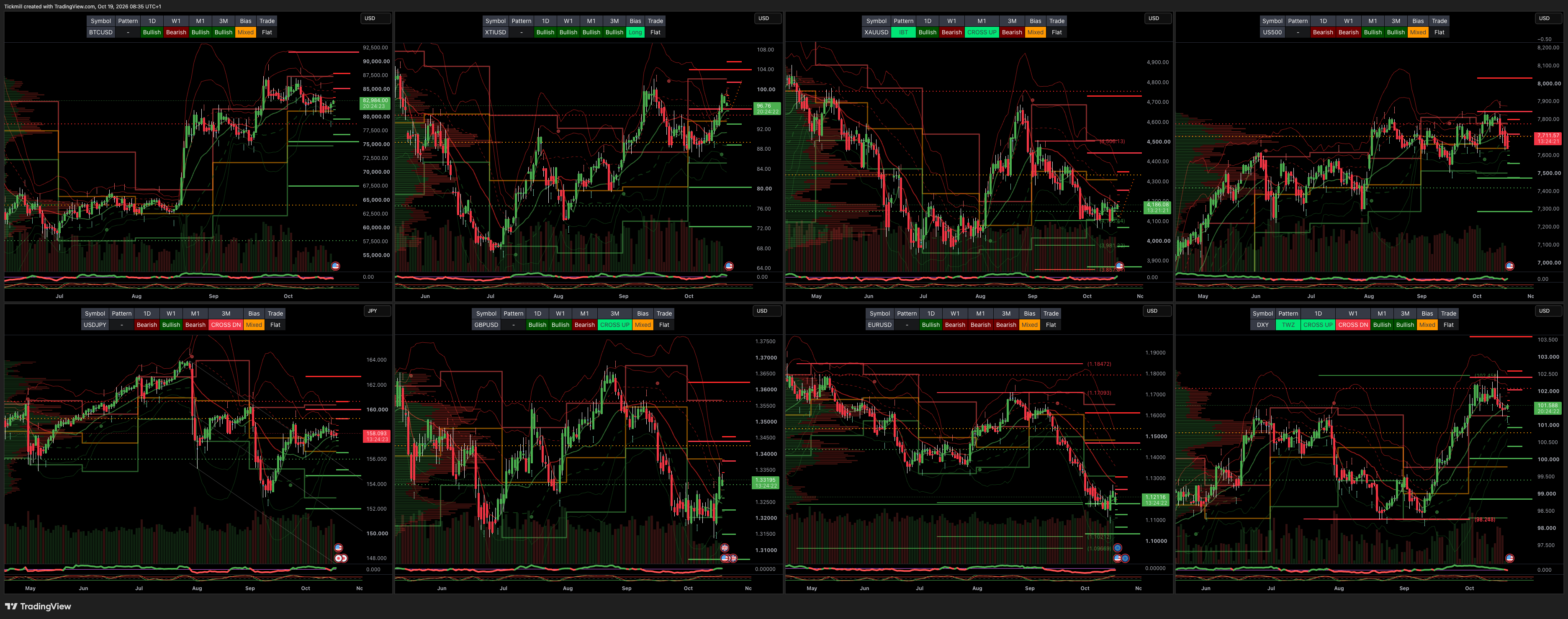
US Treasuries gained as investors sought safety amid AI valuation concerns and broader uncertainty. The bond bid shows that markets are still willing to treat technology weakness as a growth and financial-conditions event, rather than only a sector rotation. That matters for central banks because a sustained tightening in financial conditions can partially offset the need for further policy-rate action. The Dollar was mixed, while the Euro weakened against most G10 currencies. Political unrest in France, softer European sentiment and questions around fiscal stability continue to weigh on the single currency. With the ECB entering its quiet period later this week, markets will have limited official guidance as they assess whether French risk remains localised or spills into broader Eurozone spreads. Bitcoin rose more than 2% to above $82,000, helped by the softer Dollar and renewed appetite for alternative assets. Gold remained supported as well, although the key cross-asset message is more nuanced: investors are buying some risk again, but also maintaining hedges. This is not a clean risk-on reset; it is a selective rebound after a sharp positioning washout. Brent crude fell 1.8% to around $107.90/bbl, retreating from a five-month high as traders balanced renewed Middle East tensions against signs that regional oil supplies remain close to pre-war levels. The decline offers some relief, but oil remains high enough to keep inflation risks alive. For central banks, the level still matters more than a single-session pullback.
China’s Q3 GDP beat expectations, rising 4.5% y/y versus a 4.4% consensus estimate. The beat is welcome but not decisive. The monthly data flow through the quarter had pointed to softness, and even with net exports helping, Beijing still faces work in Q4 to meet the annual growth goal of 4.5-5.0%. Markets will focus on whether activity data show genuine domestic momentum or continued reliance on external demand and policy support. The broader geopolitical backdrop remains tense. Concerns over US-Ukraine relations are weakening Kyiv’s negotiating hand ahead of next month’s Russia-US-China summit. That adds another layer of uncertainty for Europe, where energy security, defence spending and political cohesion remain central issues. Markets are not pricing a clean geopolitical resolution, but they are sensitive to any shift that changes energy or fiscal assumptions.
In the US, the Fed is now in communications blackout, leaving investors to digest last week’s inflation data without much policy hand-holding. CPI and PPI both came in warm, with the PPI report particularly notable for evidence of broader input-cost pressures. Final demand rose strongly, core measures exceeded expectations, and price momentum in earlier stages of production suggests cost pressure is moving through supply chains. That makes the market’s reaction to Chair Warsh’s guarded comments important. His refusal to prejudge the October meeting helped reduce the implied probability of a hike this month, but it did not remove the December risk. His AI remarks also matter: AI may be a positive supply-side development over the longer run, but in the near term it is also a demand impulse, lifting investment, power usage, construction costs and capital spending. That demand channel is not disinflationary.
This is where the AI story intersects with inflation. Investors tend to view AI as a productivity miracle, but the buildout phase is resource-intensive. Data centres, chips, grid infrastructure, cooling systems, commodities and specialist labour all carry cost implications. If firms retain pricing power, those costs can be passed through. That keeps second-round effects on the radar even if central banks prefer to emphasise future disinflation from energy base effects or tariffs.The Fed’s latest Survey of Consumer Finances also puts new detail behind the K-shaped economy. The income picture has not been entirely skewed toward the top decile; median family incomes improved, and the gap between real median income and mean family income narrowed between 2022 and 2025. But wealth is a stock, and the stock of wealth remains heavily concentrated.
Asset price inflation widened the wealth gap. Average net worth in the top decile rose from around $2.78mn to $3.67mn, while the bottom 40% saw declines. That matters because the market rally has boosted the spending capacity of households already most exposed to financial assets. Lower-income groups, by contrast, remain more exposed to inflation, debt costs and housing affordability pressures. Housing wealth is still the dominant balance-sheet asset further down the income distribution, making these households more vulnerable to higher interest rates. If borrowing costs stay elevated, property-linked wealth becomes less supportive and mortgage or rent pressure weighs more heavily on confidence. This helps explain why strong GDP and high equity indices have not translated into a broad improvement in household sentiment. The spending side is even more skewed. The top decile accounts for roughly 32% of consumption, while the top quintile accounts for more than half. In discretionary categories such as new cars, vacations and eating out, the top decile accounts for just over 50% of spending, and the top 1% alone accounts for more than the bottom half of the population combined. No wonder the economy can look strong in aggregate while most consumers feel gloomy. That demand structure matters for markets. If the top-income cohort keeps spending because asset prices remain high, aggregate consumption can remain resilient even as lower-income households struggle. But it also means equity-market weakness can feed back into demand more directly than usual, because the spending engine is increasingly linked to wealth effects at the top. This is another reason policymakers are watching financial conditions closely.
The coming week has a strong UK skew. Labour market and wage data on Tuesday will start the sequence. Most surveys, with the exception of the REC report, point to a mild contraction in hiring, which should be visible in PAYE-linked figures. Private-sector wage pressures are expected to continue moderating, although the pace matters for the MPC’s assessment of persistence. UK CPI and borrowing figures follow on Wednesday. The headline inflation rise over winter is relatively predictable as regulated home energy costs adjust higher. The key issue is whether there is evidence of second-round effects. Any sign that energy costs are spreading into broader services or wage-setting would agitate the MPC and strengthen the case for a November hike. Public borrowing will also matter. UK GDP growth has looked better, but that improvement has not clearly appeared on the revenue side. With debt-servicing costs rising, a further drift from the OBR borrowing pathway is likely in the PSNB data. That would keep fiscal credibility in focus ahead of the UK Budget. UK retail sales on Friday have been volatile month-to-month, but the underlying trend appears healthier. Part of that reflects a rebound from weak levels, and part reflects households dipping into savings to absorb higher energy costs. That is supportive in the near term but not a durable growth model if real income pressure persists.
Flash PMIs for October also arrive on Friday for the UK, Eurozone and US. They will be important for assessing whether the inflation shock, higher yields and equity volatility are beginning to affect business activity. Price components will be watched especially closely after the strong US PPI data and renewed concern about cost transmission. In Europe, ZEW on Tuesday and French business confidence on Thursday are the main data points. France remains politically sensitive after weekend unrest. Markets will want to know whether protests begin to affect business sentiment and whether sovereign spreads continue to reflect fiscal concerns, political risk or broader fragmentation pressure.
The US calendar is lighter, with housing starts and building permits on Tuesday, the leading index and Kansas City Fed on Thursday, and final Michigan sentiment on Friday. With the Fed in blackout, these releases may carry more market weight than usual. Housing data will be especially relevant given high mortgage rates and the role of housing in both inflation and household balance sheets. Canada CPI today and Japan CPI on Friday are also worth monitoring. Japan’s inflation data are important because higher Japanese yields have already removed one of the old anchors for global rates. If inflation remains sticky, the BoJ’s normalisation path may continue to ripple through global bond markets.
Macro to Micro, markets are attempting a risk rebound after last week’s AI and chip-led selloff, but the recovery remains fragile. Nasdaq futures are firmer, Asia has stabilised, and oil has pulled back, yet the inflation backdrop remains uncomfortable, French political risk is rising and the Fed is now silent. For traders, the key markers are AI earnings guidance, semiconductor breadth, US yields, Brent, French spreads, UK wage and CPI data, China activity momentum and whether the rebound is supported by fundamentals or simply dip-buying after a volatility shock.
Overnight Headlines
China’s Q3 GDP Growth Accelerates To 4.5%, Beating Estimates
China’s Sep Retail Sales Rise 1.1% Y/Y, Industrial Output Climbs 5.5%
BoJ Governor Ueda Says Underlying Inflation Is ‘Quite Close’ To 2% Target
IMF Says BoJ May Need To Tighten Faster If Inflation Exceeds Forecasts
RBA’s Kent Says Labour Market Is Loosening Faster Than Expected
Putin Floats Summit With Trump And Xi To Decide Ukraine’s Fate
Zelenskyy Says Trump Is Pushing Ukraine To Capitulate To Russia
Trump Waives Russia Sanctions Ahead Of New Law Taking Effect
Rubio Says Trump May Take Up To 60 Days To Decide On Russia Sanctions
US Resumes Intelligence Sharing With Ukraine After Pause, Zelenskyy Says
Oil Tumbles As Trump’s Russia Sanctions Waiver Raises Supply Prospects
France Faces Aftermath Of Worst Unrest In Years As Macron Urges Calm
Euro Weakens As French Protests And Russia Risks Weigh On Sentiment
Bond Market’s Big Short Bet Faces Test As AI Trade Wobbles
ECB's Lagarde Says Bond Selloff Will Slow Inflation
BoE Scrutinises Barclays Over Private Credit Exposure Claims
Microsoft Pulls Out Of UK Data Centre Deal With Nscale
US Stock Futures Rise Ahead Of Busy Earnings Week
Korean Chip Stocks Slide As DeepSeek Model, Funding Concerns Weigh
BlackRock Sees Tokenised Funds Entering Wall Str’s Financial Infrastructure
FX Options Expiries For 10am New York Cut
(1BLN+ represents larger expiries and is more magnetic when trading within the daily ATR.)
EUR/USD: 1.1300 (EU1.92b), 1.1500 (EU1.65b), 1.1200 (EU1b)
USD/JPY: 157.15 ($430m), 156.00 ($407.9m), 161.00 ($322.9m)
AUD/USD: 0.6975 (AUD780.3m), 0.6950 (AUD569.4m), 0.6970 (AUD448m)
GBP/USD: 1.3800 (GBP376.8m), 1.3435 (GBP350m), 1.4015 (GBP342.5m)
EUR/GBP: 0.8540 (EU319.7m)
USD/MXN: 18.47 ($341.1m)
USD/CAD: 1.4165 ($718.9m), 1.4540 ($374.1m)
USD/KRW: 1365.00 ($447.3m), 1330.00 ($385m)
NZD/USD: 0.5650 (NZD334.8m)
CFTC Positions as of 16/10/26
Equity fund speculators trim S&P 500 CME net short position by 5,804 contracts to 390,896
Equity fund managers raise S&P 500 CME net long position by 8,186 contracts to 912,542
Speculators trim CBOT US 5-year Treasury futures net short position by 83,327 contracts to 1,080,204
Speculators increase CBOT US 10-year Treasury futures net short position by 91,621 contracts to 988,102
Speculators increase CBOT US 2-year Treasury futures net short position by 58,675 contracts to 911,579
Speculators increase CBOT US UltraBond Treasury futures net short position by 45,258 contracts to 321,597
Speculators increase CBOT US Treasury bonds futures net short position by 6,626 contracts to 126,438
Bitcoin net long position is 2,534 contracts
Swiss franc posts net short position of -22,078 contracts
British pound net short position is -106,964 contracts
Euro net short position is -137,573 contracts
Japanese yen net long position is 50,207 contracts
Technical & Trade Views



Comments
Log in or sign up to join the conversation.