


US and European equity futures firmed as oil retreated from intraday highs, allowing investors to look through the latest attacks on Saudi Arabia. S&P 500 futures rose around 0.3%, while European contracts gained 0.6%. The relief is fragile, but markets are treating the weekend escalation as another disruption that has not yet materially impaired regional oil supply.
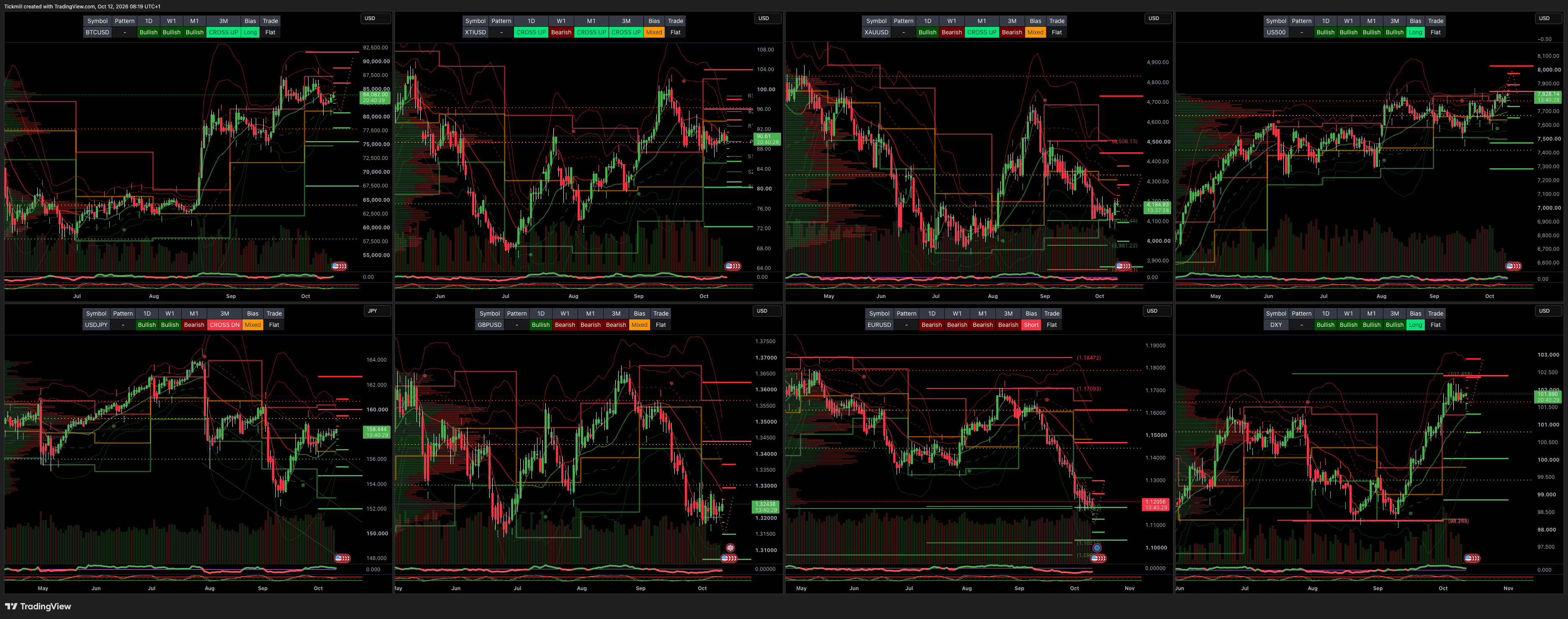
Asia was weaker. MSCI’s regional index slipped 0.2%, dragged lower by a 3% fall in South Korean equities after the long weekend. The move highlights the uneven global risk backdrop: US assets remain supported by AI-linked earnings optimism, while Asia is more exposed to energy-import costs, FX sensitivity and semiconductor volatility. Brent fell 1.2% to $103.43/bbl after touching $105.63, despite weekend Houthi strikes on Riyadh’s main airport. Traders are balancing steady physical supply against rising geopolitical risk. A reported limited Russia-Ukraine energy ceasefire helped sentiment at the margin, but with Brent still above $100, the complex remains one headline away from another spike. Gold extended gains for a third session, trading around $4,200/oz, while Treasury futures rose modestly alongside gains in Australian and New Zealand bonds. Cash Treasuries were closed for the US holiday. The combination of firmer equities and higher gold suggests investors are selectively adding risk while keeping hedges in place.
The inflation test is deferred, not resolved. Columbus Day makes for a slow US start, but Wednesday’s CPI is the week’s key event. Consensus expects headline CPI at 0.6% m/m and 3.6% y/y, up from 3.4%, largely reflecting oil’s impact on transport costs. Core inflation is expected to edge up to 2.5% y/y from 2.4%.That split matters for the Fed. Policymakers can look through energy-led headline strength if core pressures and inflation expectations remain contained. But broader pass-through into services, logistics or goods prices would challenge market confidence in an October pause. Softer payrolls and cooler PCE revisions gave the Fed room to wait; oil is now trying to take some of that room back.PPI follows Thursday, with final demand expected to rise 0.5% m/m. Import and export prices on Friday should add further evidence on input costs, energy and currency pass-through. Other US releases include NFIB small business optimism and existing home sales Tuesday, the Beige Book Wednesday, retail sales and the Philadelphia Fed Thursday, and industrial production plus TIC data Friday. Fed speak is also important in the final week before the pre-meeting blackout. Hammack speaks today and Thursday, Waller and Collins Tuesday, Bowman Wednesday and Fed Chair Warsh Friday. Markets will watch whether officials frame recent bond-market tightening as doing some of the Fed’s work, or whether renewed energy inflation keeps a tightening bias alive.
The UK calendar is lighter, with BRC retail sales Tuesday and production, trade and GDP data Thursday. Q3 began with a 0.4% m/m GDP gain, leaving quarterly tracking near 0.6%. Survey data suggest expansion extended into August, and a 0.2% m/m gain would keep UK growth looking more resilient than expected. That resilience still masks household stress. The BoE’s Q3 credit conditions survey showed overall defaults remain low, but unsecured lending is under pressure. Demand for credit cards and unsecured loans continues to rise, while default rates are also moving higher. With the Ofgem price cap set to reset higher over winter, households reliant on revolving credit face a tougher inflation, rates and tax mix.
In the Eurozone, final CPI data are due across the week, starting with Germany Tuesday and ending with the regional number Friday. The final estimate should match the flash reading, with headline inflation at 3.8% y/y and core at 2.5%. The details on energy pass-through and services inflation will matter for the ECB, especially as Europe remains more exposed to energy shocks than the US. France remains a risk focus. Fiscal pressure, high borrowing costs and political uncertainty continue to shape the European risk premium. Investors still want credible evidence of deliverable consolidation, leaving French spreads sensitive to headlines.
China trade and inflation data are due Wednesday, with credit figures likely Friday. The China-EU talks ended with a 16-point agreement covering trade, investment, export controls and intellectual property rights. China reportedly committed to cutting hybrid car exports, while the EU is still preparing safeguard measures. This looks more like managed friction than a clean de-escalation. India’s Rupee rose 1% after the central bank deployed some of its strongest support measures since the 2013 taper tantrum. The move underlines the pressure on emerging markets from high oil, firm US yields and currency volatility.
Canada’s September labour report was the weak spot. Employment fell 68.3k versus expectations for a 10k gain, after a 41.7k drop in August. Public-sector hiring fell 70k, led by education and health/social services, while the private sector added 24.1k roles. Even allowing for distortions, the report points to a deteriorating labour market. The unemployment rate rose to 6.5% from 6.4%, flattered by another decline in participation to 64.8%. Wage growth is slowing, adding pressure to consumption. For the Bank of Canada, the mix is uncomfortable: energy-led inflation and firmer core prices argue for caution, while weaker jobs, housing sensitivity, high leverage and unresolved US tariff risks argue against aggressive tightening. Markets still price around 90 bps of BoC tightening over the next year. That looks demanding without a meaningful turnaround in domestic demand. The Canadian Dollar faces a difficult backdrop: inflation risk limits easing, but the growth and labour-market picture makes aggressive hikes hard to justify.
The IMF and World Bank meetings in Bangkok will bring heavy central-bank commentary. BoE Governor Bailey and Fed Chair Warsh speak Friday, alongside BoE officials Greene, Pill and Breeden. Mann speaks today and Dhingra Tuesday in London. The key question is whether policymakers sound more worried about inflation, growth or financial stability.
Macro to Micro, markets start the week with a fragile relief bid. Oil has come off its highs, futures are firmer and bonds are steady, but Brent above $103, gold near $4,200 and Middle East tensions show hedging demand remains strong. Wednesday’s US CPI is the main test of whether the Fed can remain patient. For traders, the focus is Brent, CPI, Fed speakers, French spreads, the Canadian Dollar and whether equity strength can survive another inflation scare.
Overnight Headlines
Trump, Putin Agrees Deal For Russia To Release Diesel On To Market
Iran Says US Response On Reopening Hormuz 'Insufficient'
Putin Relayed Iran War Proposal To Trump, Kremlin Says
Iran Sets Supertanker Ablaze After US Takes Out Ship Breaking Blockade
Saudi Airport Hit Again As Riyadh Set To Host Major Conferences
Houthis Claim Attacks On Aramco Facilities At Riyadh And Khurais
Trump Says Russia And Ukraine Agreed To ‘Energy Ceasefire’
Trump Says Ukraine Needs New Leader Who Can Deal With Putin
US Threatens To Block Arms For Ukraine Over Attacks On Russian Refineries
Zelenskiy: He Will Organise Elections If Russia Agrees To 60-Day Ceasefire
Bessent Will Likely Cut US Long Bond Sales Next Month, Says Citi
House Rep, Invoking Reagan, Moves To Block Trump's Russia Oil Deal
EU To Cap Chinese Hybrid Car Imports At 350,000 Each Year
Germany Warns EU That €159B Budget Cuts Are Not Enough
Healey Plans Short-Term UK Budget Giveaways To Limit Fiscal Pain
IEA Urges More Diesel Releases As Global Market Tightens
Amazon In Talks To Buy AI Startup Decart For Around $7 Billion
China Proposes Curbs On Hidden Handles, Virtual Controls
Monte Paschi To Hold Monday Board Meeting On M&A Situation
FX Options Expiries For 10am New York Cut
(1BLN+ represents larger expiries and is more magnetic when trading within the daily ATR.)
EUR/USD: 1.2000 (EU864.2m), 1.2300 (EU748m), 1.1500 (EU663.5m)
USD/JPY: 156.00 ($459.5m), 153.15 ($430m), 153.75 ($399.1m)
AUD/USD: 0.6360 (AUD440m), 0.6825 (AUD368.6m)
USD/CAD: 1.3650 ($330m)
EUR/GBP: 0.8625 (EU440.6m)
USD/CNY: 6.7200 ($523.2m), 6.8500 ($306.6m), 6.6700 ($300m)
GBP/USD: 1.3420 (GBP562.6m)
CFTC Positions as of 9/10/26
Equity fund speculators increase S&P 500 CME net short position by 41,003 contracts to 396,700
Equity fund managers raise S&P 500 CME net long position by 3,101 contracts to 904,356
Speculators increase CBOT US 5-year Treasury futures net short position by 167,830 contracts to 1,163,531
Speculators trim CBOT US 10-year Treasury futures net short position by 4,134 contracts to 896,481
Speculators increase CBOT US 2-year Treasury futures net short position by 60,880 contracts to 852,904
Speculators trim CBOT US UltraBond Treasury futures net short position by 50,097 contracts to 276,339
Speculators trim CBOT US Treasury bonds futures net short position by 67,063 contracts to 119,812
Bitcoin net long position is 2,540 contracts
Swiss franc posts net short position of -23,740 contracts
British pound net short position is -97,611 contracts
Euro net short position is -99,332 contracts
Japanese yen net long position is 62,325 contracts
Technical & Trade Views



Comments
Log in or sign up to join the conversation.