


Global bond markets found some tentative stability in Asia after a sharp two-day selloff pushed yields to multi-decade highs. The US 10-year Treasury yield dipped 1 bp to around 5.19%, after surging more than 20 bps over the previous two sessions, while the two-year yield eased to roughly 4.90%. The move is modest, but after the scale of this week’s repricing, even a small pause matters. For now, markets are shifting from panic selling to reassessment.
A pullback in oil prices helped stabilise the situation. Brent crude fell around 0.8% to approximately $105.70/bbl, retracing part of its more than 7% surge over prior days. Reports that US and Iranian negotiators are discussing a phased agreement provided some relief, with Tehran potentially reopening the Strait of Hormuz while Washington considers easing its blockade on Iranian ports. That is not yet a settlement, but it is enough to reduce the immediate fear of a further energy price shock. Oil and bond yields remain the two dominant macro variables. The recent spike in crude had reignited inflation concerns and pushed markets to price a more aggressive Federal Reserve path. Interest-rate swaps now imply the possibility of three additional quarter-point hikes over the next year. That is a major shift from the more benign rate narrative markets were hoping for only days ago. Even with today’s pullback, Brent above $105/bbl remains uncomfortably high for central banks and consumers. Equities benefited from the calmer tone. MSCI’s Asia Pacific index rose around 0.3%, led by Japan, although holidays in South Korea, Taiwan and mainland China reduced regional liquidity. US equity futures pared earlier losses, while European contracts also pointed to a positive open. The recovery looks more like a relief bounce than a decisive turn. Equity markets can absorb higher yields when growth is strong, but the combination of rising oil, sticky inflation and aggressive Fed pricing remains a difficult backdrop for multiples.
Australian and New Zealand 10-year yields edged higher, while a global bond-yield index hovered around 4%. That level captures the broader problem for risk assets: global discount rates have moved materially higher. Unless inflation data soften or oil falls more meaningfully, investors will struggle to rebuild conviction in duration-sensitive assets. The long end remains the market’s pressure point.The Yen strengthened around 0.3% to 158.40 per Dollar after Japan’s Finance Minister Katayama said Trump had expressed concern about Yen weakness during his meeting with Prime Minister Takaichi. Katayama added that Japan and the US would continue cooperating on FX issues. This is important because it suggests Yen weakness is no longer just a domestic Japanese concern. If Washington is also uneasy, the market will treat intervention risk more seriously. Still, the underlying forces behind Yen weakness remain intact. US yields are elevated, the Dollar remains supported by Fed tightening expectations, and the BoJ’s recent hike has not been enough to close the rate differential. Verbal intervention can slow depreciation, but unless Treasury yields fall or the BoJ signals a more forceful policy path, USDJPY is likely to remain vulnerable to renewed upside pressure.
Thursday’s European rate decisions completed this month’s policy cycle. The SNB decision was arguably the most interesting. Although it raised its inflation profile, CPI was still seen at the lower end of target throughout the forecast horizon, and that was based on a constant policy rate at zero. Markets, by contrast, are pricing something closer to three hikes, which looks aggressive. The SNB also sounded more comfortable on the currency, noting that recent Swiss franc weakness has been helpful and removing the line about increased willingness to intervene in FX markets to counter an excessively strong franc. That shift matters for funding markets. The SNB appears content to let the franc depreciate gradually, especially if that helps lift inflation toward target. With yield differentials encouraging the move, the CHF increasingly looks attractive as a funding currency, particularly when compared with the traditional favourite, the Yen. If intervention risk grows around USDJPY while the SNB tolerates CHF weakness, relative funding preferences could start to shift. The broader policy theme remains resilience. Central banks are increasingly highlighting the fact that activity has held up better than expected despite the energy shock. This was visible in the September flash PMIs, especially in the US, where the composite index showed striking strength. The message is uncomfortable for rate markets: if growth remains solid while energy pushes inflation higher, central banks have more room to tighten.
The UK GfK consumer confidence survey reinforced that point. Sentiment improved only one point in September to -13, but that marks a substantial rebound from the April low of -25, when Middle East conflict fears were at their peak. More importantly, UK consumer confidence is now above its pre-conflict level. Relative to G10 peers, the UK’s performance is striking, with the standardised score currently at the top of the available September readings.That contrasts with the euro area, where the bounce from the spring trough has stalled at a lower level. For the Bank of England, this firmer activity backdrop matters. MPC members Breeden and Lombardelli understandably focused yesterday on upside inflation risks, but stronger consumer confidence and resilient activity are likely also influencing Committee thinking. If the economy is not weakening materially, the perceived cost of another rate hike falls. That keeps a November BoE hike firmly in play. The Bank is dealing with elevated headline inflation, rising energy costs, resilient demand and wage risks. Even if oil retreats from its highs, policymakers will need evidence that inflation expectations, wage-setting and business pricing intentions are cooling. For now, the activity side of the data is not giving the MPC an obvious reason to stand down.
Next week’s data calendar is heavy. In the UK, money and credit data arrive Tuesday, followed by the Lloyds Business Barometer, final Q2 GDP and Q2 current account on Wednesday. The most important release is Friday’s Decision Maker Panel, which is a key Bank of England survey for tracking price and wage risks. Given the MPC’s recent hawkish tone, the DMP could materially influence November pricing. In Europe, preliminary September CPI releases begin with Spain on Tuesday, followed by France, Italy and German state and national readings on Wednesday, before the Eurozone aggregate on Friday. Headline HICP should rise because of energy, but the ECB’s focus will be on whether the shock is bleeding into core and services inflation. If core and services stay contained, the ECB can avoid overreacting. If they firm, year-end hike expectations will build further. The Eurozone also gets final manufacturing PMIs and unemployment on Thursday. The labour market remains crucial because wages are the channel through which an energy shock becomes a persistent inflation problem. With recent ECB survey evidence pointing to upward wage pressure, the unemployment data will be watched closely.
The US calendar is packed with top-tier releases. Dallas Fed manufacturing starts the week on Monday, followed by JOLTS and Conference Board confidence on Tuesday. Wednesday brings August PCE, the third estimate of Q2 GDP and advance trade data. Thursday includes Challenger job cuts, jobless claims and ISM manufacturing, before Friday’s September non-farm payrolls report. Payrolls will be the main event. Consensus looks for a solid 104k gain, with unemployment expected to tick up to 4.2%. That would be only a modest move from 4.14%, especially if driven by better participation. The key will be breadth. If job gains continue to broaden, wage growth stays sticky and unemployment remains low, the Fed will have little reason to push back against tighter market pricing. Elsewhere, the RBA is expected to hike again on Tuesday. The decision itself is mostly priced, so the guidance will matter more. Markets have only one further quarter-point hike fully priced beyond next week, meaning the Board’s tone could move the curve. Australian CPI, due Wednesday, will provide an important inflation check. China’s RatingDog and NBS PMIs are also due Wednesday, though markets will be returning from holidays and may take time to fully digest the signal. Japan’s Q3 Tankan survey on Thursday will be closely watched by the BoJ after its recent hike, while Tokyo CPI on Friday will offer a timely read on inflation momentum and help shape expectations for the next stage of policy normalisation. Central-bank communication will stay active. In the UK, Ramsden speaks on QT on Monday, Taylor addresses NIESR on Tuesday, Bailey opens the LSE/Bank Future of Money conference on Thursday and Mann speaks on Friday. In Europe, Lagarde on Thursday is the key event. From the Fed, Williams speaks Tuesday, Cook appears Wednesday and Thursday, and Logan speaks Thursday.
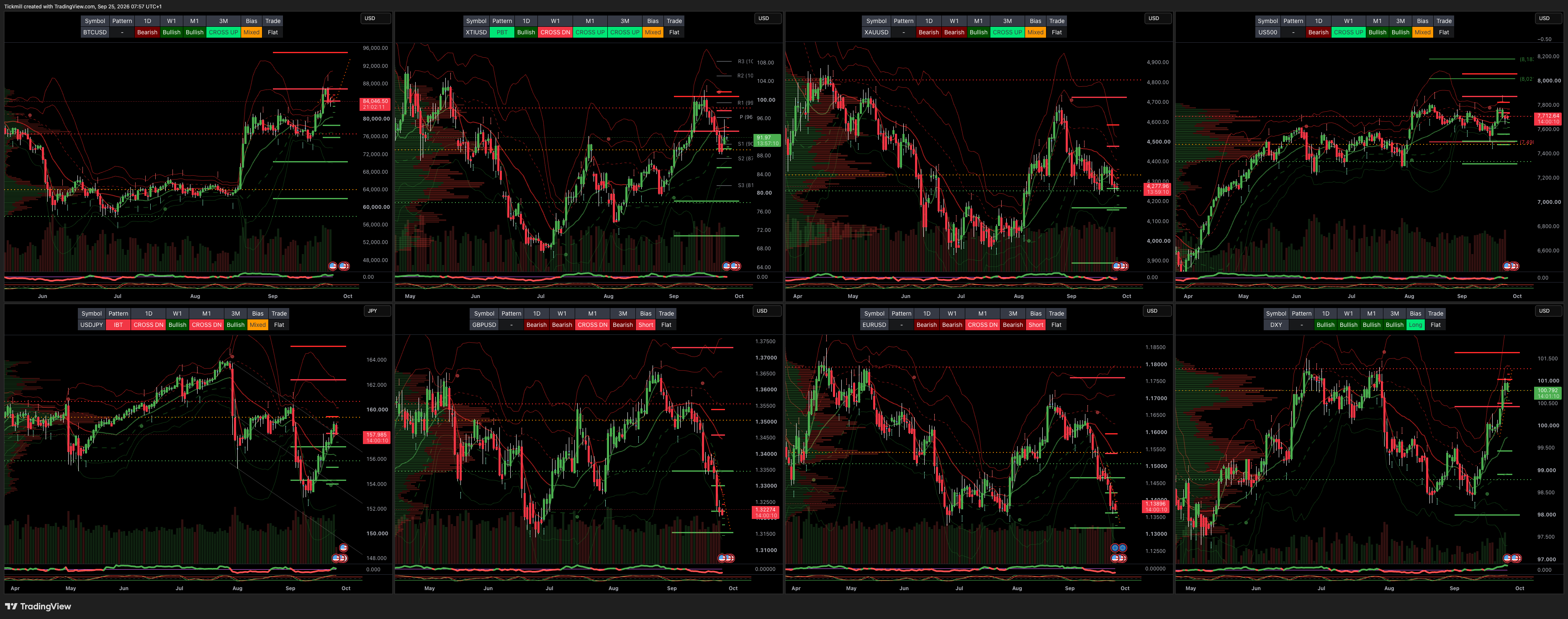
Macro to Micro, markets are trying to stabilise after a brutal rates repricing, but the underlying issue has not gone away. Oil is still high, activity remains resilient and central banks are increasingly confident they can tighten without immediately breaking growth. That combination keeps upward pressure on yields and limits the durability of equity relief rallies. For traders, the key levels are Brent around $105/bbl, the US 10-year near 5.20%, USDJPY around 158 and gold near $4,290. If oil falls further and yields consolidate, risk can breathe. But if energy rebounds or next week’s US data validate three more Fed hikes, the bond bruising may not be over.
Overnight Headlines
Trump Welcomes China's Xi With Fanfare, But No Breakthroughs Emerge
Trump Shared Concerns Over Weak Yen With Japan’s Takaichi
Xi Says US And China Must ‘Coexist In Peace’
Xi Presses Trump To Oppose Taiwan Independence During Summit
EU Urges UK To Raise Tariffs On Chinese Cars To Avoid ‘Made In Europe’ Barriers
Germany Industry Association Pushes For Tougher China Policy
Bank Of England To Raise Rates In November If Energy Prices Remain High
Iran Offers US New ‘7-Day’ Ceasefire Proposal
US And Iran Explore Phased Deal To Open Hormuz
Houthis Say They Attacked Riyadh And Aramco Facilities In Yanbu
France To Send Military Aid And Troops To Protect Saudi Oil Plant
Oil Falls As Markets Weigh Iran Truce Against Attacks On Oil Facilities
Global Bond Sell-Off Rolls On As US 30-Year Yield Hits Highest Since 2004
Dollar Set For Weekly Gains As Yields Surge And Fed Rate-Hike Bets Build
SoftBank Plans Record High-Yield Bond Sales To Invest In OpenAI
Anthropic Strikes $12B AI Computing Deal With Akamai
Costco Posts Strong Quarterly Profit On Tariff Refunds
FX Options Expiries For 10am New York Cut
(1BLN+ represents larger expiries and is more magnetic when trading within the daily ATR.)
EUR/USD: 1.1400 (EU1.77b), 1.1500 (EU1.12b), 1.1625 (EU983.6m)
USD/JPY: 155.00 ($2.01b), 149.00 ($1b), 162.00 ($866.2m)
USD/BRL: 5.1000 ($880m), 5.2000 ($674.2m)
AUD/USD: 0.7150 (AUD792.1m), 0.7050 (AUD563.4m), 0.7140 (AUD463.3m)
USD/CNY: 6.6900 ($325m), 6.6600 ($300m), 6.5800 ($300m)
USD/CAD: 1.3980 ($516.8m)
CFTC Positions as of 11/9/26
In the latest market updates, equity fund speculators have made notable adjustments to their positions. They've reduced their net short position in the S&P 500 CME by 48,186 contracts, bringing the total down to 288,457. Meanwhile, equity fund managers have also trimmed their net long position in the S&P 500 CME by 8,137 contracts, leaving them with 899,633 contracts.
Turning to the Treasury futures, speculators have significantly cut back their net short positions across various maturities. The net short position for CBOT US 5-year Treasury futures has decreased by 270,127 contracts, now standing at 997,366. The CBOT US 10-year Treasury futures saw a reduction of 13,547 contracts, bringing the total to 821,236, while the CBOT US 2-year Treasury futures experienced a trim of 73,754 contracts, now at 855,353. On a different note, speculators have increased their net short position in CBOT US UltraBond Treasury futures by 63 contracts, totaling 345,203, and added 2,640 contracts to their net short position in CBOT US Treasury bonds, which now sits at 203,157.
In the cryptocurrency realm, Bitcoin has a net long position of 2,468 contracts.
As for currency positions, the Swiss franc is showing a net short position of -28,988 contracts, while the British pound stands at -58,715 contracts in net shorts. The euro has a net short position of -26,993 contracts, whereas the Japanese yen is faring better with a solid net long position of 120,359 contracts.
Technical & Trade Views



Comments
Log in or sign up to join the conversation.