


The PMI rose to 54.1 in August, fostered by all crucial ingredients, such as output, new orders, employment, and sentiment. Renewed hiring, especially, suggests solid ground under the expansionary milieu, along with good news for profit margins. Plans for ample government spending over the next year could herald an infamous end to fiscal soundness
In expansionary territory for all the good reasons
Czech manufacturing firms saw robust expansion during August, thanks to sharper increases in output, new orders, and renewed employment growth. Demand improved particularly among international customers. Increased pressure on production capacity prompted companies to hire in August to meet production demands. That said, the number of workers has increased for only the second time this year, yet we read it as a sign of a robust rebound. Czech manufacturers were more optimistic in August about the outlook, fostered by hopes for further strengthening demand and bold investment plans.
Rebound in manufacturing much needed
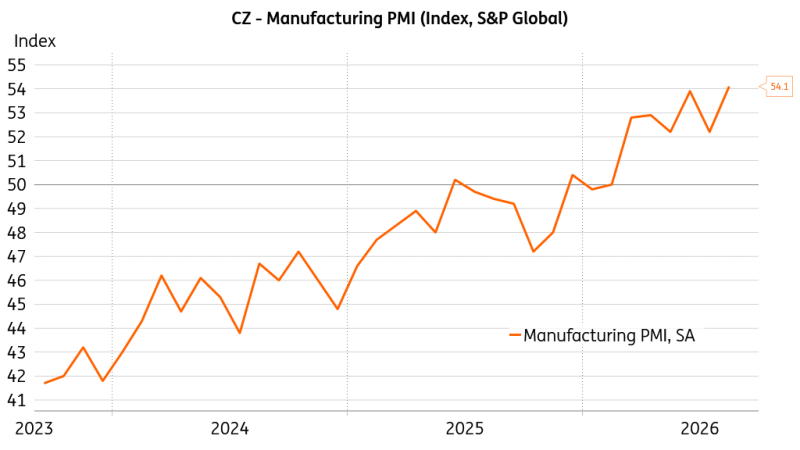
Production performance was somewhat pressured by a lagging supplier performance, while companies began to build up safety stocks once again to shield themselves against potential issues with key materials' availability. Inflationary pressures have somewhat eased from recent highs, but the pace in both input and output prices has remained relatively upbeat. The input cost pass-through was enabled by the continuous improvement in demand, with new orders rising for the sixth consecutive month. Such a development brings remedy for firms’ profit margins after the previous squeeze linked to galloping input costs and increased uncertainty in conditions of the protracted Strait of Hormuz conflict.
Requiescat in pace fiscal soundness
The Czech government has announced plans for the 2027 deficit of CZK389bn. Such a figure is above our assumption of not crossing a CZK340bn deficit that would enable the deficit-to-GDP ratio to remain just below or at the 3% threshold of the Maastricht criteria even in the next year. Yesterday’s new proposal and our nominal GDP outlook imply that the government deficit would reach 3.5% of GDP next year, after adjusting for the estimated surplus of municipalities. The Ministry of Finance still paints a deficit-to-GDP ratio below 3% in 2027, yet this is subject to the potential exclusion of some defence-related expenses.
Meanwhile, the European Council activated the national escape clause for 15 member states, including Czechia, in July 2025 to exclude some defence-related expenditures from the budget. Other countries followed suit. Well, should all that is proposed by the Czech Ministry be exempted, then you end up with this below-3% deficit number, indeed.
Deep deficits is a trend better not to join
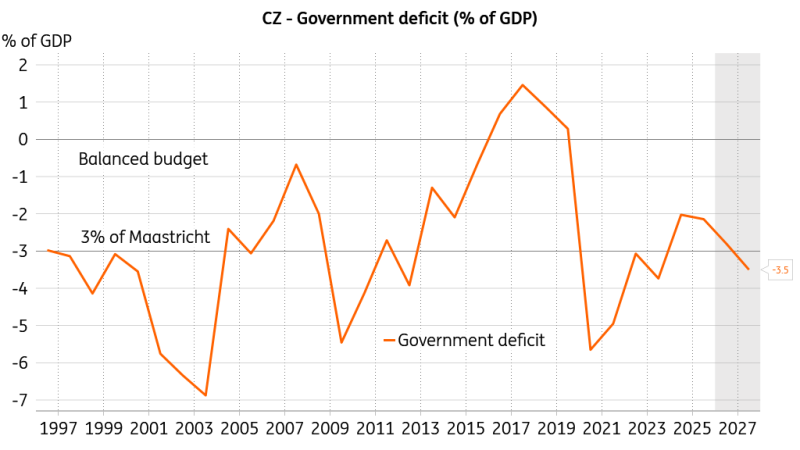
For Czechia, this unpleasant shift to a higher government deficit will come under some scrutiny, with the Czech electorate being traditionally very much allergic to large fiscal deficits. Petr Macinka, the chairman of the Motoriste coalition party, plans to discuss the too-high deficit with Prime Minister Andrej Babis this Thursday. That said, Motoriste pose themselves as a classical central-right party, with fiscal responsibility representing one of their priorities during the election campaign. This may end up as a political manoeuvre in which the 3% deficit looks wonderful in the end. There is still hope that things may change towards a less burdensome public finances outlook. We are as tense as you, so stay tuned.


Comments
Log in or sign up to join the conversation.