
The Czech National Bank will likely proceed with a rate hike next Thursday in a split vote. We don’t consider the Czech economy to be ready for tighter monetary policy, yet hawkish rhetoric – true to Chekhov's principle – makes a hike more likely than unchanged rates. Credibility and independence are in the spotlight this time.
Headline close to target while core inflation still upbeat
We are changing our stance when it comes to the next CNB meeting held on Thursday 18 June, as the hawkish communication implies an increase to the policy rate. Taking on board May’s CPI breakdown and the latest developments in our econometric model’s explanatory variables, we expect headline inflation to hover around target until November. A subsequent uptick should prove temporary, largely driven by base effects from last year, before inflation returns to a more moderate pace by April. Annual core inflation remained elevated at 2.9% in May, but we expect it to ease materially over the coming year. Considering our economic growth outlook of 2% for this year, we take the position that the underlying inflationary pressures are peaking now and will soften over the forecast horizon.
Inflation set to ease next year
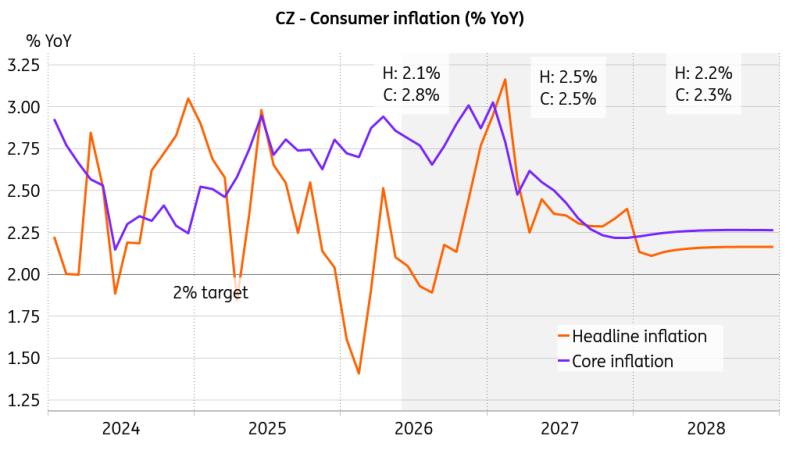
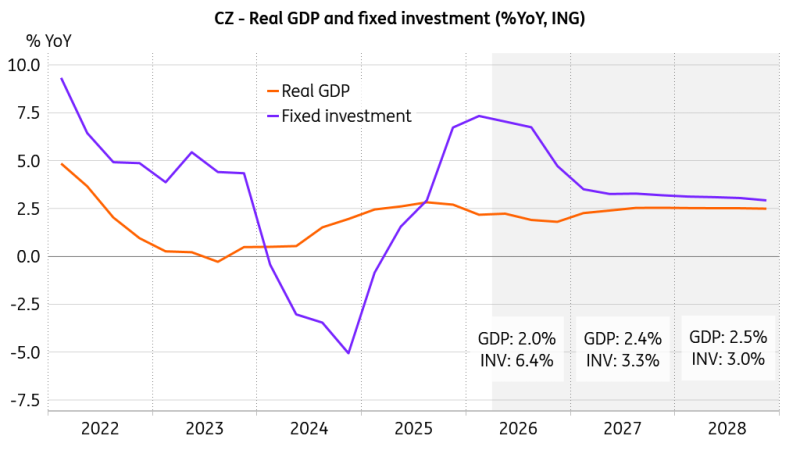
Still, the persistence of core inflation, driven by elevated price growth in services and buoyant rent growth, represents one of the reasons for tighter monetary policy, loudly heralded by some CNB members. Our conviction remains the same; the current state of the Czech economy and the outlook do not suggest a need for tighter monetary policy, as headline inflation is set to hover around the target at the monetary policy relevant horizon, the core rate is set to decelerate over the next year, the economy is not likely to enter a phase of overheating until the middle of next year, and there are downward risks to economic activity linked to the Hormuz crisis.
Chekhov's gun rule suggests a rate hike
Indeed, it is only the recent hawkish CNB communication that makes us change our stance when it comes to the June meeting, seeing a rate hike as a more likely outcome than keeping rates unchanged. Governor Ales Michl has become rather vocal about the need for tighter monetary policy, suggesting that he is willing to raise interest rates even though this could weigh on economic growth. We have been waiting for more balanced views and comments until very recently. What we have heard instead suggests that, if a rate hike materialises, it could be reversed should policy ultimately prove too restrictive.
And it holds in monetary policy that if you have deemed a certain action as appropriate, you should go ahead sooner rather than later, as it takes time for the adjustment to the base rate to kick in, with one to two years considered a full pass through. The intensity of the CNB’s hawkish communication, with repeated references to a rate hike, suggests that the phase of tough talk paired with unchanged rates has passed. Instead, the focus has shifted to tackling still-elevated core inflation, persistent services price pressures, and strong rental growth. In this sense, the CNB appears to be following Chekhov's dramatic principle: “One must never place a loaded rifle on the stage if it isn't going to go off. It's wrong to make promises you don't mean to keep.” We will see whether the CNB honours the rule but the outcome will have important implications for the credibility of its forward guidance.
Real interest rates set to hover in restrictive area
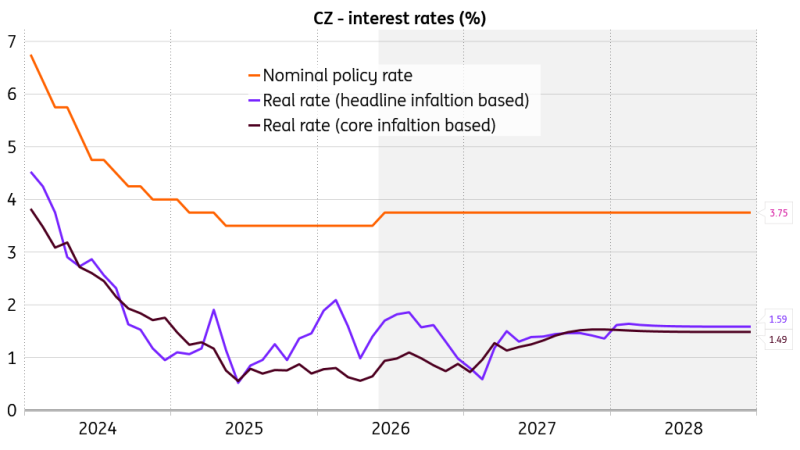
The continued boom in the housing market, ample credit growth, and strong wage growth in the first quarter would provide the rest of the reasoning basis to justify tighter monetary policy. That said, we expect a split vote next Thursday and would not be surprised if the base rate were to remain the same. However, we consider one hike in June as the most likely outcome at this stage. Whether it’s one and done or we see a sequel in August will come down to 2Q GDP performance, the potential hit from the Middle East conflict, and the path of core inflation. For now, the comments suggest that policymakers may take time to assess developments.
Indirect connotations
There are several notable aspects to the June CNB meeting. First, the rate hike was put firmly on the table by Governor Ales Michl, while other board members appear to have largely fallen in behind him. Some have remained unusually silent, despite typically offering clear guidance ahead of rate decisions. This raises the question of whether the governor is seeking to distance himself from the 2022–23 inflation surge, during which he consistently voted to keep rates unchanged, even as purchasing power eroded with inflation approaching 20%. All increases to the 7% policy rate were delivered under his predecessor, Jiri Rusnok. This, in turn, leaves open the question of whether the governor is fighting a past battle, given that today’s economic backdrop is substantially different.
Hormuz will likely pressure economic activity
Secondly, government representatives have recently been vocal about monetary policy being too tight, especially as compared to the European Central Bank. This certainly exerts pressure on the CNB and the question is how to deal with it in a way that the central bank’s independence is not affected. Here, the question arises of whether a hike aimed at pushing back against government pressure might be perceived as simply reactive rather than as a sign of genuine policy conviction. Well, we don’t have clear answers to these questions, yet they are actively being debated.
Our market view
The market has consistently maintained the most hawkish expectations for CNB and CZK rates in the EMEA space since the start of the US-Iran conflict. A June rate hike is almost fully priced in, and the market is expecting roughly two more hikes this year. This is about one hike fewer than was priced in mid-May and early June, but it still represents the most hawkish pricing in the EMEA region, including the ECB. As oil prices remain relatively stable compared to previous months, the widening rate differential should support a stronger Czech koruna. EUR/CZK has fallen from ranges around 24.300-400 to the current 24.150-300, and we believe there is further downside, with the CNB among the first globally to hike rates.
We do not expect a significant increase in terminal rate expectations; on the contrary, three hikes already seem substantial. However, the market may frontload pricing with a CNB rate hike next week, pushing the front end of the curve higher. EUR/CZK may therefore test 24.00 in the coming weeks and outperform Poland’s zloty, where the central bank is turning more dovish.
CZK rates are still largely driven by global developments, oil prices and views on core rates. That said, a CNB rate hike should strengthen the local narrative and lead to a flattening of the curve. The forward curve is already relatively flat across most maturities, and we expect some inversion, particularly at the front end. The CNB is maintaining a very hawkish tone despite data showing headline inflation close to target and core inflation still within the tolerance band. At the same time, the Czech economy is generally perceived by the market as sensitive to global shocks and some slowdown in GDP growth will understandably be expected. Therefore, we see significant room for further flattening of the curve here. Having said that, this also implies some resistance at the long end of the IRS and CZGBs curve to move further upwards.

Comments
Log in or sign up to join the conversation.