


Bitcoin gained about 44%, and Ethereum climbed more than 70% in the third quarter, reviving talk of a new crypto boom. Bitcoin posted its best third quarter since 2017, while Ethereum had its strongest quarter on record. The question now is whether a new cycle is forming, or whether prices are rebounding ahead of another macro-driven reversal.
For the wider crypto market, the coming challenge is whether demand for investment products continues. Rising real yields, a stronger dollar, and shocks to risk appetite may undermine the liquidity that frequently influences speculative assets.
The rebound has put Bitcoin and Ethereum back at the center of the cycle debate, but the case for continuation requires evidence beyond prices. A sustained spot Bitcoin ETF rally would help demonstrate that institutional demand is reinforcing the move rather than simply following it.
Crypto Boom: Bitcoin and Ethereum’s Third-Quarter Rebound
The scale of the gains is the clearest fact in the available account. Bitcoin rose more than 40% during the third quarter, while Ethereum climbed more than 70%.
The relative strength of Ethereum suggests the advance was not confined to Bitcoin, while Bitcoin’s gain provides the central benchmark for the renewed discussion of a broader digital-asset cycle. Still, two large quarterly returns cannot establish that the market has entered a lasting expansion.
Bitcoin is the core market reference, while Ethereum’s larger percentage advance indicates that the rally reached beyond Bitcoin. Recent investment-product flows into Bitcoin and Ether are a useful measure to watch, but no specific flow figure should be treated as established by the excerpt.

Are ETF Flows Strong Enough to Sustain the Crypto Boom?
ETF demand is the clearest test of whether institutions are driving the move or following it. A sustained spot Bitcoin ETF rally would show buyers reinforcing the trend.
So far, the signal is positive but uneven. U.S. spot Bitcoin ETFs took in about $2.39 billion between September 21 and 25, the largest weekly total since October 2025, CoinGlass data shows. Flows then cooled sharply. The funds saw a 1,780 BTC outflow on September 30, before returning to a $102.7 million inflow on October 1.
Cumulative net inflows now stand near $58 billion. Several weeks of steady inflows would be stronger evidence of lasting demand than a single strong week. A return to outflows would weaken the case.
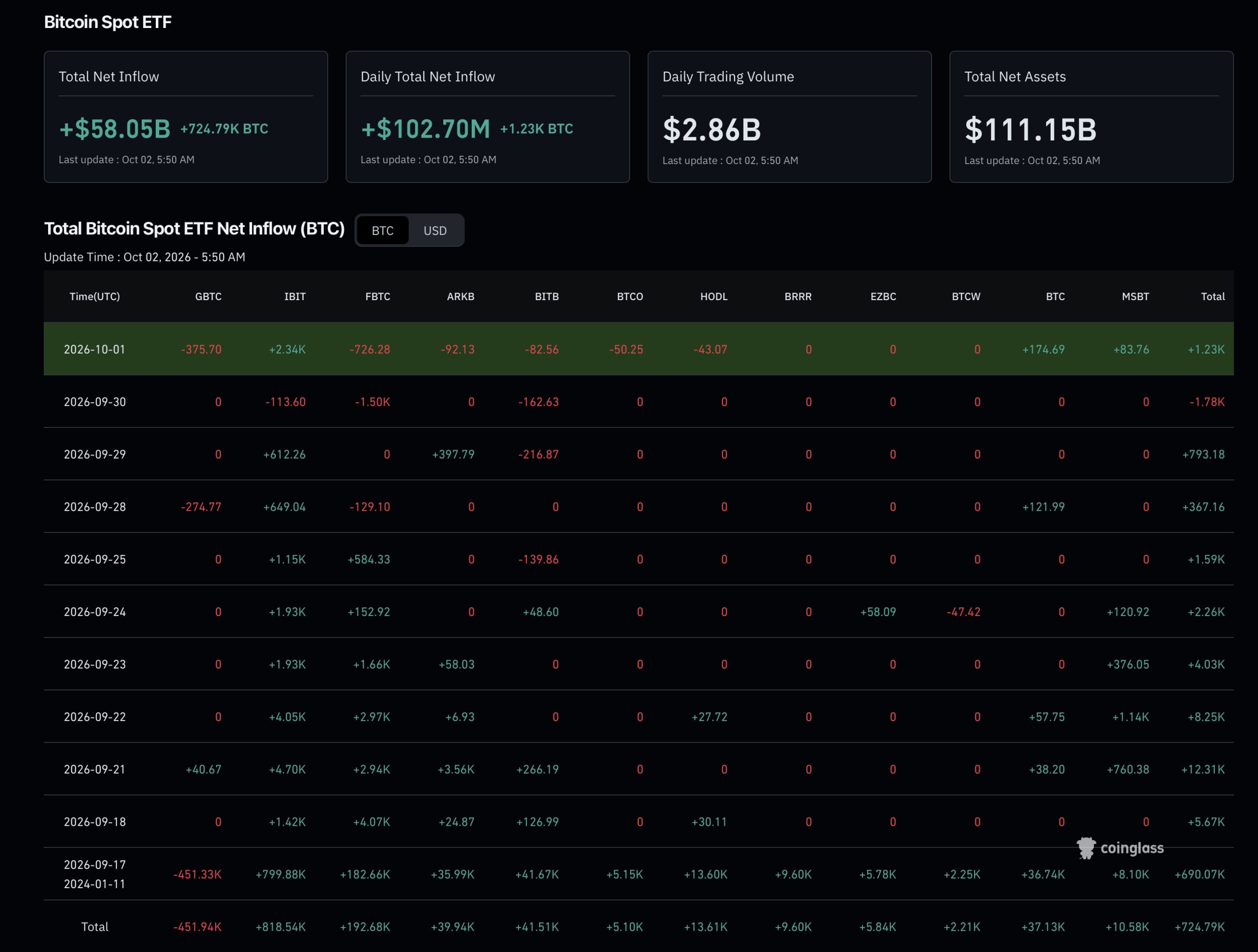
BTC ETF Flow Coinglass
Can Fed Liquidity Offset Higher Yields and a Strong Dollar?
The macro risks are clear. ETF outflows, higher real yields, a stronger dollar, or a broader economic shock could all reduce demand for risk assets.
The Fed’s stance is mixed. Its focus on keeping bank reserves ample may help at the margin, but it is not a new round of quantitative easing. The Federal Reserve’s H.4.1 balance-sheet release showed reserves of $2.930 trillion for the week ended September 23, down $83.6 billion from the prior week. That is one weekly snapshot, not a verdict on market liquidity.
Meanwhile, the 10-year Treasury yield sits above 5%. Higher yields and a firm dollar could still outweigh any support from reserve management.
The related tension between Treasury yields, Federal Reserve policy, and Bitcoin ETF flows is not a side issue: it goes directly to whether demand can withstand a less favorable macro environment.



Comments
Log in or sign up to join the conversation.