

Credit, debt and interest rates have an interesting relationship, yet they mean totally different things to different people. To the bankers, high-interest rates appeal to them more directly than they do to the average consumer. This is because it means more money ahead—from all floating interest loans. To consumers and especially borrowers, this could mean a spike in their debt load.
On the other hand, economists and policy makers view higher interest rates as a positive sign of an improving economy. This is basically what has been happening in the US over the last 18 months. The US Federal Reserve has hiked interest rates on three occasions and investors are anticipating at least two more rate hikes before the business end of the calendar year. Whether this will be good for the economy remains to be seen.
Subsequently, the increase in the US Funds Rate has led to the increase in the average monthly prime lending rate. It now stands at a multi-year high of 4.0% and could increase in the next few months if another hike comes in June as anticipated. Right now, individuals can borrow at a rate of about 4.5% up to about 10.5% depending on the nature of the loan and their credit scores. However, as more rate hikes come along, things will only get worse especially for those on floating interest rate loans.
This will have an adverse impact on the credit market. Nonetheless, data on individual loans market indicates that there is massive room to run before lending rates get to extreme levels, which means that it would be better to go for fixed rate loans.
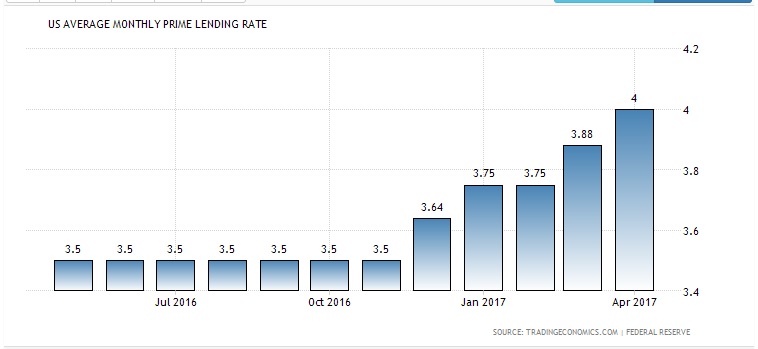
Based on the current incremental rate on the prime lending rate, the next hike could take the US Prime Lending rate to about 4.15%, while a third interest rate hike in 2017 will take it closer to 4.5%. This sets the year 2018 through 2020 for a rapid increase in the US lending rates, thereby creating an interesting opportunity for lenders.
Another couple of rate hikes will set a positive tone for more rate hikes next year, which augers well for the US economy. When the economic outlook is bright, lenders will expect interest rates to go higher from year-to-year. This will make lending on floating rates more attractive. On the contrary, floating rates are less attractive when the economic outlook is negative. That’s why banks and other lending institutions tend to be swayed towards fixed rates during economic meltdowns.
On the other hand, the credit market tends to benefit more when the rates are low in the sense that there are more businesses and individuals willing to finance their operations with debt. More debt at significantly low-interest rates reduces the cost of capital while at the same time increasing a firm’s liquidity levels, which open it up to more investment opportunities.
This is pretty much what has been taking place in the US economy over the last few years. Businesses and individuals have rallied the US credit market, in the process contributing the country’s economic growth. And in turn, this growth has convinced the Federal Reserve to hike interest rate on three occasions over the last 18 months. So, the US has moved from a state of “Quantitative Easing” (QE), to “Tapering”, and now, “Rate Hikes.” It has moved from a state of massive borrowing to moderate borrowing, which puts it amongst the best performing developed economies in the world.
However, this fast-paced return to normalcy has faced its critics along the way and even now, there are those who strongly believe that caution should be observed before hiking interest rates again. One such critic is the president of the Fed's St. Louis regional branch, James Bullard, who recently said that Fed's intended rate-hike plans may be "overly aggressive relative to actual incoming data on U.S. macroeconomic performance."
Conclusion
In summary, an increase in the base interest rate will have a different bearing to the common consumer as compared to banks and other institutional lenders. Investors can capitalize on the increased returns from their investments in capital goods.
However, if the fears raised by various economists are anything to be taken into consideration, then caution may be required before the next rate hike. Either way, the US lending rates are still very low compared to historical averages, which makes fixed rate borrowing an interest option for the common consumer.

Comments
Log in or sign up to join the conversation.