


Every few years, skepticism of officially calculated inflation rates surges, so it seems a good idea to now recap how the CPI measures (and mis-measures) the cost of living, remembering that in the absence of knowledge of the “true” utility function of the “representative agent”, one can’t know the correct approach.
- Weights in basket are unrepresentative
- Weights don’t change
- Quality changes are included
- CPI calculation changed to understate true inflation (aka Shadowstats argument)
Here is a graph of month-on-month annualized inflation over the past two years, as measured by the CPI, the chained weight CPI, CPI of sticky price items, 16% trimmed CPI inflation, and personal consumption expenditure deflator.
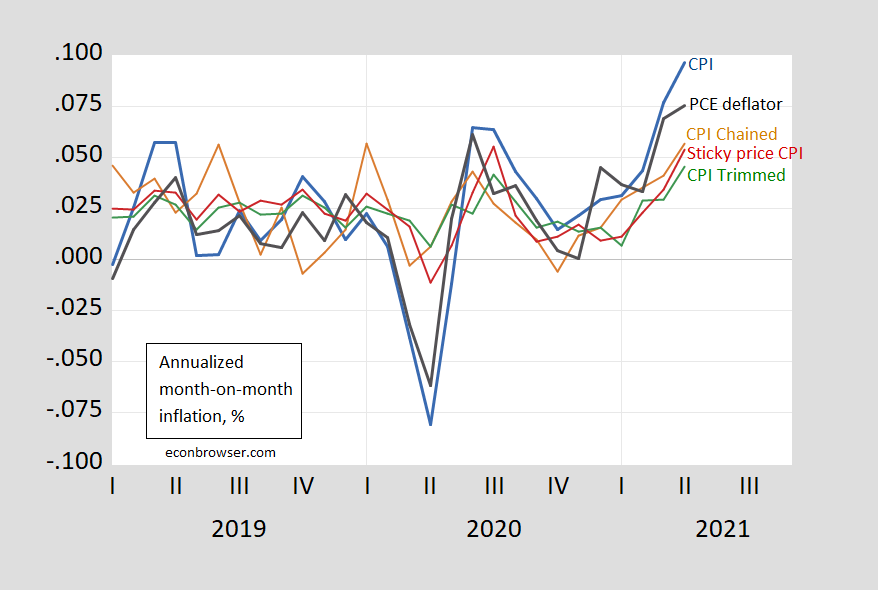
Figure 1: Month-on-month annualized inflation from CPI-all urban (blue), from personal consumption expenditure (PCE) deflator (black), chained CPI (brown), sticky price CPI (red), and 16% trimmed mean CPI (green). Source: FRED, and author’s calculations.
As discussed elsewhere, the official CPI is quasi-Laspeyres (main category weights fixed at 1982-84 levels, subcategories flexible), PCE is a chained-weight index (based on NIPA goods and services), chained CPI is chained-weight using CPI categories (including factor payments like rent). Sticky price CPI measures inflation of sticky price goods and services, and 16% trimmed CPI excludes the 16% of biggest and smallest changes in goods prices.
Notice the official CPI inflation rate is the highest of the series, in the most recent period (not guaranteed to be true in general).
The plutocratic aspect is addressed in any of these alternative measures. Here is my recalculation of year-on-year annual inflation, from a 2008 post.
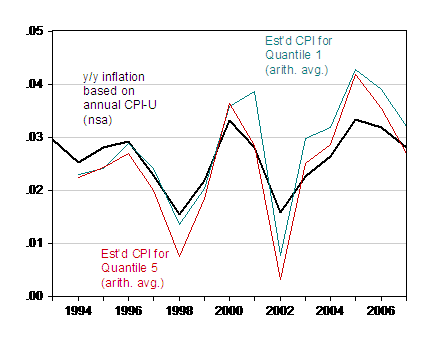
Figure 2: Year-on-year inflation calculated using annual CPI (not seasonally adjusted) , (black), and guesstimated CPI for first quintile (blue) and fifth quintile (red). Inflation calculated as first log difference of annual CPI. Guesstimated CPIs calculated as arithmetic averages of component indices. Source: BLS, and author’s calculations based on weights in Kokoski (2003), Table 5.
None of the foregoing should be taken to imply that one should take actual reported CPI inflation numbers as “the truth”. Rather, it’s that you need to be careful to understand what the official CPI number measures, and how alternatives provide answers to different questions.
What you should take from the foregoing is to stay far away from anything like Shadowstats. Jim H. describes in detail why this is so.


Comments
Log in or sign up to join the conversation.