CoreWeave Tests The Limits Of Cloud Pricing

CoreWeave leveraged surging AI demand to hike cloud pricing by 25%, signaling strong pricing power in a supply-constrained market.

The standard worry about renting out computing power is that it eventually becomes a commodity business. You buy expensive servers, you rent them out, and over time your margins get squeezed between rising hardware costs and customers demanding cheaper rates. CoreWeave CRWV is showing that the current artificial intelligence infrastructure market is behaving differently. The company raised prices across its cloud offerings by about 25% in July as near term capacity remained effectively sold out, while also saying it is passing through higher component costs. That is meaningful evidence of pricing power today. The open question is whether that power lasts once supply catches up and customers have more alternatives.

Main Note

CoreWeave Proves Its Pricing Power

CoreWeave (CRWV) Quote

Verdict: CoreWeave is showing that it has meaningful pricing power in today’s supply constrained artificial intelligence market. The company raised prices across its cloud offerings by about 25% in July and said it is also passing through higher component costs. That should improve the economics of new contracts, but it does not prove customers are permanently insensitive to price or that the same economics will hold once more capacity comes online.

What happened

CoreWeave disclosed on its August earnings call that it raised prices across its cloud offerings by about 25% in July. Management said the move reflected the current demand environment and the improving returns customers are seeing as more workloads shift to inference. Separately, customers have reportedly been told that prices for some Nvidia based artificial intelligence server systems shipping early next year will rise by more than 15%. Nvidia has not publicly confirmed those increases.

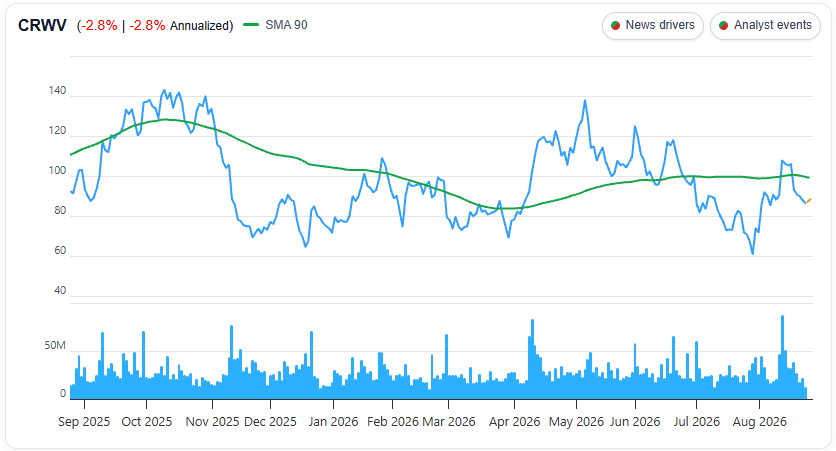
Separately, CoreWeave chief executive Michael Intrator sold roughly $28.2 million of stock on August 4 at an average price near $91.80. The sale was made under a Rule 10b5 to 1 trading plan adopted in November 2025, but it was not a one time transaction. SEC filings show a recurring series of similar weekly sales, so the better approach is to watch the cumulative pace of insider selling rather than dismiss any single sale as routine.

CoreWeave (CRWV) 1 Year Chart

CoreWeave 1 Year Chart

Why it matters

This weakens the traditional commodity hardware argument, but it does not eliminate it. CoreWeave’s current pricing suggests that scarce near term capacity gives the company leverage when negotiating new contracts. Truist (TFC) estimates that the pricing dynamic could lift contribution margins on future longer duration deals from about 24% to about 33%. That is meaningful, but it is a deal level estimate, not a nine percentage point increase in CoreWeave’s companywide operating margin.

What changed in the thesis

Investors previously had to wonder if CoreWeave was essentially a highly levered bet on hardware that would depreciate in value and command lower rental rates over time. The latest evidence is more encouraging. Near term capacity remains effectively sold out, pricing on newer systems is reaching new highs, and older Nvidia systems are still being re contracted at attractive rates. That improves the thesis, but it does not turn CoreWeave into a toll booth with absolute pricing authority. The company still has to prove that those economics can survive more competition, rising supply, heavy depreciation and a large debt load.

What the market may be missing

The assumption is that this pricing power can last indefinitely. But this dynamic relies entirely on end users continuing to see a massive return on investment from their own artificial intelligence models. If inference demand cools or enterprise budgets tighten, hardware costs might keep rising while customer willingness to pay hits a ceiling.

Valuation and expectations

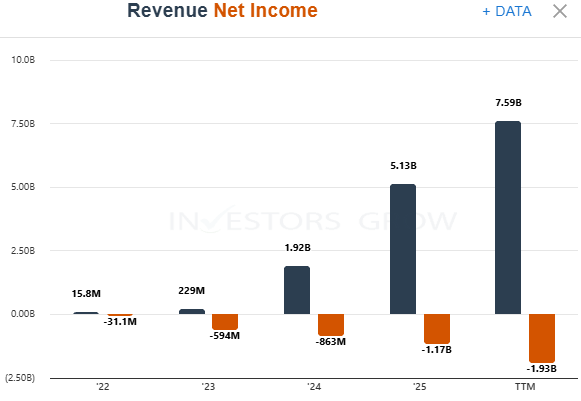
Truist estimates that the pricing changes could lift contribution margins on future longer duration deals by roughly 9 percentage points, from about 24% to about 33%. That is not the same as a nine point increase in CoreWeave’s companywide operating margin. The company reported a 2% GAAP operating loss margin and a 5% adjusted operating margin in the latest quarter, recorded $9.4 billion of capital expenditures and incurred $640 million of net interest expense. Better contract economics help, but the valuation still depends on whether those gains can outrun the cost of building and financing the infrastructure.

CoreWeave (CRWV) Revenue & Net Income

CoreWeave (CRWV) Revenue & Net Income

Bottom line

For now, CoreWeave holds the leverage. As long as the supply of advanced chips remains tight, the company can dictate terms. But this strategy is a balancing act that requires the underlying artificial intelligence economy to keep growing fast enough to absorb every price hike.

Pre Market Pulse

  • Tech stocks saw some pressure yesterday as bond yields remained elevated, with the 30 year Treasury holding above 5.2%.

  • Investors are waiting for Nvidia to report earnings on Wednesday to gauge the exact health of the infrastructure spending boom.

Why it matters this morning

Yields dictate the cost of capital for hardware intensive businesses. A higher cost of capital makes it critical for cloud providers to prove they can generate expanding cash flow from their server fleets right now.

Peer Read Through

Nebius (NBIS)

As a fellow emerging cloud provider focused on artificial intelligence, Nebius could benefit if the industry accepts higher baseline rental rates.

Nvidia (NVDA)

The ability of its downstream partners to pass on cost increases gives Nvidia even more room to raise prices on future hardware generations without breaking the ecosystem.

Microsoft (MSFT) and Amazon (AMZN)

The major cloud platforms face different dynamics because they bundle computing with other enterprise software, but a general acceptance of higher infrastructure costs gives them cover to maintain their own premium pricing.

Group takeaway

The infrastructure layer of the artificial intelligence market is still supply constrained. As long as the pure play rental companies can push prices higher without losing customers, the entire supply chain from silicon to server racks can maintain its margin expansion story.

What to Watch

  • Nvidia earnings Wednesday for commentary on demand for Blackwell and Vera Rubin systems, supply, gross margins and the reported price increases on systems shipping next year.

  • CoreWeave’s next quarterly results for evidence that July pricing is lifting contribution margins on new contracts without slowing demand.

  • Capital expenditures, depreciation, interest expense and cash generation, because better pricing does not automatically create free cash flow in a business that is still spending heavily to build capacity.

  • Whether older graphics processing unit fleets continue to be re contracted at attractive rates as newer systems come online.

Bottom line

The critical question is not just whether operating margins improve. It is whether better contract economics can produce durable cash generation after capital spending and interest costs. Price hikes matter, but only if customers keep signing, utilization stays high and the balance sheet does not absorb most of the benefit.

STOCKS IN THIS ARTICLE

Also Mentions:

Comments