


It has long been said that a chain is only as strong as its weakest link. Thus, it is encouraging when one of those perceived weak links demonstrates its strength. For several weeks, CoreWeave (CRWV) has been a source of stress both for the artificial intelligence (AI) investment theme and for high-yield creditors. Yesterday afternoon’s earnings report assuaged many fears, at least for now.
Remember, less than a month ago, concerns about CRWV’s creditworthiness weighed heavily on that stock specifically and on the entire tech sector. Those concerns were sufficient to cause the Nasdaq 100 (NDX) to fall every day from October 12 through 16, during which time it sank by more than 5%. The S&P 500 (SPX) was hardly unscathed, dropping nearly 2% after falling on all but one day that week. Even though today’s market reaction might seem extreme, it is not without precedent, even if it was in the opposite direction.
Investors’ positive reaction was spurred during CRWV’s post-earnings conference call, when the CFO announced that the company would be switching from raising money via unsecured public debt to utilizing loans collateralized by customer contracts. (Prior to that comment, the stock had been doing little.) He claimed that the company’s next loan would cost somewhere between 7% and 7.5%, which is far below the 14% to 15% levels last sported by CRWV’s B-rated corporate bonds. With the bond market closed for Veterans Day, we can’t get an accurate reading of the current yields for the outstanding notes, but the stock market is weighing in, nonetheless. CRWV stock is up nearly 25% this morning.
CRWV has been on a wild ride since it went public in March 2025 at $40. The stock had a nice post-IPO bounce, but it then more than quadrupled as the broad market rebounded after its post-Liberation Day decline. Even with today’s rally, the stock is still about two-thirds below its peak in summer 2025. Considering that most of the company’s bonds were issued with coupons between 8% and 10%, the market perceptions about CRWV’s creditworthiness amid its ongoing lack of profitability – the company has never reported a quarter with positive EPS since its IPO – have certainly weighed heavily on the stock. Remember, if bondholders don’t get paid, stockholders certainly don’t.
There are two broad takeaways from today’s activity. The first is something we wrote about late last month, in a piece called Pre-Earnings Positioning Is Key. We asserted that stocks that come into earnings reports with strong institutional sentiment, and thus a surfeit of long positions, have a higher bar to clear for a post-earnings rally. If “everyone” is already long, who is left to buy, even if results are good? That explains why we have seen several high-profile stocks decline even after a solid report. But if a stock is out of favor, positive news can spur a stampede of institutional investors and/or short covering that pushes it to a substantial gain. That is almost certainly a key catalyst for CRWV’s outsized move today.
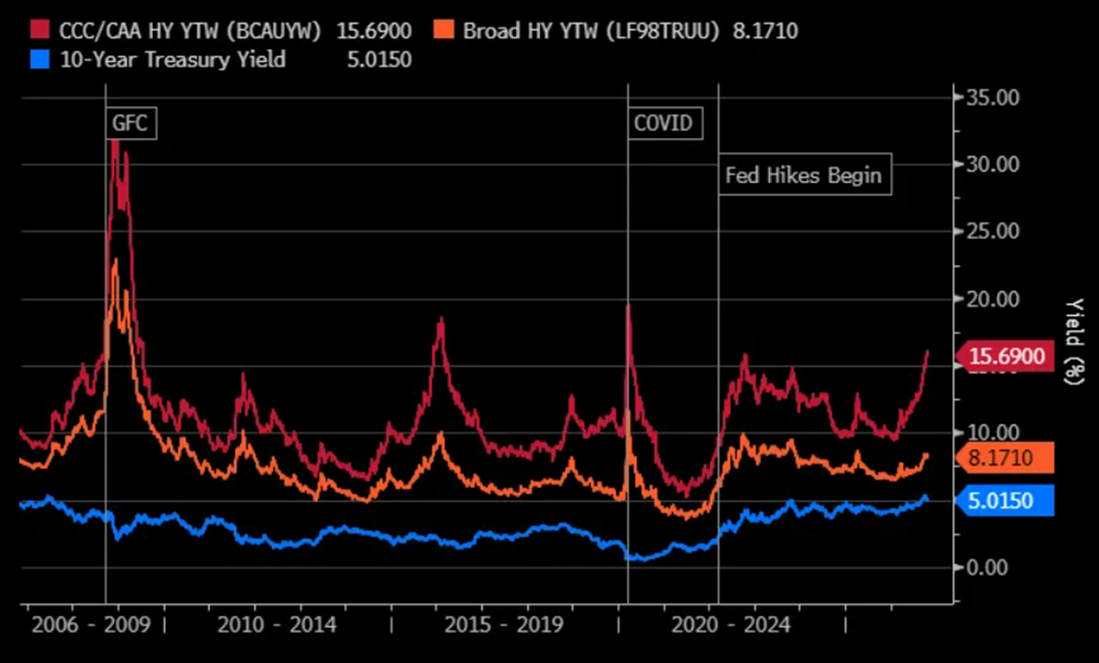
The other factor is a bit more subtle. Interest rates have risen substantially over the past few months and yields on high-yield bonds have been rising even faster. Frankly, the worse the credit, the worse its market performance. On Halloween, I was asked to provide a “scary” chart to a reporter compiling them from Wall Street strategists, analysts, and portfolio managers. I offered the following:
20 Years of Yields, 10-Year Treasuries (blue), Broad High-Yield Bonds (orange), CCC Rated Bonds (red)
I also supplied the following commentary:
High yield spreads, on an overall basis, have been rising alongside Treasuries. That said, the spread for a broad basket of high-yield vs Treasuries has not been widening too much. But when we look more specifically at CCC yields, those have exploded. This is not a good precedent, especially with an FOMC that seems committed to reducing monetary accommodation. The weakest credits are feeling the pinch — the question is whether that affects next tier of credit and eventually equities.
Since then, we have learned that a hedge fund called Arini Capital Management lost 32% this year, saying it “underestimated” the dislocation in CCC-rated debt. That may explain why CCC credits have reacted so negatively, but we can also see that rates on high-yield bonds must be pressuring the companies that rely on that type of borrowing. Therefore, it is a huge relief for owners of B-rated CRWV debt to be able to switch to a far cheaper source of funds. Today’s rally may indeed be getting overextended as traders incessantly chase the rally even as 5 of 11 SPX sectors trade lower, but there is indeed a basis for the enthusiasm.



Comments
Log in or sign up to join the conversation.