


A classic market cliche is that we can expect few fireworks during a holiday-shortened week. After last week’s plunges, the prospect of a truly placid Thanksgiving week seemed unlikely even before yesterday’s seismic events. We characterized the administration’s role in the reinstatement of Jensen Huang as Nvidia’s (NVDA) CEO as an example of the “Trump Put” in action, a move specifically designed to put a floor under a falling market. So far today, that floor is holding, even if we have seen a pullback in the broad market.
Periods of high volatility take some time to calm down. Think of it as a stretched spring oscillating until it returns to its normal shape. Some of this stems from trader behavior. During periods of high volatility, market-makers tend to do some combination of widening spreads and shrinking posted bid and offer sizes. It means that smaller amounts of shares and/or options contracts are required to move prices. That exacerbates volatility. Over time, fewer traders are willing to cross wide bid/ask spreads, causing market-makers to re-tighten them, and volatility eventually returns to more normal levels.
Daily Moves in S&P 500 (white), Nasdaq 100 (blue), Philadelphia Semiconductor Index (red)
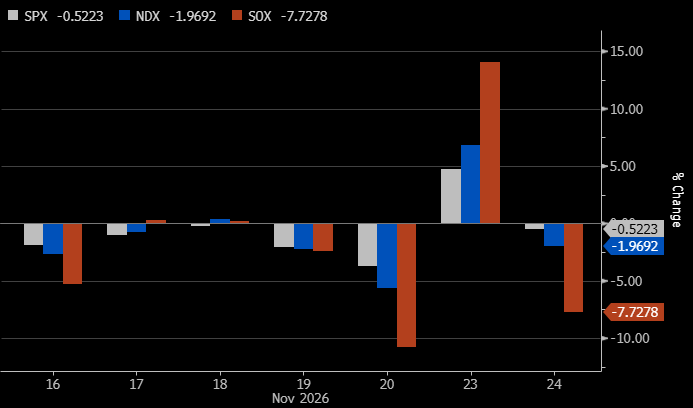
Source: Bloomberg
The return to more normal volatility levels might take a bit more time during a period when activity typically shrinks. Expecting lower volume, market-makers often preemptively take the liquidity-reducing measures outlined above. Around holidays, when the number of market participants tends to shrink, this tends not to contribute to volatility. During this holiday period, when traders are already on edge, that may keep prices swinging more than expected. Although the Cboe Volatility Index (VIX) has declined substantially from its Friday peak, it remains quite elevated compared to longer-term levels. This tells us that traders still expect residual volatility to persist.
VIX, 3 Months, Hourly Candles
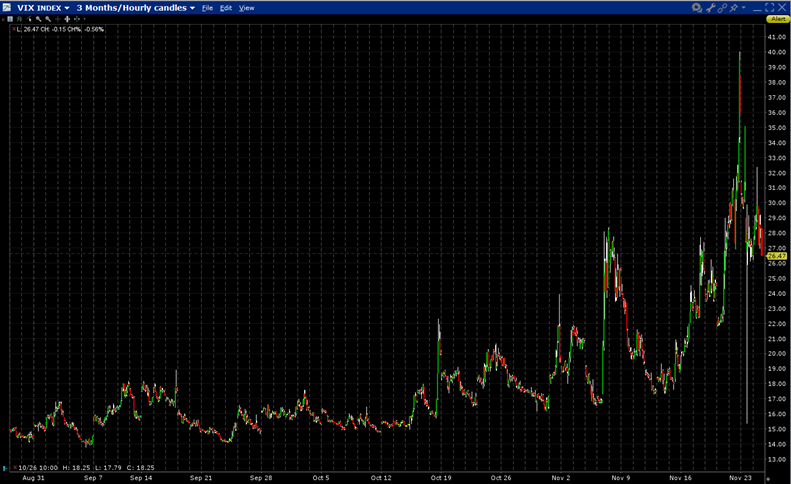
Source: Interactive Brokers
Today is emblematic of the type of volatility that might persist. Even though yesterday’s 4.73% rally in SPX was quite dramatic, the intraday range wasn’t. The range between open and close was a mere 0.14% while the high-low range was a relatively wide 1.96%. This shows that there was a general consensus about intraday valuation. By contrast, we have seen a 1.18% intraday range already today despite, or perhaps because of, lighter volume and far less dramatic news.
As the week goes on, the combination of reduced trader participation and pricing uncertainty could keep volatility relatively elevated. Then again, the combination of exhaustion, football, and food coma might ultimately prevail.


Comments
Log in or sign up to join the conversation.