

ConocoPhillips (COP) stock has been trading flat for the last two or three months. That's ideal for investors who short sell out-of-the-money COP puts and put credit spreads.
COP closed at $134.10 on Friday, Oct. 9, but over the last 2 months it's been as high as $141.22 on Sept. 15 and as low as $124.52 on Aug. 13. So, right now, it's in the middle of a trading range.
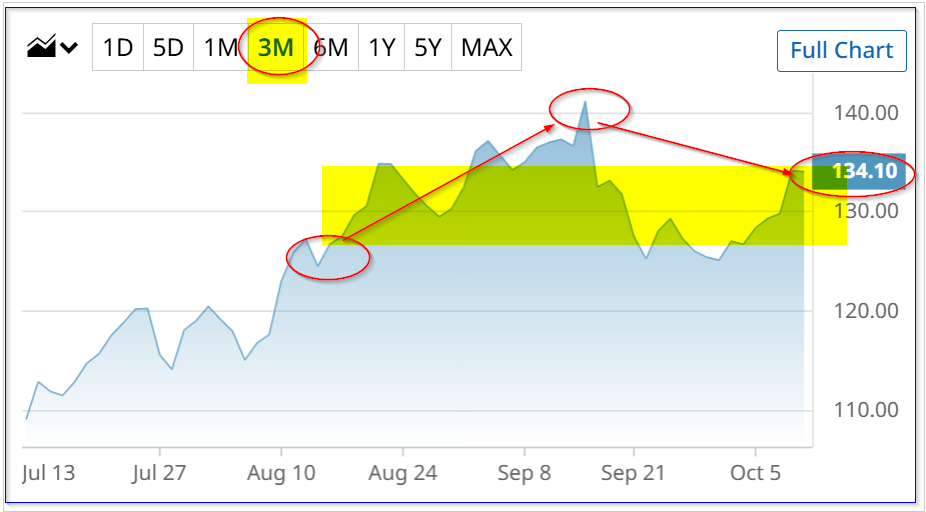
COP stock - last 3 months - Barchart - Oct. 9, 2026
But analysts still see significant upside in their price targets (PTs). For example, Yahoo! Finance's survey shows an average PT of $146.88.
That's up from $145.44, as seen in my last Barchart article a month ago (Sept. 13), “Is ConocoPhillips Stock Worth Buying Here? - Shorting COP Puts and Credit Spreads are Better Plays.”
Moreover, analysts are preparing to update their price targets after the upcoming Nov. 5 Q3 earnings results. That means the stock may be stuck in this trading range up until then.
I previously discussed shorting out-of-the-money (OTM) COP put options. This has worked well, as I will show below. It's time to redo this play.
OTM COP Short-Put and Put Credit Spread Plays Worked Well
In my Sept. 13 Barchart article on COP, I discussed selling short the $130 put strike price expiring Oct. 16. At the time, COP was at $137.35, so this play was -5.6% OTM (i.e., $130/$137.35-1) and the delta ratio was -0.263, implying a 73.7% chance of success.
As it turned out, that play worked out well as the put premium fell from $2.21 to just $0.62 as of Friday, Oct. 9. That means the investor has made $159 (i.e., ($2.21-$0.62) x 100), on $13,000 in collateral, or 1.22% over the last month.
I also discussed doing a put credit spread for investors who didn't have $13K in collateral. The spread was also $159 (i.e., $221-$62) (quite a coincidence!) for a $120 put buy as well as the short $130 put.
But the required collateral capital for this play was only $1,000 (i.e., ($130-120) x 100). So, the expected return (ER) was $159/$1,000, or 15.9%.
As it has turned out, the spread has narrowed to just $57 (i.e., ($0.62 - 0.05) x 100). So, the implied profit, if this play is closed out now, is $102 (i.e., $159-$57). That represents a 10.2% gain (i.e., $102/$1,000) over the last 3 weeks.
The investor can wait until closer to Oct. 16 to close the play at an even lower spread if COP stays flat.
New COP Short-Put and Put Credit Spread Plays
A new play worth investigating is to short the $127 put expiring Nov. 13 for $2.39 at the midpoint. That represents a potential yield of 1.88% over the next month (i.e., $2.39/$127).
This could be a good play since the delta ratio is just -0.27, implying a 73% chance of success. In addition, the strike price is still 5.3% lower, providing some downside protection.
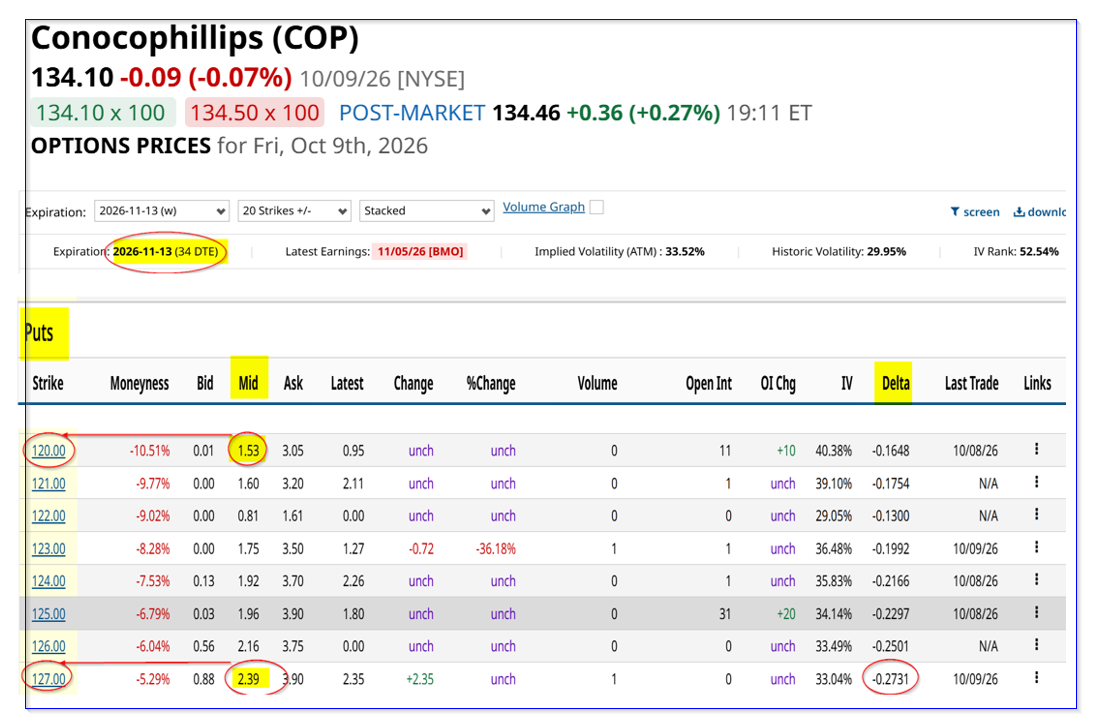
COP puts expiring Nov. 13 - Barchart - As of Oct. 9, 2026
Moreover, the breakeven point is $127-$2.39, or $124.61, or 7.1% lower. That means even after assignment, the investor is buying in at an attractive price.
However, this play requires $12,700 in collateral. For investors willing to take on more risk, a put credit spread is potentially more attractive.
For example, the table above shows that the $120 put premium is $1.53. So, shorting the $127 put for $239 and buying the $120 put for $153 (to provide downside protection), provides a net spread of $86.00.
But the required collateral capital is just $700 (i.e., ($127 - $120) x 100). So, the put credit spread expected return (ER) is high:
$86/$700 = 12.29%
Since the $86 is collected upfront, the net collateral at risk is just $614. So, the net ER is higher:
$86/$614 = 14.0%
The risk is that COP drops below $126.14 (i.e., $127 - $0.86 net credit spread), or -5.94%. If it drops to $120, the whole $700 (net $614) collateral is lost.
Moreover, unlike a short-put play, the investor does not end up owning COP shares upon assignment, unless they sell the long put leg.
Nevertheless, this could be a more speculative play for investors to make higher returns on COP, ahead of its earnings release.


Comments
Log in or sign up to join the conversation.