

Weak Chinese consumption and investment persisted amid soft domestic demand, while solid external demand continues to support industrial activity. Overall, China's third-quarter GDP looks likely to stay near or below the low-end of the target range
Weak August suggests 3Q growth will remain soft
Today's data suggest that China's economy continued to face downward growth pressures in August. Barring an unexpectedly strong September, GDP growth will likely remain sluggish in the third quarter, and risks to our 4.5% year-on-year forecast - and our 4.6% call for 2026 - both look tilted to the downside. Policy support has been rather limited to date. As a result, we continue to see growth and investment momentum remain sluggish.
The bright spot remains industrial activity, where resilient external demand and China's own tech and industrial upgrading continue to drive growth.
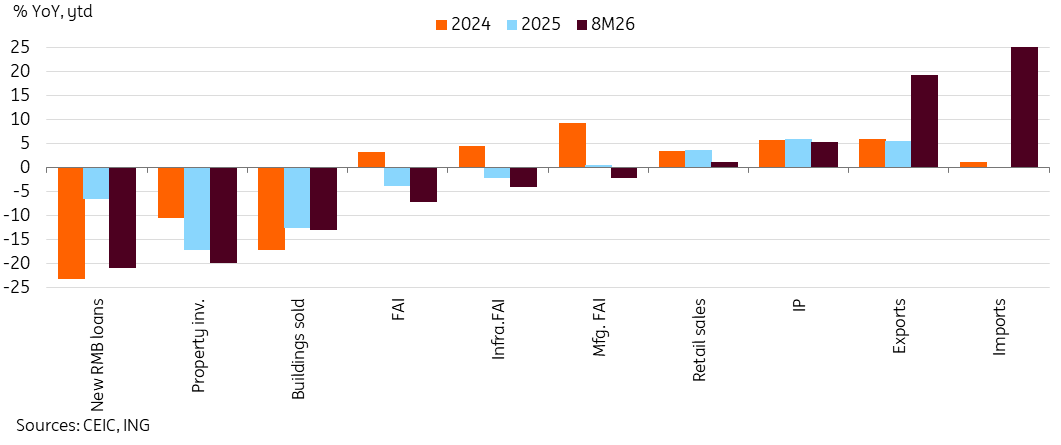
Divergence continues to widen within China's economy. Hi-tech and external demand-focused sectors continue to perform well, but most other categories are underperforming.
China's economic indicators have been quite uneven this year
Retail sales deceleration highlights weak consumption
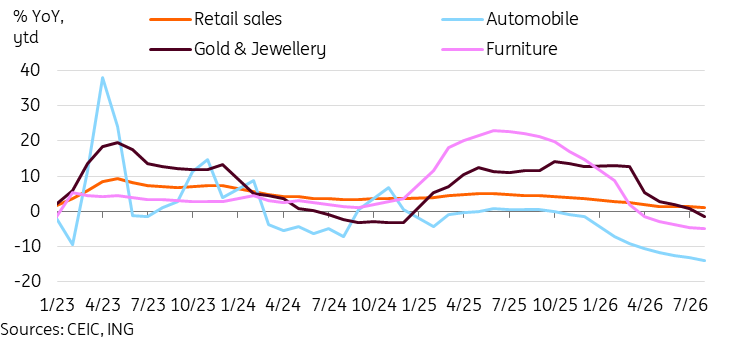
Retail sales slowed to 0.4% YoY in August, down from 0.6%, weaker than expectations (market: 0.8%, ING: 0.7%). This was the second straight month of deceleration, bringing year-to-date retail sales growth down to just 1.1% YoY.
Looking at the breakdown, we continued to see a significant drag from a few key categories. Auto sales were the biggest drag on retail sales, down 18.5% YoY. Despite strong exports, China has been both the largest producer and the largest consumer of electric vehicles, and the drop in domestic demand has weighed on the auto sector this year. Furniture sales also remained well in contraction territory (-7.9%), but household appliance sales bounced back to 2.3% YoY, the first positive growth since September 2025.
Gold and jewellery sales fell sharply by -17.5% YoY, a 4-month low, despite a recovery in gold prices in August.
Two categories bucked the trend with strong growth. Communication devices grew 27.3% YoY, while tobacco and alcohol rose 12.5%. Consumer staples categories such as grains and oils (4.0%) and beverages (4.9%) continued to outperform.
Recent measures to support consumption include interest rate subsidies for consumer loans. These are expected to have a modest, at-best, impact on headline consumption growth. Moving forward, as the drag from the trade-in policy weakens, we may see some stabilisation in retail sales, but a more significant turnaround will likely require additional support.
Several categories are causing a big drag on overall consumption
Hi-tech only silver lining in otherwise dismal picture
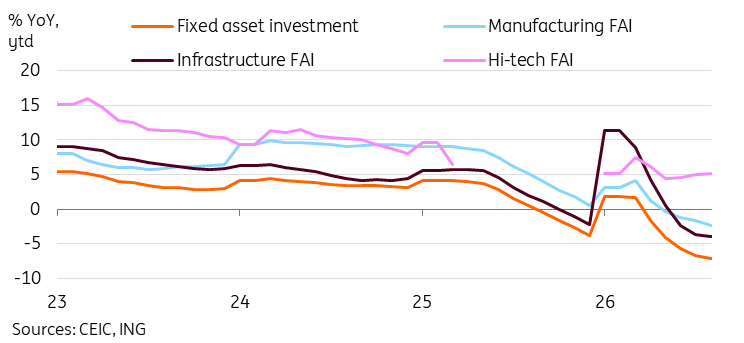
China's fixed asset investment growth fell -7.2% YoY ytd through the first eight months of the year, largely in line with expectations (market: -7.1%, ING: -7.4%), and decelerated for a sixth consecutive month.
In terms of the key categories for FAI, hi-tech FAI is the only highlight in the data, up 5.2% YoY ytd from 5.0% YoY ytd in the first seven months of the year. Resources continue to funnel into the AI race, industrial upgrading, and general tech self-reliance themes.
Unfortunately, the good news pretty much ends there. Other categories generally saw slumps worsen in August. Infrastructure (-4.0%), manufacturing (-2.3%), and real estate (-19.9%) investment all fell.
Public sector investment (-3.6%) continued to outperform private sector investment (-10.1%). However, efforts to accelerate fiscal expenditures in 2H26 have yet to translate into a turnaround in public sector investment. We will see if these efforts can help FAI bottom out in the coming months.
For now, FAI looks like a clear drag on growth, and the data is a microcosm of China's K-shaped divergence, with resources pouring into tech while other areas languish. Negative FAI growth hasn't translated into negative gross fixed capital formation in the GDP data, and the relationship between the monthly data and the GDP data has weakened this year.
FAI looks bleak outside of hi-tech sectors
IP beats forecasts amid solid external demand
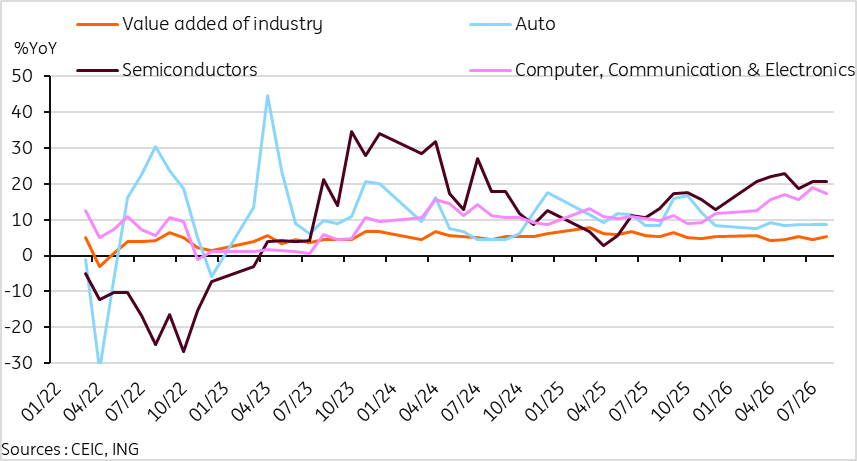
Industrial production rose 5.2% YoY in August, accelerating from 4.5% in July, outperforming expectations for a smaller rebound (market: 4.8%, ING: 4.9%). Year-to-date growth remained at 5.3% YoY, with industrial production the clear standout amid weakness in consumption and investment.
Manufacturing continued to outperform the headline, growing 6.1% YoY, while equipment manufacturing and high-tech manufacturing rose 12.1% and 16.7%, respectively. In contrast, mining output fell to -1.4%, highlighting that the improvement was concentrated in manufacturing rather than broad-based across the industrial sector.
At the industry level, strength remained concentrated in higher-end manufacturing. In value-added terms, computer, communication and other electronic equipment manufacturing rose 17.2% YoY, followed by rail, ships, aerospace and other transport equipment at 13.4%, special equipment at 11.4%, and electrical machinery at 9.9%. Export delivery value also rose 11.1% YoY in nominal terms, consistent with strong merchandise export growth. This indicates that external demand remained an important support for production.
Product-level data showed a similar pattern. Lithium-ion battery production rose 57.2% YoY, industrial robots increased 34.6%, new energy vehicles rose 21.9%, and semiconductor integrated circuits increased 20.6%. However, solar cells, smartphones and microcomputer equipment recorded double-digit declines, highlighting continued divergence within the advanced manufacturing sector.
Traditional property and construction-linked industries remained weak. Cement (-11.7%), flat glass (-7.6%), and steel products (-5.5%) all contracted year on year.
Overall, industrial production regained momentum in August, but growth remains heavily reliant on high-tech manufacturing and exports.
Industrial production continues to clearly outperform
Property prices continue the slow grind downward
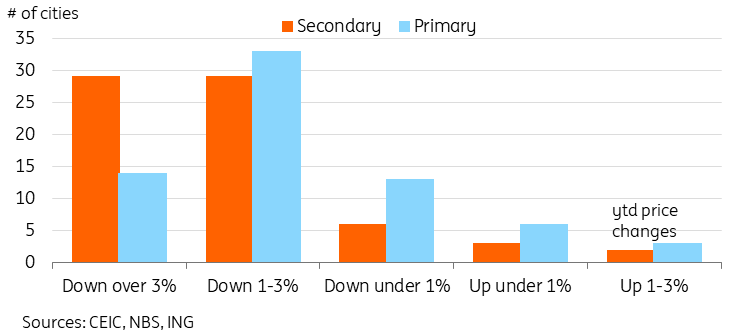
China's National Bureau of Statistics released its 70-city sample of property prices for August. New home prices fell by -0.17% month-on-month, while used home prices dipped by -0.31%. This was similar to the pace of declines seen in July.
The city-level breakdown showed that 21 of 70 cities saw new home prices stabilise or pick up in August, down a little from July's 23. Just 8 of 70 cities saw secondary market prices stabilise or pick up in August, unchanged from July.
The silver lining was another solid month for property prices in China's tier 1 cities, with prices improving in Shanghai, Shenzhen, and Guangzhou, though prices in Beijing edged down. A bottoming-out in property prices would likely start in the core, where demand is most genuine.
The entire property sector remains a major drag on the economy, with investment down 19.9% YoY ytd. It’s arguably one of the biggest overhangs on confidence, with the negative wealth effects holding back consumption and investment appetite. It has forced local governments to rethink financing models, as land sale revenue has dried up. A recent Beijing land sale was cancelled after only one developer bid at a land auction. There's still a long road ahead before this drag fades. Property prices need to stabilise, and inventories need to normalise before we might see a recovery of investment demand.
Most cities continue to see prices falling



Comments
Log in or sign up to join the conversation.