

Chinese exports surged in July as external demand remained strong for sectors from ships to autos to tech. Imports continue to be driven by tech, while coal and natural gas imports picked up in July as oil imports remained in contraction
Exports saw another strong month in July
China’s exports rose 23.9% year-on-year in July, edging down from 27.0% YoY, and coming in broadly in line with expectations (market: 23.0%, ING: 28.1%). In the first seven months of the year, exports rose 18.5% YoY to $2.52tn.
The product breakdown of China's exports continued to show the shift toward higher value-added exports. In July, semiconductor exports saw another month of triple-digit growth at 116.6% YoY, ship exports surged to 92.4%, auto exports slowed slightly to 60.4%, and hi-tech exports were stable at 52.7%.
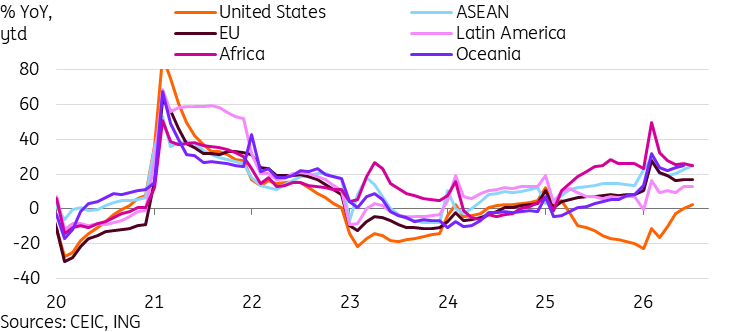
By export destination, we saw the fourth straight month of double-digit YoY export growth to the US, which rose 17.0% in July to bring the full-year export growth to 2.6% YoY. We’ve seen some further scuffles between China and the US over the past month, particularly in tech-related categories. The US banned imports of certain robotics products and power inverters from China. It added 43 Chinese companies to the Uyghur Forced Labor Prevention Act, leading to retaliation from China in the form of export controls on drones to the US. China also added 6 US entities to countermeasure lists. For now, the fragile trade truce remains in place ahead of President Xi's visit to the US on 24 September. This meeting could go a long way to deciding whether this recovery will persist into the fourth quarter.
China's fastest-export-growth destinations in July included Mexico (48.8%), Korea (46.6%), ASEAN (38.4%), and Russia (34.9%), while exports to the EU (16.0%) and Japan (14.0%), though solid, grew at a more moderate pace.
Exports to the US continued to recover despite renewed tensions
Imports continued to be tech driven
Imports remained strong at 27.5% YoY, though this was down from June's 36.0% and also weaker than expectations (market: 29.7%, ING: 33.6%). Through the first seven months of the year, imports rose 26.7% YoY to $1.84tn.
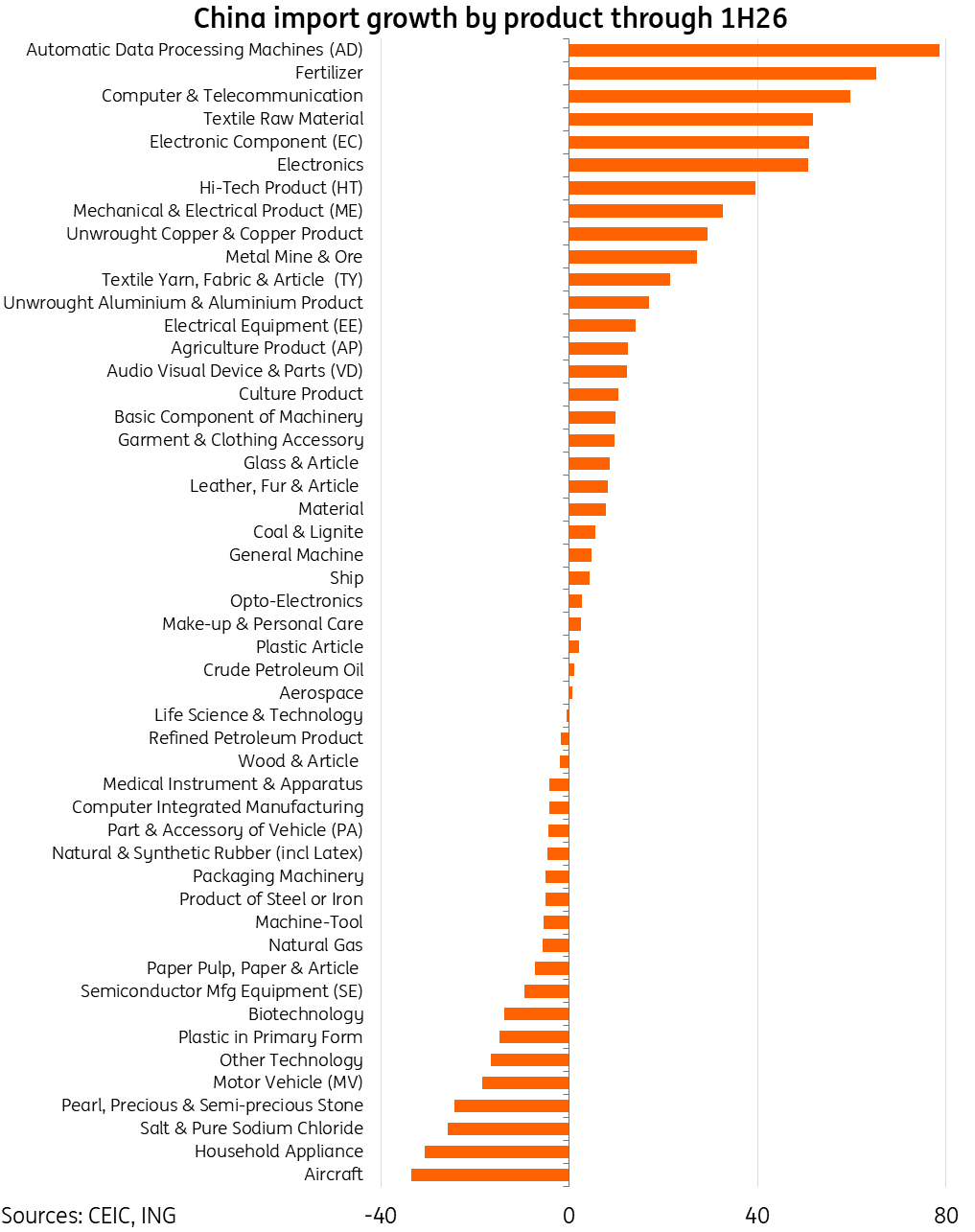
China’s import breakdown shows that oil has become a key focal point for markets, with traders watching crude inflows especially closely. July's data showed that oil imports remained in contraction, but the drop was shallower than in June. Oil import volumes were down -24.3% YoY, up from June's -41.3% to reach a 3-month high, while oil import value was down -4.6%. Oil imports are still significantly lower than the pre-war normal. Instead, we're seeing imports shift to alternatives. Coal and lignite (83.8%) as well as natural gas (20.2%) both saw strong import growth in July.
However, the main area of growth for China's imports is clearly in the hi-tech categories. Hi-tech imports rose 58.8% YoY, with ADP machine imports surging 198.8% in July.
China's import breakdown by product for 1H26
Trade surplus is now positive for 2026
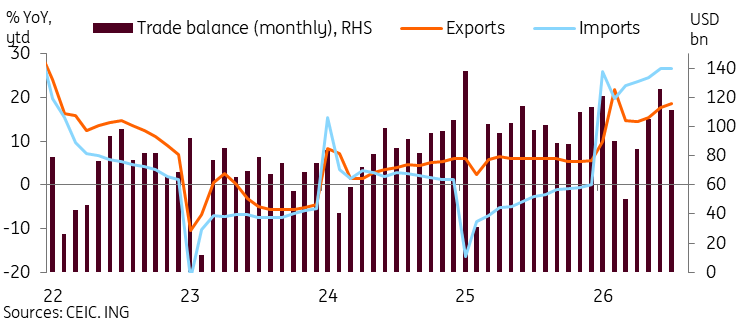
Both export and import growth came in a bit slower than we were looking for. But the end result was almost exactly in line with our forecasts, with China's trade surplus coming in at $112.5bn (market: $107.1bn, ING: $112.6bn).
Through the first seven months of the year, the trade surplus is now at $687.4bn, up 1.0% YoY. This marks the first time since February that we've seen the year-to-date trade surplus in positive YoY growth.
External demand has become increasingly important this year for the growth outlook as China's K-shaped divergence widens. It has thus far been one of the main bright spots this year, also helping to support industrial activity. Incremental easing after July's Politburo meeting might help support domestic demand in the second half, but external demand will likely remain the main driving force this year.
Trade surplus has returned to positive year-on-year growth



Comments
Log in or sign up to join the conversation.