


The details of the October retail sales and industrial production reports are more encouraging than the headline figures alone suggest. Strip out volatile components and it is apparent consumer spending remains firm, while advanced manufacturing in the US is surging thanks to tech capex, a strong economy, energy security and potentially also tariffs
Retail sales details send a positive message
US October retail sales rose 0.2% month-on-month, a touch above the 0.1% consensus, but the control group, which excludes volatile gasoline, autos, building materials and restaurants, and better tracks broader consumer spending trends, was good. It rose 0.6% MoM versus expectations of a 0.3% gain, while September's growth rate was revised up 0.4pp to 0.5% MoM. The caveat to all of this is that these are nominal dollar figures, so the hotter-than-anticipated October inflation figures eat into the volume growth, leaving headline sales in negative territory in real terms and flat to slightly higher in terms of core activity. This suggests a more modest, but still respectable, GDP growth contribution from consumer spending in 4Q versus 3Q.
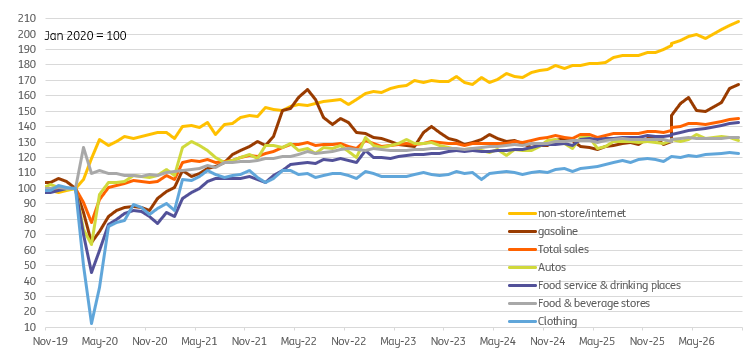
The details show the bulk of the strength is in the "miscellaneous" store category (think florists, office supplies, pet stores, gift shops etc), which rose 4.7% MoM after falling 3% in September. Outside of this, decent gasoline station sales and health & personal care (both up 1.5%) and non-store/internet (up 1.2% MoM) were offset by sizeable declines in furniture (-2.3%), autos (-1.6%), clothing (-0.7%) and sporting goods (-0.7%). Below is a chart of the relative performance of different sectors within retail sales since the pandemic.
Retail sales sector performance Jan 2020 =100
Bifurcation suggests non-retail spending will continue to outperform
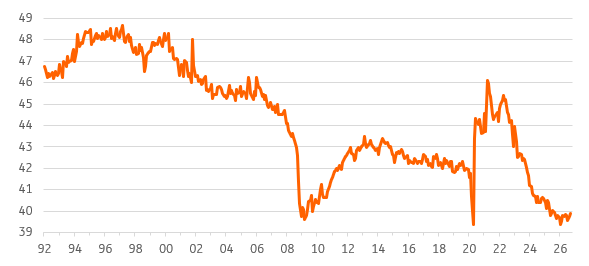
Another important point about this report is that retail sales are accounting for a shrinking share of consumer spending, which is likely a consequence of the bifurcation seen within the household sector. Middle and lower income households are under financial pressure from subdued wage growth that’s failing to keep pace with the rising cost of living. This position is reflected in the weak consumer sentiment readings.
Middle and lower income households tend to spend more of their income on physical goods, such as food and clothing, and squeezed spending power limits the potential for growth. Conversely, high income households have seen their wealth surge, boosting consumption, and are accounting for a growing share of total consumer spending. However, they spend more of their income on services and experiences, such as leisure, hospitality and travel, which are not included in retail sales. Below is a chart of retail sales as a proportion of total consumer spending.
Retail sales as a proportion of total consumer spending (%)
Advanced manufacturing an obvious bright spot for the US economy
US industrial production fell 0.4% MoM in October, well below the +0.1% consensus forecast, but this disappointment is due to a 4.3% MoM drop in utilities output, reflecting relatively mild weather for the time of year. Mining fell 0.8%, but manufacturing rose 0.3% MoM, with business equipment (+1%) and defence and space (+0.9%) looking particularly strong. There was also a 4.4% jump in the output of motor vehicles and parts, with computer and electronic products up 1.4%. There was some weakness in aircraft, electrical equipment and appliances and fabricated metal products.
The sector has struggled in recent years with stagnant output, but the business surveys have all been pointing to an improving picture. The October US ISM manufacturing index rose to 55.5 from 54.5 in September, well above the breakeven 50 level while order levels remain very healthy, suggesting ongoing firm growth in the sector. Moreover, 101,000 jobs have been added by manufacturing firms year-to-date, after three years of consecutive declines and the average hours worked by each worker has increased 30 minutes to 40.5 hours per week versus 12 months ago.
Tariffs and US energy security have boosted the attractiveness of manufacturing in the US, with relatively low energy costs giving the US a competitive boost for the long-troubled steel and glass industries. But so too has US economic growth, which continues to outperform other key markets.
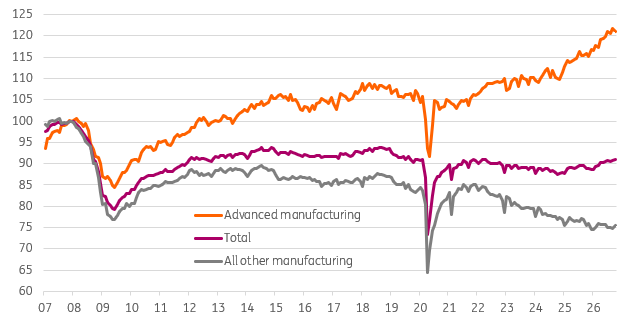
High value-added or advanced manufacturing, within which we group tech, electronics, transport and power-related sectors, has significantly outperformed other sectors. We expect this story to continue with strong pipelines for tech-related investment. However, more traditional, labour-intensive, commoditised manufacturing sectors will continue to shrink under pressure from foreign competitors. Here, tariffs are not enough to provide the competitiveness boost needed to offset the high cost of producing in the US. These same producers are also often adversely affected in foreign markets by retaliatory tariffs.
US manufacturing output, 2007=100



Comments
Log in or sign up to join the conversation.