

China’s purchasing managers index came in much softer than expected, with both manufacturing and non-manufacturing PMI slumping into contraction territory. This signals that the recent macro slowdown may continue into the second half. The incremental policy easing signalled at yesterday's Politburo meeting seems increasingly necessary
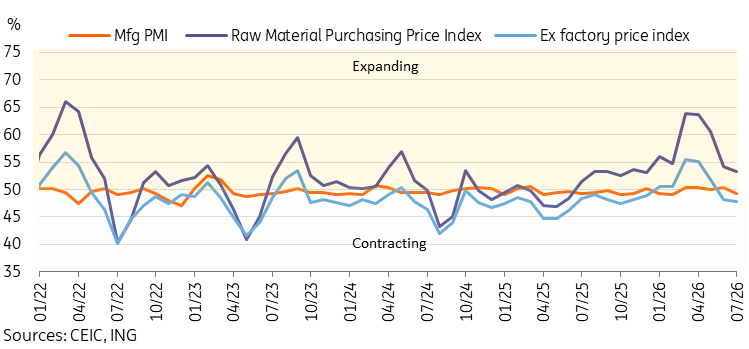
Manufacturing PMI data suggests we might have already seen the peak for PPI inflation
China’s manufacturing purchasing managers’ index fell to 49.2 in July, down from 50.3 in June and well below expectations (market: 50.1, ING: 50.1). This level marked a 5-month low and is well into contraction territory. Although the PMI's correlation with industrial output has weakened in recent years, the latest reading remains an unpromising start to the first wave of economic data for the second half of the year.
Most key subindices fell below the 50 threshold in July, with production (49.6), new orders (48.5), new export orders (49.6) and purchase volumes (49.4) all slipping from expansion in June back into contraction in July. Ex-factory prices remained in contraction for a second month, suggesting an increased likelihood that we have already seen the peak of PPI inflation this year. China's reflation trend could face increasing challenges in the second half of the year if this continues.
The only two subindices still in expansion were the raw materials purchase price (53.2), which nonetheless was still lower than what we saw in June, and activity expectations (54.1).
Price subindices continue to drop in sign that PPI may have peaked
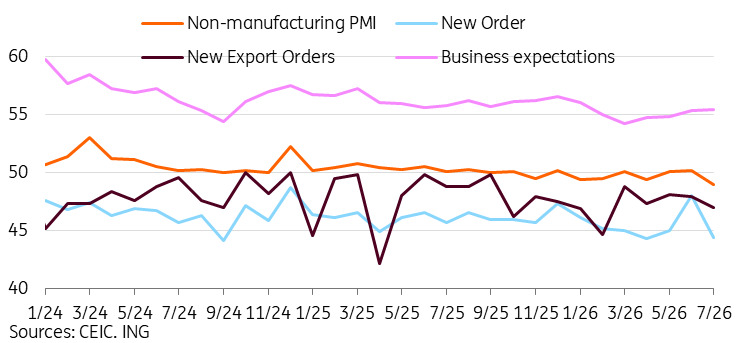
Non-manufacturing PMI dropped to 43-month low
Non-manufacturing PMI fell to 49.0, down from 50.2, coming in well below forecasts (market: 50.0, ING: 50.0). This level was the lowest since the pandemic-stricken 2022, and is a negative sign amid the recent push to unleash the potential of services consumption.
The subindices suggest weakness across the board. New orders (44.4), new export orders (47.0), and sales prices (47.9) all fell to multi-month lows.
The only two subindices in expansion territory were business expectations (55.4) and suppliers' delivery time (50.9).
Overall, the PMI data suggests a weak start to the second half of the year. Yesterday's Politburo meeting offered a more supportive tone and suggested more incremental easing measures are on the way. We believe the main area of support could be fiscal policy, where there was a commitment to accelerate fiscal expenditures. The overall investment appetite has been weak amid soft confidence, geopolitical uncertainty, and a tighter regulatory environment. Project approvals have slowed after calls to reduce redundant investment, but restarting this pipeline could support the rapid decline in investment growth we have seen in the past few months.
Non-manufacturing PMI hits post-pandemic low



Comments
Log in or sign up to join the conversation.