


They say timing is everything in finance. And the Bank of England’s timing this week was, let’s just say, far from ideal.
Oil is down 14% since last week’s close, natural gas 16%, and the Nasdaq more than 6%. That is an awkward backdrop for the Bank’s first rate hike since the Iran war. Sweden, Australia and the Czech Republic tightened too.
The market is clearly having its doubts. Neither an ECB nor a Fed hike is fully priced in for December, while the probability of the latter has fallen to 70%. Rates priced one year ahead have dropped almost 50bp in both dollars and euros since late September.
This all feels a bit premature. We have long thought central bank pricing looked too aggressive. But has the past week, and especially the US midterms, really changed the short-term policy outlook? I’m not convinced.
Interest rate expectations have fallen in the US and Europe
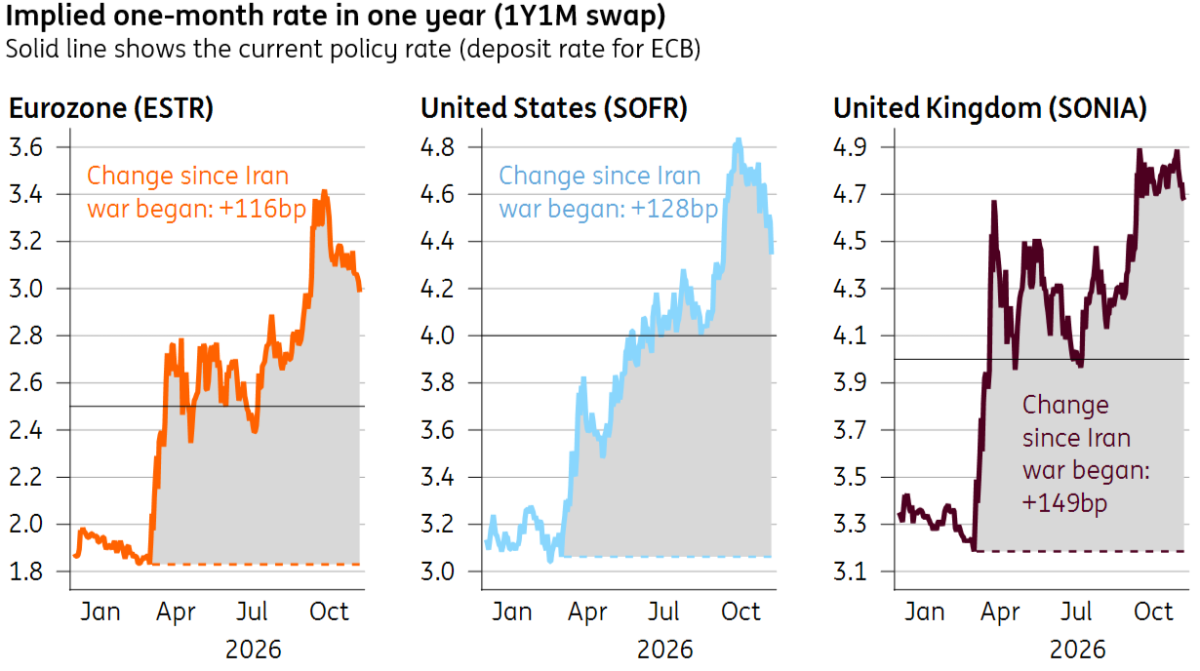
Data as of 5 November
Source: Macrobond, ING
Start with energy. This week’s sharp fall in prices hasn’t been built off much, let’s be honest. Sure, gasoline prices mattered enormously to US voters and politicians have been surprisingly frank about that. But if diplomacy could not deliver a solution before the elections, why should it suddenly do so now the political clock has reset for two years?
That does not mean oil cannot fall further. Flows from the Middle East have been strong for weeks. And if the war doesn’t escalate, as many thought it would mere days ago, then our commodities team thinks the risk premium in prices can erode further.
But as Bank of England Governor Andrew Bailey argued this week, it is too simplistic to focus only on the level of energy prices when officials meet in December. What matters is what those prices tell us about the risk of further escalation. If prices fall while the geopolitics remain volatile, central banks have good reason to tread carefully.
And don’t forget, there’s already plenty of inflation already in the system. The crisis has reached sufficient longevity now to ensure that. Eurozone producer price inflation topped 11% in September. In the UK, I reckon energy is set to contribute more than one percentage point to inflation right through to next summer unless something changes dramatically.
True, there is still no sign that higher energy prices are spilling out across Europe’s inflation basket. We still don’t expect that to happen at scale, either.
But should the absence of second-round effects so far reassure us?
I’d argue yes, but the Bank of England clearly thinks otherwise. Its breakdown of how inflation projections have changed since July suggests it is taking little comfort from recent data outturns.
Its point was that, among other things, longer energy-price fixes than in 2022 may simply be delaying the hit to firms and the pressure to raise prices. And because the crisis looked less severe until recently, pressure for one-off employee bonuses has been less intense than four years ago too. With utility bills only now rising sharply, perhaps that could change.
Now, that all rather conveniently skates over the fact that central bankers have spent recent years arguing that firms now change prices more quickly than in the past. And that the jobs market is much cooler, too. Still, it’s clearly going to take several more months of data to calm nerves about second-round effects.
The same applies in the US. There are good reasons to expect inflation to ease. Just think of tariffs, rents and benign wage growth. But core inflation remains too hot for the Fed. Six-month annualised rates of both main inflation measures are around 3%. And Chair Warsh’s preferred breadth gauge – flawed though I think it is – shows that the share of categories running above 3% inflation has fallen but remains high. Remember, too, that back in September, all-bar-two Fed officials saw more rate hikes this year. The bar for that see-saw to flip feels relatively high.
Chair Warsh's favourite inflation metric is looking a bit better
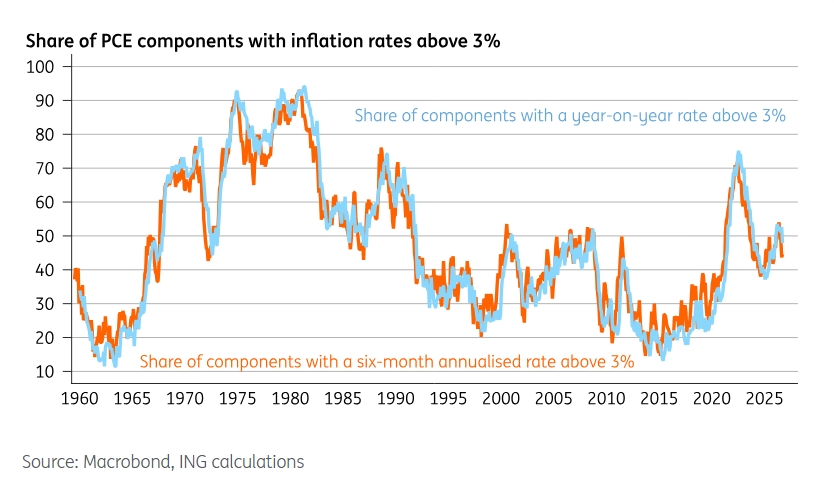
Source: Macrobond, ING calculations
Then there’s growth. US resilience has been obvious for several quarters and, despite the recent anxiety around AI and the midterms, it is difficult to see the investment tailwinds disappearing immediately.
Activity is increasingly relevant for policymakers in Europe too. The BoE meeting made that clear. Some of the surprise strength in growth is simply because the energy shock wasn’t – until very recently – that severe. By that logic, growth should slow into winter as inflation bites.
But that is not the whole story.
In the UK, like most economists, I have been surprised not just by data centre investment but also surging professional services output. Those two industries together alone are likely to account for more than half of next week's third quarter growth, despite only representing 14% of GDP. Tech is a huge story in the Netherlands, too. And as for Germany, low water levels and higher energy prices didn’t prevent a solid rise in production this summer.
There are risks there for sure, but clearly it will take more than a few weak releases to seriously question the resilience on display across the developed world.
So what could actually stop central banks in December? If inflation and growth won’t do it, financial markets might.
The rout in AI stocks matters because Warsh has rationalised a decent chunk of the Fed’s rate hikes through loose financial conditions, widely seen as a euphemism for soaring equity prices. That’s clearly changing. And a much deeper correction could raise serious doubts about another December hike. Even at the October meeting, Warsh sounded a little more cautious. As for the ECB, it would presumably require the French situation to get a whole lot messier to disrupt plans for a December hike.
Markets may ultimately be right that the hiking cycle has less far to run. But even after a roller coaster week, central banks will take more convincing.
James Smith
THINK Ahead in developed markets
United States (James Knightley)
Big swings in energy, stock and bond prices in the wake of the Democrat's clean sweep of Congress suggest the commentary from policymakers, and there are at least eight different Federal Reserve officials currently scheduled to speak next week, will be cautious. While the majority continue to advocate gradual tightening in an environment of above-target inflation and low unemployment, none are prepared to give a number on how many more hikes they think are needed. We continue to forecast just one December hike given the cooling housing market, weak wage growth and cautious optimism that a diplomatic solution to the Iran-US standoff over the Strait of Hormuz will be found.
October CPI (Tue): Given the current situation, the October CPI report is going to be the obvious focus, and we expect both the headline and core rates to rise 0.3% month-on-month. This is hotter than the 0.17% MoM rate that we need to trend at to bring inflation down to 2% year-on-year. Consequently, markets look set to remain priced for a 25bp hike at the December FOMC meeting. The Bureau for Labor Statistics has stated it will not be publishing YoY figures given that October last year was when we had a protracted government shutdown that led to no data being collected.
United Kingdom (James Smith)
3Q GDP (Thur): We already know from the monthly data in July and August that the UK economy had a blockbuster third quarter. Some of this is down to AI investment, but more eye-catching has been the surge in services like legal and advertising. Tempting as it is to put this down to AI productivity, we’re sceptical that this is the whole story. That could point to a near-term pullback in monthly GDP, exacerbating the consumer slowdown we expect over winter.
Key events in developed markets
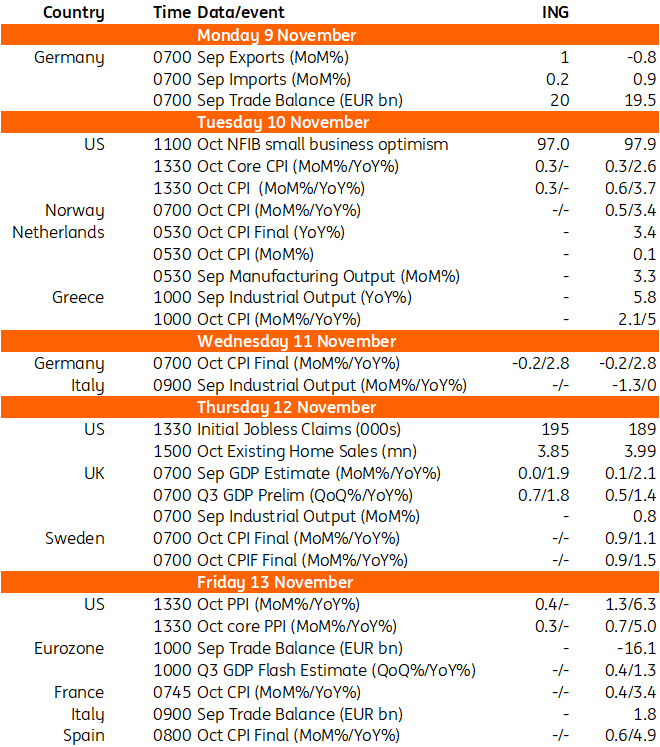
Source: Refinitiv, ING

Comments
Log in or sign up to join the conversation.